Reflecting on 20 years of Intel Macs and Apple's transition
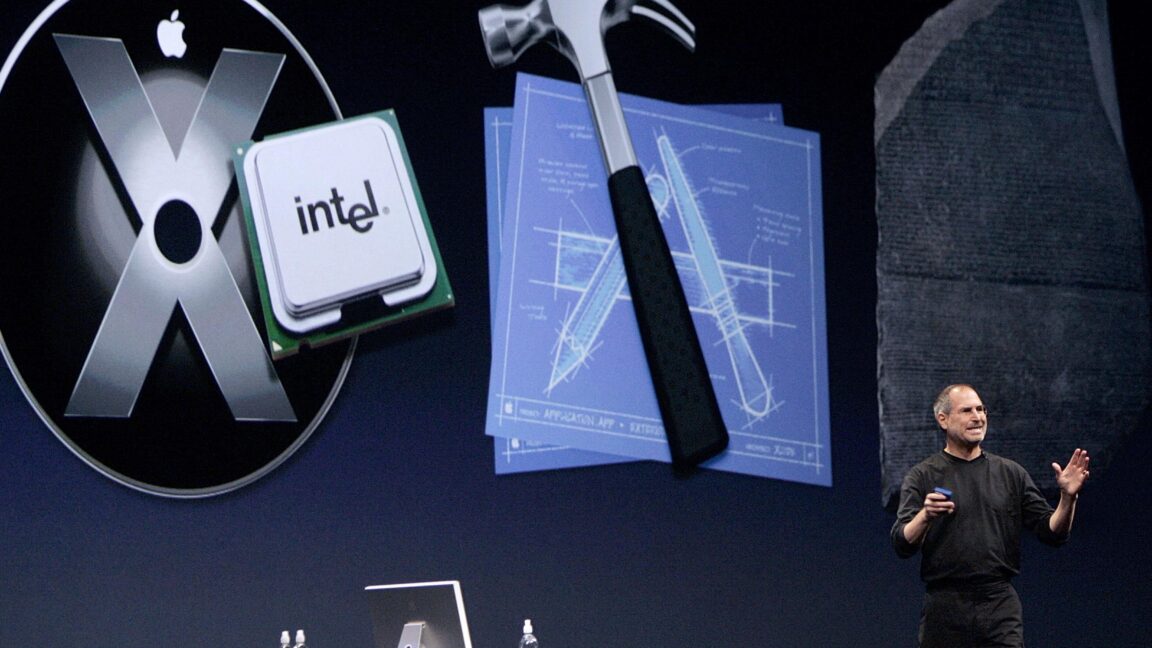
💡Understand how Apple's hardware transition enables local AI inference and why it matters for your dev stack.
⚡ 30-Second TL;DR
What Changed
Apple's strategic shift to custom silicon architecture
Why It Matters
The transition to Apple Silicon fundamentally changed the landscape for local AI development, enabling high-performance on-device inference via the Neural Engine.
What To Do Next
Optimize your local ML models to leverage the Apple Neural Engine using Core ML for better performance.
Key Points
- •Apple's strategic shift to custom silicon architecture
- •Performance gains from vertical hardware-software integration
- •The end of the Intel-based Mac era
🧠 Deep Insight
Background and context from public sources — not the original article. 24 sources cited.
🔑 Enhanced Key Takeaways
- •Apple's transition from PowerPC to Intel was primarily driven by the PowerPC G5's inability to meet Apple's performance-per-watt requirements for laptops, alongside Intel's superior product roadmap.
- •A significant advantage of the Intel transition was the introduction of Boot Camp in April 2006, which allowed Mac users to natively run Microsoft Windows, addressing a key concern for many potential switchers and business users.
- •The shift to Apple Silicon was motivated by Apple's desire for greater control over its product roadmap, improved profit margins by designing its own chips, and the ability to integrate custom technologies for enhanced performance and power efficiency.
- •Rosetta 2, the binary translation layer for Apple Silicon, employs both ahead-of-time (AOT) and just-in-time (JIT) compilation, with the M1 chip featuring a special instruction to mimic x86 memory ordering (Total Store Order) for highly efficient translation.
- •Apple's long-standing vertical integration strategy, encompassing hardware, software, and services, is a core enabler of these transitions, allowing for optimized performance, stringent quality control, and accelerated innovation cycles that are difficult for competitors to replicate.
📊 Competitor Analysis▸ Show
Processor Comparison: Apple Silicon vs. x86 (Intel/AMD) vs. ARM (Qualcomm)
| Feature/Category | Apple Silicon (M-series) | Intel (Core Ultra, Xeon) | AMD (Ryzen, Epyc) | Qualcomm (Snapdragon X) |
|---|---|---|---|---|
| Architecture | ARM-based (custom design) | x86-64 | x86-64 | ARM-based |
| Single-Core Perf. | Generally leads (e.g., M5 chip) | Strong, especially in high-end chips (e.g., Core Ultra 9 285K) | Competitive, but often slightly behind Intel/Apple | Strong, aims to rival Apple Silicon in efficiency |
| Multi-Core Perf. | Highly competitive, especially with Ultra/Max variants | Strong, particularly in higher-tier and workstation CPUs | Very strong, known for competitive multi-threaded performance | Competitive with Intel/AMD in efficiency-focused tasks |
| Performance/Watt | Industry-leading | Improving with new architectures (e.g., Lunar Lake) | Improving, competitive in some segments | Excellent, a primary focus for Windows ARM PCs |
| Integrated Graphics | Highly powerful, unified memory (e.g., M3 Ultra exceeds AMD Radeon 6900XT in some tests) | Intel UHD/Iris Xe, improving with Arc Graphics | Radeon Vega, strong for integrated solutions | Adreno GPU, designed for efficiency and AI PCs |
| AI Acceleration | Dedicated Neural Engine (16-core, more efficient) | Dedicated NPUs (e.g., Core Ultra 258V at 47 TOPS) | Dedicated NPUs (e.g., Ryzen AI 7 350 at 50 TOPS) | Strong focus on AI PCs, dedicated NPUs |
| Target Market | Premium laptops, desktops, workstations (macOS ecosystem) | Wide range: consumer, business, gaming, workstation, server (Windows/Linux) | Wide range: consumer, business, gaming, workstation, server (Windows/Linux) | Windows laptops (AI PCs), efficiency-focused |
| Software Comp. | Native ARM, x86-64 via Rosetta 2 (phasing out) | Native x86-64, wide compatibility | Native x86-64, wide compatibility | Native ARM, x86-64 via emulation (potential issues) |
| Key Differentiator | Vertical integration, unified memory, ecosystem control | Long-standing market leader, broad ecosystem, gaming performance | Strong multi-core value, gaming performance | High efficiency for Windows laptops, AI PC focus |
🛠️ Technical Deep Dive
-
Apple Silicon Architecture (M-series):
- Based on ARM architecture, specifically ARMv8, utilizing custom-designed ARM cores.
- Employs a System-on-a-Chip (SoC) design, integrating CPU, GPU, Neural Engine, and I/O into a single chip.
- Features a Unified Memory Architecture (UMA) where CPU, GPU, and Neural Engine share the same pool of high-bandwidth, low-latency memory, eliminating data copying and improving efficiency.
- Utilizes heterogeneous computing with a mix of high-performance (P-cores) and high-efficiency (E-cores) CPU cores to optimize power consumption and performance for different workloads.
- Includes a dedicated Neural Engine (e.g., 16-core) for accelerating machine learning tasks.
- Newer generations like the M3 chip introduce advanced graphics features such as hardware-accelerated ray tracing and mesh shading, built on a 3nm process technology.
-
Rosetta 2 Translation Layer:
- A binary translation software that enables Macs with Apple Silicon (ARM-based) to run applications compiled for Intel x86-64 processors.
- Offers two primary translation methods: Ahead-of-Time (AOT) compilation and Just-In-Time (JIT) translation.
- AOT compilation translates the entire x86-64 binary into ARM code once, typically upon application installation, and caches the translated artifact for faster subsequent launches.
- JIT translation handles code that cannot be AOT compiled (e.g., dynamically generated code like JavaScript in browsers) by translating instructions on the fly during execution.
- A key technical enabler for Rosetta 2's high efficiency is a special instruction within the M1 CPU that switches the memory-ordering model to an x86-equivalent Total Store Order (TSO), crucial for correct multi-threaded x86 code execution.
- The kernel verifies code hashes of translated pages against the original binary's code signature to maintain security.
🔮 Future ImplicationsAI analysis grounded in cited sources
⏳ Timeline
📎 Sources (24)
Factual claims are grounded in the sources below. Forward-looking analysis is AI-generated interpretation.
Weekly AI Recap
Read this week's curated digest of top AI events →
👉Related Updates
AI-curated news aggregator. All content rights belong to original publishers.
Original source: Ars Technica ↗
This is a summary, not the original. Read the source, or get the weekly briefing.
Weekly AI briefing
One email a week. Unsubscribe anytime.