AMD Zen 6 CPUs May Replace iGPU with NPU
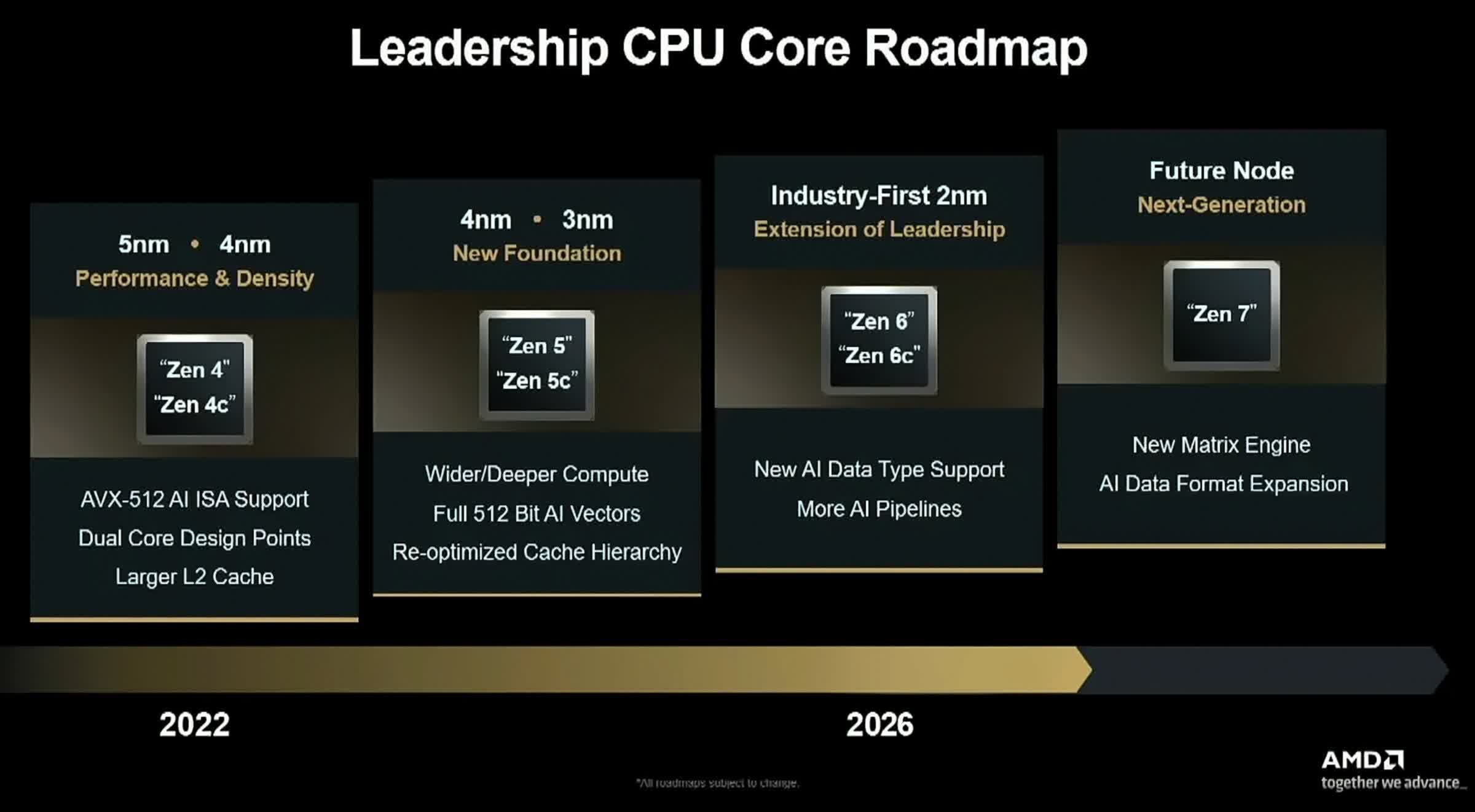
💡Hardware shift: AMD may prioritize local AI inference over integrated graphics in next-gen desktop CPUs.
⚡ 30-Second TL;DR
What Changed
Zen 6 'Morpheus' architecture expected by early 2027
Why It Matters
This signals a major shift in hardware design where AI inference becomes a primary function of consumer CPUs rather than an auxiliary task.
What To Do Next
Monitor AMD's official roadmap for NPU TOPS specifications to plan for future local-first AI application deployments.
Key Points
- •Zen 6 'Morpheus' architecture expected by early 2027
- •Potential removal of traditional iGPU in desktop Ryzen 10000 series
- •Strategic pivot toward dedicated on-chip NPU for local AI workloads
🧠 Deep Insight
Background and context from public sources — not the original article. 20 sources cited.
🔑 Enhanced Key Takeaways
- •AMD's Zen 6 desktop CPUs, codenamed "Olympic Ridge," are anticipated to be manufactured using TSMC's 2nm process (N2P).
- •The upcoming Ryzen 10000 series will maintain compatibility with the existing AM5 socket and is expected to introduce support for native CUDIMMs and CAMMs, along with the EXPO 1.2 standard for DDR5 memory overclocking.
- •The integrated NPU in Zen 6 is projected to achieve over 40 Tera Operations Per Second (TOPS), a performance threshold necessary for Microsoft's Copilot+ AI PC certification.
- •The removal of the integrated GPU (iGPU) from desktop Zen 6 processors will necessitate a discrete graphics card for all display output and troubleshooting functions, eliminating the iGPU's previous role as a fallback.
- •Zen 6 desktop configurations are rumored to scale up to 24 cores, potentially featuring a new CCD design capable of housing up to 12 Zen 6 cores and 48 MB of L3 cache per CCD.
📊 Competitor Analysis▸ Show
| Feature / Competitor | AMD (XDNA 2 / Ryzen AI 300) | Intel (NPU 4 / Lunar Lake) | Qualcomm (Snapdragon X Elite / X2 Elite) | Apple (M4 / M4 Max) |
|---|---|---|---|---|
| Peak NPU Performance (TOPS) | 50-55 TOPS | 48 TOPS | 45 TOPS (X Elite), up to 80 TOPS (X2 Elite) | 38 TOPS (M4), 546 GB/s unified memory bandwidth (M4 Max) |
| Developer Ecosystem | Strong x86 compatibility for Windows AI workflows | Most mature developer ecosystem (OpenVINO) | Focus on Windows on ARM, strong battery efficiency | Integrated with Apple's ecosystem, high memory bandwidth for LLMs |
| Architecture Basis | XDNA (spatial dataflow, Xilinx technology) | Dual parallel NPUs, each with independent inference pipeline | Hexagon NPU | Apple Neural Engine (ANE) |
| Copilot+ PC Certification | Aims for >40 TOPS requirement | Exceeds 40 TOPS minimum | Exceeds 40 TOPS minimum | N/A (Apple ecosystem) |
| Typical Integration | Ryzen AI-branded processors (supplements Zen CPU and RDNA GPU) | Core Ultra processors | Snapdragon X series for Windows laptops | M-series SoCs for Mac and iPad |
🛠️ Technical Deep Dive
- AMD's XDNA architecture is a microarchitecture for deep learning processors, based on Xilinx technology acquired in 2022.
- XDNA employs a spatial dataflow architecture, where AI Engine (AIE) tiles process data in parallel with minimal external memory access.
- Each AIE tile typically contains a VLIW + SIMD vector processor optimized for high-throughput compute tasks and tensor operations, along with a scalar RISC-style processor for control flow.
- Local memory blocks are integrated within each tile for storing weights, activations, and intermediate coefficients, reducing reliance on external DRAM and lowering latency.
- Dedicated DMA engines and programmable interconnects facilitate deterministic and high-bandwidth data transfers between tiles.
- The XDNA Array is a 2D array of compute and memory tiles, with configurations like 4x5 topology in Phoenix and Hawk Point NPUs, and 4x8 in Strix Point.
- The architecture supports mixed spatial and temporal scheduling, allowing dynamic partitioning of the 2D array to accommodate various workloads.
- A microcontroller runs the NPU Firmware, responsible for command processing, XDNA Array partition setup, configuration, and workload orchestration.
- The second generation, XDNA 2, significantly increased AI throughput, notably by increasing engine tiles from 20 to 32.
- Zen 6 'Morpheus' is described as a "Chiplet 2.0" approach, utilizing advanced 2.5D and 3D packaging to reduce latency between CPU cores and the memory controller.
- Rumored Zen 6 enhancements include a wider memory bus and improved PCIe 6.0 support.
- The evolution of 3D V-Cache in the Zen 6 era is expected to involve layering cache directly over the cores with new thermal interface materials.
🔮 Future ImplicationsAI analysis grounded in cited sources
⏳ Timeline
📎 Sources (20)
Factual claims are grounded in the sources below. Forward-looking analysis is AI-generated interpretation.
Weekly AI Recap
Read this week's curated digest of top AI events →
👉Related Updates


AI-curated news aggregator. All content rights belong to original publishers.
Original source: cnBeta (Full RSS) ↗
This is a summary, not the original. Read the source, or get the weekly briefing.
Weekly AI briefing
One email a week. Unsubscribe anytime.