Ralph Loop: The Secret to Long-Running Coding Agents
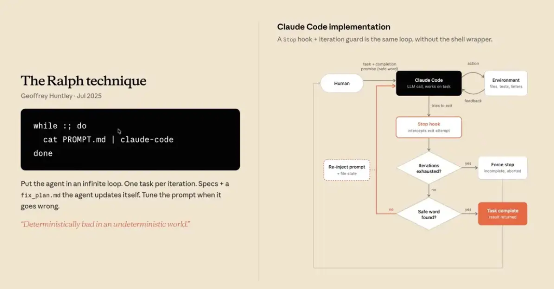
💡Learn the architectural pattern used by Claude Code and Cursor to build persistent, self-correcting coding agents.
⚡ 30-Second TL;DR
What Changed
Ralph Loop enables agents to handle complex tasks by using loops instead of single-session generation.
Why It Matters
This pattern is becoming a standard for production-grade coding agents, forcing developers to move beyond simple prompt engineering toward robust system architecture.
What To Do Next
Implement a simple while-loop wrapper around your LLM agent with a defined 'stop hook' to test multi-step task completion.
Key Points
- •Ralph Loop enables agents to handle complex tasks by using loops instead of single-session generation.
- •Key components include max iterations, safe words, and stop hooks to manage agent autonomy.
- •Focus shifts from 'coding' to 'software verification' using tools like TLA+ and formal methods.
🧠 Deep Insight
AI-generated analysis for this event — not the original article.
🔑 Enhanced Key Takeaways
- •The Ralph Loop architecture integrates a 'State-Persistence Layer' that allows agents to resume execution across server restarts, mitigating the volatility of ephemeral cloud environments.
- •It utilizes a 'Heuristic Feedback Loop' where the agent cross-references its own generated code against a local sandbox environment before committing to the main repository.
- •The pattern incorporates 'Dynamic Token Budgeting,' which automatically adjusts the agent's reasoning depth based on the complexity of the detected error logs.
- •Ralph Loop is specifically designed to interface with 'Agentic Orchestration Frameworks' like LangGraph or CrewAI to manage multi-agent handoffs during long-running software engineering tasks.
- •The methodology emphasizes 'Observability Hooks' that export real-time telemetry data to external monitoring tools, allowing human operators to intervene in the loop via a 'Human-in-the-Loop' (HITL) override.
📊 Competitor Analysis▸ Show
| Feature | Ralph Loop | AutoGPT (Recursive) | Devin (Cognition AI) |
|---|---|---|---|
| Persistence | Native State-Persistence | Ephemeral/External | Managed Cloud Session |
| Verification | Formal Methods (TLA+) | Unit Testing | Sandbox Execution |
| Autonomy | High (Loop-based) | High (Goal-based) | High (Task-based) |
| Pricing | Open Source/Modular | Open Source | Enterprise/Subscription |
🛠️ Technical Deep Dive
- Architecture: Implements a circular state machine where the output of the 'Code Generation' node is fed into a 'Verification' node, which then triggers a 'Correction' node if the exit code is non-zero.
- State Management: Uses a JSON-based state schema to store the 'Context Window' and 'Task History,' ensuring the agent does not lose track of previous failed attempts.
- Formal Verification: Integrates TLA+ model checking to verify concurrent logic before code execution, reducing runtime race conditions.
- Stop Hooks: Configured via a 'Safety Controller' that monitors token usage, execution time, and error frequency to prevent infinite loops and runaway costs.
🔮 Future ImplicationsAI analysis grounded in cited sources
⏳ Timeline
Weekly AI Recap
Read this week's curated digest of top AI events →
👉Related Updates

AI-curated news aggregator. All content rights belong to original publishers.
Original source: 虎嗅 ↗
This is a summary, not the original. Read the source, or get the weekly briefing.
Weekly AI briefing
One email a week. Unsubscribe anytime.