Quantum OS Claims Debunked as Classical Hype
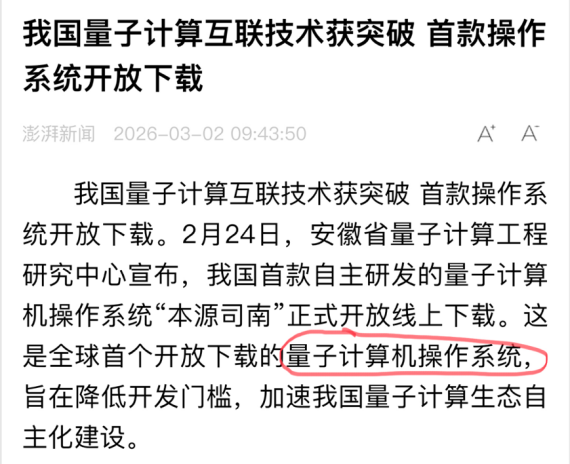
💡Debunks quantum OS hype—save time on real hybrid quantum-classical tools.
⚡ 30-Second TL;DR
What Changed
OS essence is hardware-native; quantum devices are classical co-processors like GPUs.
Why It Matters
Clears hype around immature quantum tech, urging precise terminology. Delays false expectations for quantum-AI breakthroughs.
What To Do Next
Evaluate quantum SDKs like Qiskit for classical-hybrid workflows instead of chasing mythical quantum OS.
Key Points
- •OS essence is hardware-native; quantum devices are classical co-processors like GPUs.
- •Quantum hardware lacks persistent states, processes for OS features.
- •Current tools compile circuits, send pulses—no internal quantum software runs.
- •Hype misleads; call it 'quantum system control stack' instead.
🧠 Deep Insight
Background and context from public sources — not the original article. 6 sources cited.
🔑 Enhanced Key Takeaways
- •Quantum Machines' Pulse Processing Unit (PPU) performs real-time classical computation for quantum experiments, enabling error correction and feedback without native quantum processing.[1]
- •Quantum control layer serves as the interface between classical software and qubits, using microwaves or lasers for precise manipulation while addressing noise from environmental interference.[2]
- •Microsoft's quantum computing stack includes specialized error correction layers due to qubits' high error rates from decoherence, unlike reliable classical systems.[3]
🔮 Future ImplicationsAI analysis grounded in cited sources
📎 Sources (6)
Factual claims are grounded in the sources below. Forward-looking analysis is AI-generated interpretation.
- tjr-lab.mit.edu — Quantum Machines Qubit Control
- mckinsey.com — Understanding Quantum Controls Role in Scaling Quantum Computing
- quantum.microsoft.com — Quantum Computing Stack
- quantinuum.com — Built for All Introducing Our New Software Stack
- riverlane.com — The Full Quantum Computing Stack
- quantum-machines.co — Quantum Technologies and Quantum Control Systems
Weekly AI Recap
Read this week's curated digest of top AI events →
👉Related Updates

AI-curated news aggregator. All content rights belong to original publishers.
Original source: 虎嗅 ↗
This is a summary, not the original. Read the source, or get the weekly briefing.
Weekly AI briefing
One email a week. Unsubscribe anytime.