Quantum Computing Costs: 60% Spent on Control Systems
💡A deep dive into the real cost structure of quantum computers: why control systems are the new bottleneck.
⚡ 30-Second TL;DR
What Changed
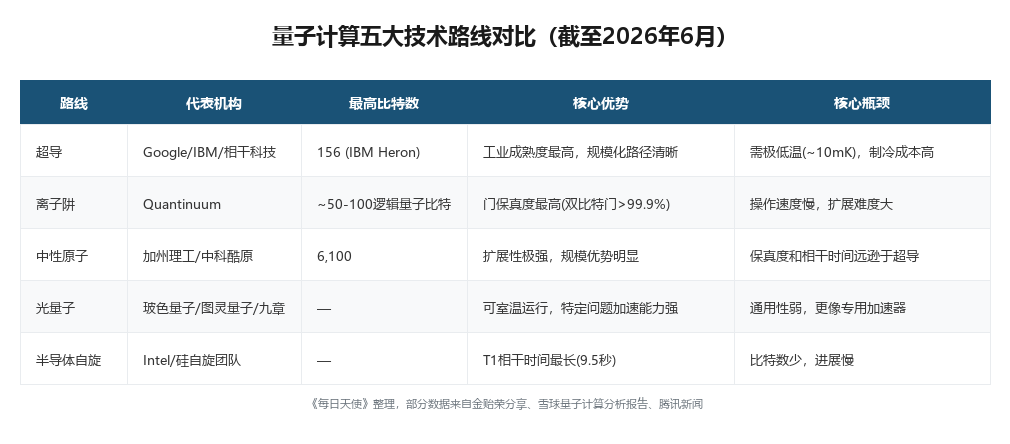
Superconducting quantum computing is the most mature and heavily invested route as of 2026.
Why It Matters
This insight shifts the focus of quantum hardware development from purely increasing qubit counts to optimizing the cost and efficiency of control electronics, which is critical for commercial viability.
What To Do Next
If you are working on quantum hardware, prioritize the development of integrated, scalable CMOS-based control electronics to reduce system-level costs.
Key Points
- •Superconducting quantum computing is the most mature and heavily invested route as of 2026.
- •Control and measurement (测控) systems scale linearly with the number of qubits, unlike refrigeration costs.
- •Quantum entanglement allows for exponential scaling of computational space, enabling high-dimensional information processing.
🧠 Deep Insight
AI-generated analysis for this event — not the original article.
🔑 Enhanced Key Takeaways
- •The 'wiring bottleneck' in superconducting quantum systems arises because each qubit typically requires dedicated coaxial lines, leading to thermal load and physical space constraints at the dilution refrigerator's mixing chamber.
- •Cryogenic CMOS (cryo-CMOS) technology is emerging as a primary solution to reduce control system costs by integrating control electronics directly into the cryogenic environment, thereby reducing the number of cables.
- •Multiplexing techniques, such as frequency-division multiplexing (FDM), are being actively researched to allow a single control line to address multiple qubits, aiming to break the linear scaling cost model.
- •Beyond hardware costs, the power consumption of room-temperature control electronics is becoming a significant operational expenditure (OPEX) factor for large-scale quantum data centers.
- •Industry standards for quantum control interfaces, such as the Quantum Instrumentation Control Kit (QICK), are being developed to lower the barrier to entry and reduce proprietary hardware development costs.
🛠️ Technical Deep Dive
- Control systems utilize Arbitrary Waveform Generators (AWGs) and digitizers to perform microwave pulse shaping and state readout.
- Signal latency between the room-temperature control rack and the cryogenic qubit environment must be minimized to maintain coherence times during gate operations.
- Superconducting qubits operate in the gigahertz range, requiring high-bandwidth digital-to-analog converters (DACs) and analog-to-digital converters (ADCs) with high sampling rates.
- Attenuators and filters are placed at various temperature stages (e.g., 4K, 100mK, 10mK) within the dilution refrigerator to suppress thermal noise and protect qubit states.
🔮 Future ImplicationsAI analysis grounded in cited sources
Weekly AI Recap
Read this week's curated digest of top AI events →
👉Related Updates

AI-curated news aggregator. All content rights belong to original publishers.
Original source: 虎嗅 ↗
This is a summary, not the original. Read the source, or get the weekly briefing.
Weekly AI briefing
One email a week. Unsubscribe anytime.