💰钛媒体•Freshcollected in 13m
Qualcomm, Nvidia, and Horizon Robotics target smart vehicle chips
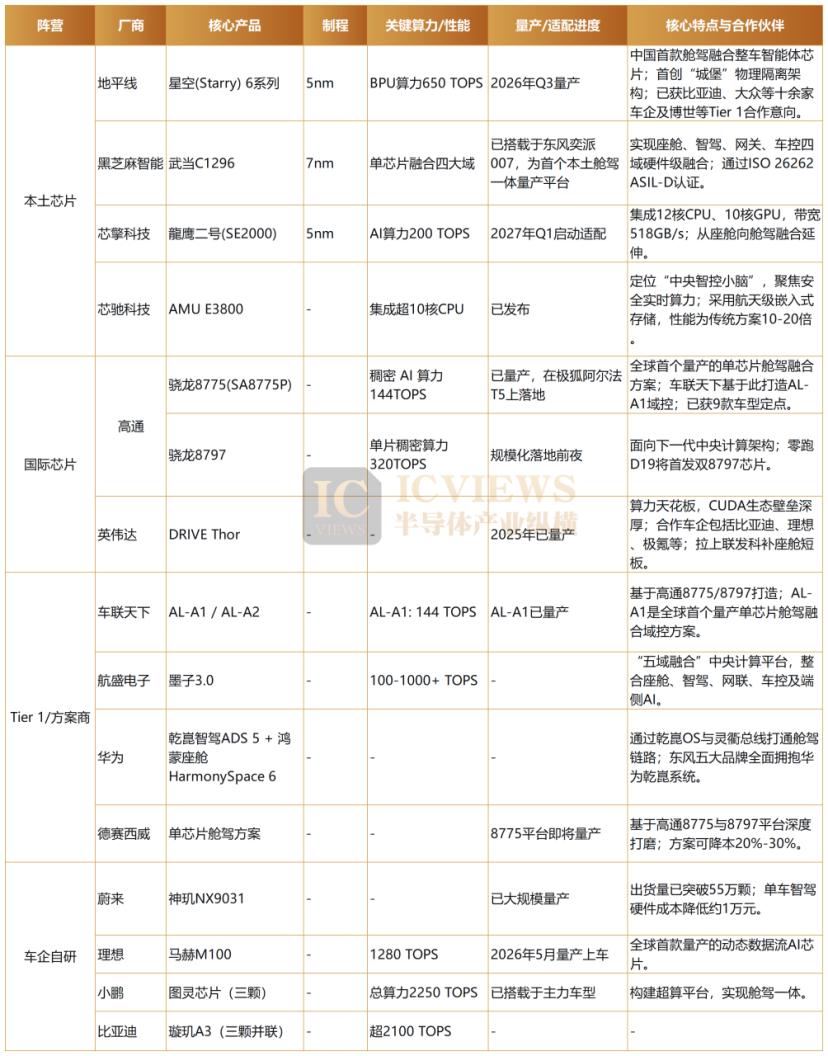
💡See how major chip giants are pivoting to automotive to sustain growth amid profit pressures.
⚡ 30-Second TL;DR
What Changed
Intensifying competition among major chipmakers for automotive market share
Why It Matters
The concentration of top-tier silicon providers in the automotive space will accelerate the development of autonomous driving and smart cockpit features.
What To Do Next
Evaluate the hardware-software stack of these providers to determine the best platform for your autonomous driving model deployment.
Who should care:Developers & AI Engineers
Key Points
- •Intensifying competition among major chipmakers for automotive market share
- •High-performance chips as the central pillar of vehicle intelligence
- •Industry-wide focus on navigating profit margin pressures
🧠 Deep Insight
AI-generated analysis for this event.
🔑 Enhanced Key Takeaways
- •The automotive chip market is shifting toward 'Centralized Computing' architectures, where a single SoC handles both cockpit infotainment and autonomous driving functions to reduce vehicle weight and cost.
- •Horizon Robotics has increasingly adopted a 'hardware-software co-design' strategy, emphasizing open-source development environments to attract Chinese domestic OEMs seeking supply chain independence.
- •Nvidia's DRIVE Thor platform has emerged as the industry benchmark for high-compute automotive SoCs, offering up to 2,000 teraflops of performance to support generative AI in-cabin experiences.
- •Qualcomm is leveraging its dominance in mobile connectivity (5G/C-V2X) to integrate 'Snapdragon Digital Chassis' solutions, creating a unified ecosystem that bundles telematics with compute power.
- •Geopolitical trade restrictions have accelerated the localization of automotive semiconductor supply chains in China, forcing international players to form joint ventures or localized partnerships to maintain market access.
📊 Competitor Analysis▸ Show
| Feature | Qualcomm (Snapdragon Ride) | Nvidia (DRIVE Thor) | Horizon Robotics (Journey Series) |
|---|---|---|---|
| Primary Focus | Integrated Cockpit & ADAS | High-Performance Autonomous Driving | Cost-Effective Localized ADAS |
| Architecture | Heterogeneous Computing | Blackwell-based GPU/Transformer Engine | BPU (Brain Processing Unit) |
| Market Strength | Power Efficiency & Connectivity | Raw Compute & AI Ecosystem | Local Support & Cost Optimization |
| Target Segment | Mass Market to Premium | Premium/Robotaxi | Mass Market/Entry-Level ADAS |
🛠️ Technical Deep Dive
- Nvidia DRIVE Thor: Utilizes a transformer engine to process multi-modal sensor data, supporting up to 2,000 TFLOPS of FP8 performance for real-time AI inference.
- Qualcomm Snapdragon Ride: Employs a scalable architecture using 4nm process nodes, integrating dedicated AI accelerators and safety-certified (ASIL-D) islands for autonomous driving tasks.
- Horizon Robotics Journey 6: Features a proprietary BPU (Brain Processing Unit) architecture optimized for sparse neural networks, specifically designed to handle BEV (Bird's Eye View) and Transformer-based perception algorithms efficiently.
🔮 Future ImplicationsAI analysis grounded in cited sources
Automotive chip margins will continue to compress through 2027.
The commoditization of standard ADAS features and the rise of domestic Chinese competitors are forcing aggressive price competition among Tier-1 suppliers.
Software-Defined Vehicle (SDV) revenue will surpass hardware sales for chipmakers by 2028.
As hardware performance plateaus, manufacturers are shifting business models toward recurring software licensing and OTA (Over-the-Air) feature updates.
⏳ Timeline
2021-07
Horizon Robotics launches Journey 5, its first high-performance chip for L4 autonomous driving.
2022-09
Nvidia announces the DRIVE Thor platform, succeeding Orin with significantly higher compute capabilities.
2023-01
Qualcomm expands the Snapdragon Digital Chassis to include advanced generative AI capabilities for vehicle cockpits.
2024-04
Horizon Robotics officially files for an IPO on the Hong Kong Stock Exchange to fund R&D for next-gen chips.
2024-10
Horizon Robotics completes its IPO, marking a major milestone for Chinese automotive semiconductor independence.
📰
Weekly AI Recap
Read this week's curated digest of top AI events →
👉Related Updates



AI-curated news aggregator. All content rights belong to original publishers.
Original source: 钛媒体 ↗