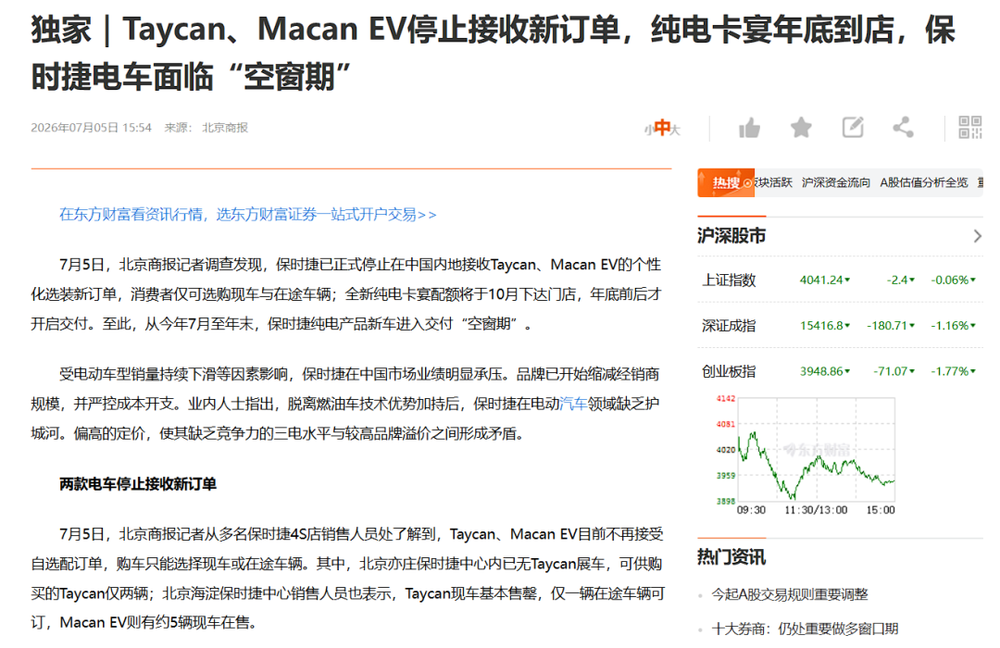
Porsche halts custom orders for Taycan and Macan EV
💡Legacy luxury struggles against local EV software: a case study on why brand heritage isn't enough in the AI era.
⚡ 30-Second TL;DR
What Changed
Stopped custom orders for Taycan and electric Macan in China.
Why It Matters
This highlights the difficulty legacy luxury automakers face when competing with domestic EV players in China, emphasizing the critical need for localized software and smart cockpit features.
What To Do Next
Analyze the software integration gaps in legacy automotive platforms to identify opportunities for third-party smart cockpit middleware.
Key Points
- •Stopped custom orders for Taycan and electric Macan in China.
- •Significant sales decline in the Chinese market (down 21% in Q1).
- •Strategic shift to 'quality over quantity' with a reduction in dealership count.
- •Focusing on localizing R&D, specifically for in-car infotainment systems.
🧠 Deep Insight
AI-generated analysis for this event — not the original article.
🔑 Enhanced Key Takeaways
- •Porsche's decision follows a broader trend of luxury automakers re-evaluating their 'China-first' sales strategies as domestic EV brands like Xiaomi and Nio gain significant market share in the premium segment.
- •The move to halt custom orders is specifically linked to inventory management challenges, as Porsche aims to reduce the high stock levels currently sitting in Chinese dealership lots to stabilize residual values.
- •Porsche is accelerating the integration of local Chinese tech partners, such as Horizon Robotics, to overhaul its digital cockpit experience which has been criticized by local consumers for lacking the responsiveness of domestic competitors.
- •The 'quality over quantity' strategy includes a restructuring of the dealer incentive program, shifting focus away from pure volume-based bonuses to customer satisfaction and service retention metrics.
- •Internal reports suggest that Porsche is reallocating production capacity from the Chinese market to North American and European markets where demand for the Taycan and Macan EV remains more resilient.
📊 Competitor Analysis▸ Show
| Feature/Benchmark | Porsche Taycan/Macan EV | Xiaomi SU7 / Nio ET7 | Tesla Model S/X |
|---|---|---|---|
| Infotainment | Legacy-based (Transitioning) | Highly integrated/Local OS | Proprietary/High-speed |
| Pricing Strategy | Premium/High Margin | Aggressive/Value-focused | Dynamic/Volume-focused |
| Market Positioning | Heritage/Performance | Tech-first/Smart EV | Tech-first/Mass Market |
🛠️ Technical Deep Dive
- Porsche is transitioning its infotainment architecture in China to a more open, Android-based framework to support local apps like WeChat, Baidu Maps, and specialized EV charging networks.
- The Macan EV utilizes the Premium Platform Electric (PPE) architecture, featuring an 800-volt system that supports up to 270 kW DC fast charging, though local charging infrastructure compatibility remains a focus for software optimization.
- Future software updates are expected to move toward a centralized domain controller architecture to improve Over-the-Air (OTA) update frequency and stability, addressing previous complaints regarding slow feature deployment.
🔮 Future ImplicationsAI analysis grounded in cited sources
⏳ Timeline
Weekly AI Recap
Read this week's curated digest of top AI events →
👉Related Updates

AI-curated news aggregator. All content rights belong to original publishers.
Original source: 虎嗅 ↗
This is a summary, not the original. Read the source, or get the weekly briefing.
Weekly AI briefing
One email a week. Unsubscribe anytime.