Pentagon Adds Alibaba, Baidu, and BYD to Military List
💡Regulatory update impacting major AI/robotics players; check your supply chain for compliance risks.
⚡ 30-Second TL;DR
What Changed
New additions include Alibaba, Baidu, BYD, and Unitree
Why It Matters
This move may trigger further investment restrictions and supply chain audits for companies utilizing technology from these entities.
What To Do Next
Audit your software supply chain for dependencies on APIs or hardware components from these newly listed entities.
Key Points
- •New additions include Alibaba, Baidu, BYD, and Unitree
- •Total list now includes 188 companies
- •Focus on China's military-civil fusion strategy
🧠 Deep Insight
Background and context from public sources — not the original article. 25 sources cited.
🔑 Enhanced Key Takeaways
- •The Pentagon's 1260H list, which now includes 188 companies, is mandated by Section 1260H of the Fiscal Year 2021 National Defense Authorization Act (NDAA) and requires annual updates until at least December 31, 2030.
- •The designation of companies as 'Chinese military companies' under Section 1260H is based on their direct or indirect ownership/control by, or affiliation with, the People's Liberation Army (PLA) or other Chinese security services, or their identification as a 'military-civil fusion contributor' to the Chinese defense industrial base.
- •Effective June 30, 2026, the Department of Defense (DoD) will be prohibited from entering into, renewing, or extending contracts directly with entities on the 1260H list, with a broader ban on goods or services incorporating products from these firms taking effect in June 2027.
- •China's Military-Civil Fusion (MCF) strategy is a national policy aimed at developing the PLA into a 'world-class military' by 2049, achieved by eliminating barriers between civilian and defense sectors and leveraging dual-use technologies such as artificial intelligence (AI), quantum computing, big data, and semiconductors.
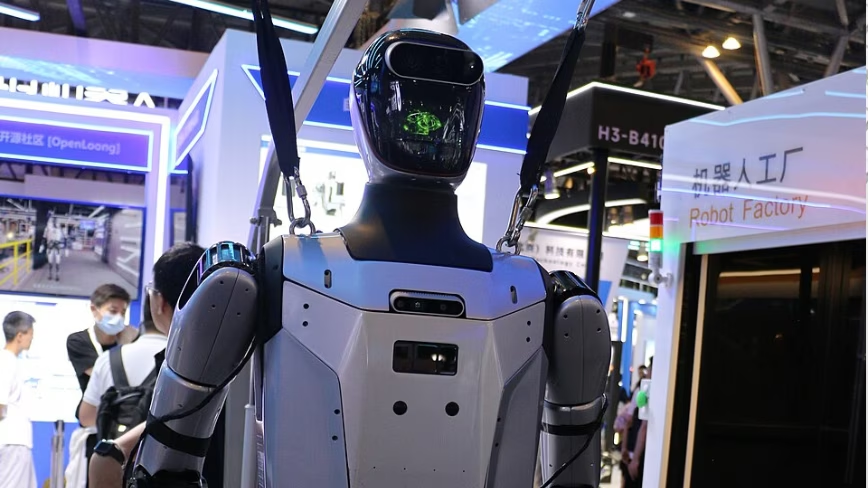
- •Unitree, a robotics company, has been cited for well-documented ties to PLA-affiliated institutions, receiving state funding, contributing to defense research, and producing robotic systems with clear military utility, despite the company's public statements asserting its civilian nature.
🛠️ Technical Deep Dive
Alibaba and Baidu's inclusion on the list is linked to their significant roles in e-commerce, cloud computing, AI, search, and autonomous systems, raising concerns about the dual-use nature of these technologies and their affiliations with China's Ministry of Industry and Information Technology (MIIT).
- BYD's designation stems from its research and development centers being located in 'military-civil fusion industry zones' and its advancements in battery technology, including a National State Council Progress Award for work conducted jointly with a university affiliated with the State Administration for Science and Technology for National Defense (SASTIND) and a partner of the military Aviation Corporation of China (AVIC).
- Unitree's products include quadrupedal and humanoid robots equipped with cameras, sensors, and embedded software. Concerns have been raised regarding remote-access features, such as 'CloudSail,' PRC-subsidized software, and allegations of data transmission to Chinese servers. A Bluetooth Low Energy vulnerability, dubbed 'UniPwn,' was disclosed in September 2025, which could enable full device takeover and automatic compromise of other robots within Bluetooth range.
🔮 Future ImplicationsAI analysis grounded in cited sources
⏳ Timeline
📎 Sources (25)
Factual claims are grounded in the sources below. Forward-looking analysis is AI-generated interpretation.
- usc.edu
- federalregister.gov
- modeldiplomat.com
- akingump.com
- dechert.com
- zerohedge.com
- thenextweb.com
- morganlewis.com
- seekingalpha.com
- substack.com
- hoganlovells.com
- nationaldefensemagazine.org
- state.gov
- wikipedia.org
- state.gov
- georgetown.edu
- house.gov
- techtimes.com
- house.gov
- warontherocks.com
- kharon.com
- tradingview.com
- americanmanufacturing.org
- taipeitimes.com
- squirepattonboggs.com
Weekly AI Recap
Read this week's curated digest of top AI events →
👉Related Updates


AI-curated news aggregator. All content rights belong to original publishers.
Original source: The Next Web (TNW) ↗
This is a summary, not the original. Read the source, or get the weekly briefing.
The weekly digest
One email a week. Unsubscribe anytime.