Paradromics implants first brain-computer interface in patient
💡A new major competitor enters the BCI space, challenging Neuralink's dominance.
⚡ 30-Second TL;DR
What Changed
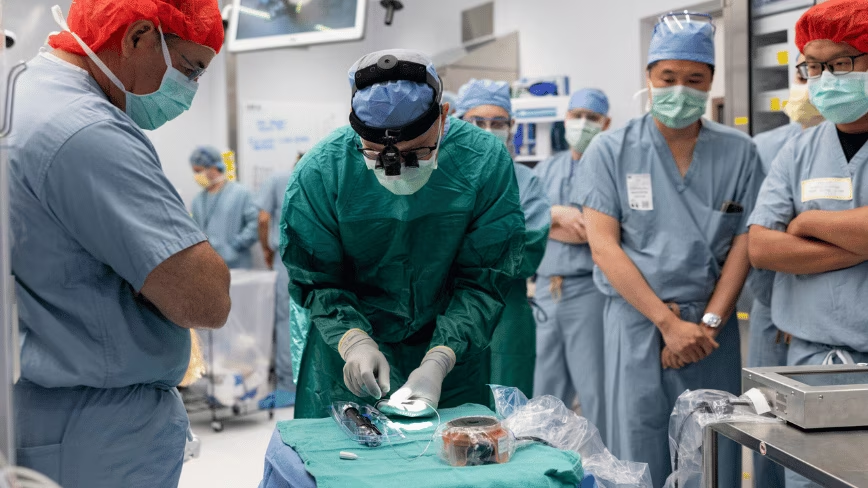
Paradromics implants Connexus BCI in first human patient
Why It Matters
The entry of a second major player into the BCI market accelerates the pace of innovation in neural signal processing. It increases the likelihood of rapid regulatory and clinical advancements for assistive technologies.
What To Do Next
Research the signal processing algorithms used in BCI platforms to understand the data requirements for neural decoding.
Key Points
- •Paradromics implants Connexus BCI in first human patient
- •FDA-approved clinical study marks a major milestone
- •Direct competition with Neuralink in the brain-chip market
🧠 Deep Insight
Background and context from public sources — not the original article. 21 sources cited.
🔑 Enhanced Key Takeaways
- •Paradromics, founded in 2015, has secured approximately $88.7 million in total funding across 13 rounds, including an initial $18 million from the United States Defense Advanced Research Projects Agency (DARPA).
- •The Connexus BCI received two FDA Breakthrough Device Designations in May 2023, recognizing its potential for both speech restoration and control of computer devices, which facilitates an expedited regulatory review process.
- •Preclinical testing of the Connexus BCI has demonstrated an information transfer rate exceeding 200 bits per second (bps) with a latency of 56 milliseconds, and over 100 bps with a latency of 11 milliseconds for latency-sensitive applications.
- •The Connect-One clinical study, which received FDA Investigational Device Exemption (IDE) approval in November 2025, is designed to evaluate the long-term safety and efficacy of the Connexus BCI in restoring speech and enabling computer control for individuals with severe motor impairment.
- •The Connexus BCI utilizes 421 ultra-thin electrodes, made of platinum-iridium and thinner than a human hair, which are designed to extend 1.5 mm into the brain's auditory cortex to record individual neural signals.
📊 Competitor Analysis▸ Show
| Company | Device | Invasiveness | Electrode Count | Data Rate/Latency | Key Focus/Features |
|---|---|---|---|---|---|
| Paradromics | Connexus BCI | Intracortical | 421 | >200 bps @ 56ms, >100 bps @ 11ms | Speech restoration, computer control, fully implantable, wireless, high-fidelity data acquisition |
| Neuralink | N1 | Intracortical | 1,024 (on 64 threads) | High resolution, 7-10 bps control speeds reported | Cursor control, speech, vision restoration, robotic implantation, fully wireless |
| Synchron | Stentrode | Endovascular (less invasive) | 16 | Lower resolution | Basic digital interaction, lower surgical risk, implanted via jugular vein |
| Blackrock Neurotech | Utah Array | Intracortical | 100-128 | High-quality scientific data | Motor control, longest clinical track record, percutaneous connectors (wired) |
| Precision Neuroscience | Layer 7 Cortical Interface | Surface ECoG (partially invasive) | 1,024 | Hundreds of contacts | Safety testing, data gathering, thin-film microelectrode array, minimally invasive cranial micro-slit |
🛠️ Technical Deep Dive
- The Connexus BCI consists of an implantable high-density microelectrode array that records neural signals and a discrete transceiver in the chest that wirelessly transmits data through the skin to an external receiver.
- It features 421 ultra-thin electrodes, each approximately 40 microns in diameter and made of platinum-iridium, designed to extend 1.5 mm into the brain tissue, specifically the auditory cortex for speech-related applications.
- The system is engineered for chronic stability and long-term daily use, aiming to withstand harsh biological conditions.
- Advanced artificial intelligence algorithms are used to decode the recorded brain activity, translating neural signals into text, synthesized speech, or computer commands.
- Paradromics has developed SONIC, an open benchmarking standard to rigorously measure BCI performance, demonstrating information transfer rates over 200 bits per second with 56ms latency and over 100 bits per second with 11ms latency in preclinical models.
🔮 Future ImplicationsAI analysis grounded in cited sources
⏳ Timeline
📎 Sources (21)
Factual claims are grounded in the sources below. Forward-looking analysis is AI-generated interpretation.
- tracxn.com
- from-the-interface.com
- reddit.com
- pitchbook.com
- wikipedia.org
- paradromics.com
- reddit.com
- synbiobeta.com
- paradromics.com
- paradromics.com
- medium.com
- businesswire.com
- umhealthresearch.org
- paradromics.com
- paradromics.com
- paradromics.com
- substack.com
- neurapod.com
- subconsciousmind.ai
- paradromics.com
- prnewswire.com
Weekly AI Recap
Read this week's curated digest of top AI events →
👉Related Updates


AI-curated news aggregator. All content rights belong to original publishers.
Original source: The Next Web (TNW) ↗
This is a summary, not the original. Read the source, or get the weekly briefing.
The weekly digest
One email a week. Unsubscribe anytime.