Outdated STEM PhD Training Fails Era
💡STEM PhD reform targets AI talent mismatch; vital for hiring researchers
⚡ 30-Second TL;DR
What Changed
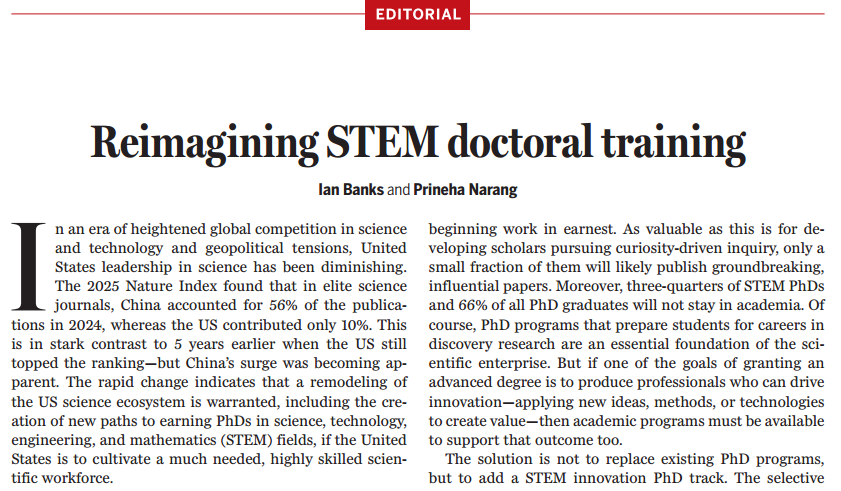
US STEM PhD grads stagnant at <46k in 2024 vs China's 56% top journal share
Why It Matters
Exacerbates US talent shortage in fast-evolving fields like AI, risking tech leadership. New track could bridge academia-industry gap, boosting innovation.
What To Do Next
Evaluate industry-PhD programs like Germany's Fraunhofer for faster AI research alignment.
Key Points
- •US STEM PhD grads stagnant at <46k in 2024 vs China's 56% top journal share
- •75% PhDs enter industry but trained only for academia/papers
- •New 4-year track: structured industry projects, 2-3 month internships
🧠 Deep Insight
Background and context from public sources — not the original article. 5 sources cited.
🔑 Enhanced Key Takeaways
- •US produced under 46,000 science and engineering PhD graduates in 2024, a 12.8% increase since 2014, lagging behind China's dominance in top journal publications[1].
- •75% of US STEM PhDs enter industry jobs but current training emphasizes academic papers and tenure-track preparation, creating a mismatch with industry needs in AI, quantum, biotech, and advanced materials[1].
- •Proposed STEM innovation PhD track is a selective 4-year accelerated program with structured industry-aligned research projects from year one and 2-3 month internships in years two and three[1].
- •Hybrid funding model suggested: federal for academic independence, industry for equipment, internships; examples include partnerships at Stanford, MIT, Cambridge with Google, IBM, Microsoft[1].
- •Universities like Arizona State University exemplify industry-aligned STEM training through partnerships in semiconductors, internships, and career-focused models emphasizing employability[2].
🔮 Future ImplicationsAI analysis grounded in cited sources
The critique highlights risks to US competitiveness from stagnant PhD output and academic-industry mismatch amid China's rise, proposing innovation tracks to boost talent for AI, quantum, and biotech; successful adoption could enhance workforce agility via public-private partnerships, though funding uncertainty poses challenges[1].
⏳ Timeline
📎 Sources (5)
Factual claims are grounded in the sources below. Forward-looking analysis is AI-generated interpretation.
Weekly AI Recap
Read this week's curated digest of top AI events →
👉Related Updates
AI-curated news aggregator. All content rights belong to original publishers.
Original source: 虎嗅 ↗
This is a summary, not the original. Read the source, or get the weekly briefing.
Weekly AI briefing
One email a week. Unsubscribe anytime.