Optimizing Hybrid Search with Tokenization and Accent Folding
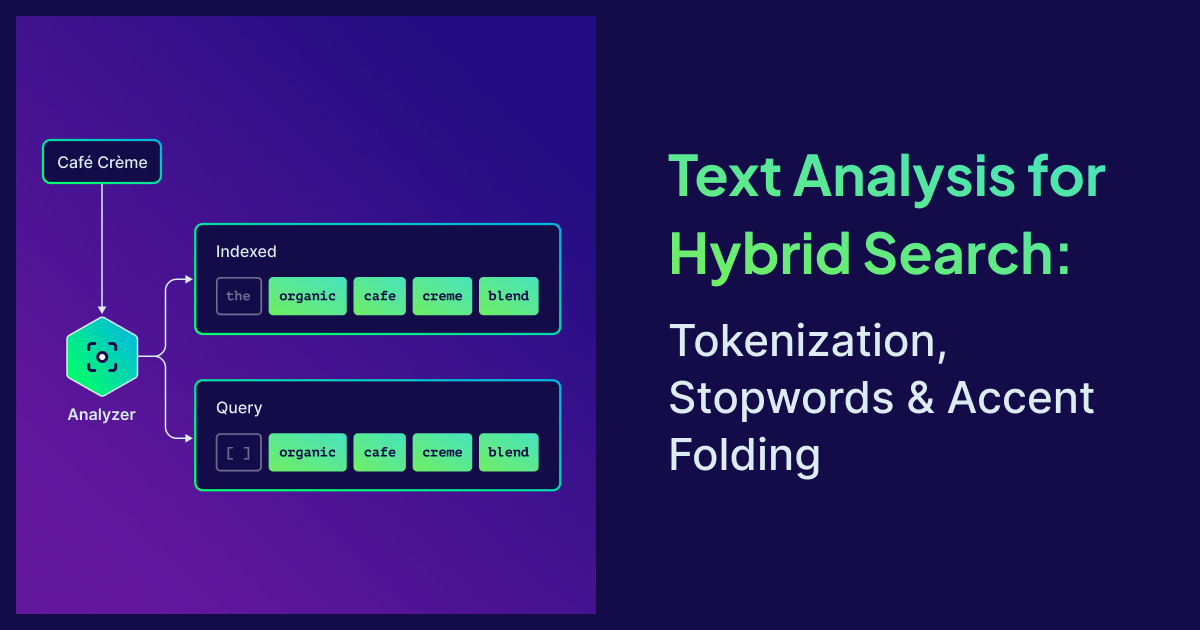
Learn how to improve your RAG search accuracy using Weaviate's new tokenization and accent folding features.
30-Second TL;DR
What Changed
Introduced accent folding to normalize text for better search matching
Why It Matters
These improvements allow developers to build more accurate and language-agnostic search systems. By fine-tuning tokenization, practitioners can significantly reduce noise in retrieval-augmented generation (RAG) pipelines.
What To Do Next
Test your current search queries against the /v1/tokenize endpoint to verify if accent folding and custom stopwords improve your retrieval precision.
Key Points
- •Introduced accent folding to normalize text for better search matching
- •Added support for custom stopwords to refine search relevance
- •Exposed text analysis capabilities via the /v1/tokenize API endpoint
- •Enhanced BM25 performance for multilingual search applications
Deep Insight
Background and context from public sources — not the original article. 8 sources cited.
Enhanced Key Takeaways
- •The new text analysis features, including accent folding and custom stopwords, were released as part of Weaviate v1.37, which also introduced other significant capabilities like a Model Context Protocol (MCP) Server for AI agent integration, Diversity Search with MMR, and Query Profiling.
- •The
/v1/tokenizeendpoint allows developers to test different tokenizer and analyzer configurations on arbitrary text before committing them to a schema, providing transparency and aiding in the tuning of text analysis. - •Custom stopword presets can be defined per collection and assigned to individual text properties, enabling tailored multilingual configurations without requiring reindexing when stopword settings are changed, as stopwords are filtered at query time.
- •Weaviate's hybrid search leverages the BM25F algorithm, an extension of BM25 that supports multiple weighted fields, allowing different property weights in ranking calculations for more accurate results.
Competitor Analysis
- Weaviate
- Semantic Search, Hybrid Search, AI-native Vector Database
- Milvus
- High-performance, Large-scale Vector Similarity Search
- pgvector
- PostgreSQL extension for vector search
- Elasticsearch/OpenSearch
- Full-text search, Vector search (add-on), Hybrid Search
- Weaviate
- Primarily HNSW, but also supports BM25/BM25F for keyword search
- Milvus
- HNSW, IVF, ANNOY
- pgvector
- Limited, leverages PostgreSQL indexing
- Elasticsearch/OpenSearch
- Inverted index for keywords, dense_vector fields for vectors
- Weaviate
- Excels, built-in ML model integrations for automatic embedding
- Milvus
- Primarily vector similarity, less native semantic understanding
- pgvector
- Basic vector similarity
- Elasticsearch/OpenSearch
- Requires external models for semantic embeddings
- Weaviate
- Designed for horizontal scaling, multi-tenancy support, handles billions of vectors
- Milvus
- High performance and scalability for massive datasets (100B+)
- pgvector
- May struggle with very large datasets and high query loads
- Elasticsearch/OpenSearch
- Scalable, distributed architecture
- Weaviate
- Native, combines BM25/BM25F and vector search with fusion strategies (e.g.,
relativeScoreFusion,rankedFusion) - Milvus
- Supports hybrid search (alpha parameter for tuning BM25 and vector search)
- pgvector
- Can be combined with traditional SQL search, but not natively hybrid
- Elasticsearch/OpenSearch
- BM25 + dense_vector fields, RRF for hybrid scoring
- Weaviate
- Accent folding, custom stopwords, configurable tokenization (word, lowercase, whitespace, field, trigram),
/v1/tokenizeendpoint - Milvus
- Less focus on advanced text analysis features within the vector database itself
- pgvector
- Relies on PostgreSQL text processing capabilities
- Elasticsearch/OpenSearch
- Extensive keyword analysis, tokenization, stemming, stopwords
- Weaviate
- GraphQL and REST APIs
- Milvus
- REST API, Python/Java/Go SDKs
- pgvector
- SQL interface
- Elasticsearch/OpenSearch
- REST API
- Weaviate
- Self-hosted (Docker), Weaviate Cloud (managed, serverless)
- Milvus
- Self-hosted, Zilliz Cloud (fully managed Milvus)
- pgvector
- PostgreSQL extension
- Elasticsearch/OpenSearch
- Self-hosted, managed cloud services
- Weaviate
- Relatively newer, but rapidly evolving with strong community
- Milvus
- Well-established, mature ecosystem
- pgvector
- Leverages PostgreSQL maturity
- Elasticsearch/OpenSearch
- Highly mature, widely adopted
- Weaviate
- Strong metadata management, namespaces, metadata filtering
- Milvus
- Partitioning, advanced metadata handling, fine-tuned control over index creation
- pgvector
- Leverages PostgreSQL data management
- Elasticsearch/OpenSearch
- Comprehensive data management, filtering, aggregation
| Feature / Product | Weaviate | Milvus | pgvector | Elasticsearch/OpenSearch |
|---|---|---|---|---|
| Core Focus | Semantic Search, Hybrid Search, AI-native Vector Database | High-performance, Large-scale Vector Similarity Search | PostgreSQL extension for vector search | Full-text search, Vector search (add-on), Hybrid Search |
| Indexing Algorithms | Primarily HNSW, but also supports BM25/BM25F for keyword search | HNSW, IVF, ANNOY | Limited, leverages PostgreSQL indexing | Inverted index for keywords, dense_vector fields for vectors |
| Semantic Understanding | Excels, built-in ML model integrations for automatic embedding | Primarily vector similarity, less native semantic understanding | Basic vector similarity | Requires external models for semantic embeddings |
| Scalability | Designed for horizontal scaling, multi-tenancy support, handles billions of vectors | High performance and scalability for massive datasets (100B+) | May struggle with very large datasets and high query loads | Scalable, distributed architecture |
| Hybrid Search | Native, combines BM25/BM25F and vector search with fusion strategies (e.g., relativeScoreFusion, rankedFusion) | Supports hybrid search (alpha parameter for tuning BM25 and vector search) | Can be combined with traditional SQL search, but not natively hybrid | BM25 + dense_vector fields, RRF for hybrid scoring |
| Text Analysis Features | Accent folding, custom stopwords, configurable tokenization (word, lowercase, whitespace, field, trigram), /v1/tokenize endpoint | Less focus on advanced text analysis features within the vector database itself | Relies on PostgreSQL text processing capabilities | Extensive keyword analysis, tokenization, stemming, stopwords |
| API | GraphQL and REST APIs | REST API, Python/Java/Go SDKs | SQL interface | REST API |
| Deployment | Self-hosted (Docker), Weaviate Cloud (managed, serverless) | Self-hosted, Zilliz Cloud (fully managed Milvus) | PostgreSQL extension | Self-hosted, managed cloud services |
| Maturity | Relatively newer, but rapidly evolving with strong community | Well-established, mature ecosystem | Leverages PostgreSQL maturity | Highly mature, widely adopted |
| Data Management | Strong metadata management, namespaces, metadata filtering | Partitioning, advanced metadata handling, fine-tuned control over index creation | Leverages PostgreSQL data management | Comprehensive data management, filtering, aggregation |
Technical Deep Dive
- Architecture: Weaviate employs a 3-layer architecture consisting of an API layer (handling REST and GraphQL), a Search layer (executing queries), and a Storage layer (storing objects and vectors).
- Hybrid Search Mechanism: Weaviate's hybrid search executes both vector search (for semantic similarity using HNSW) and keyword search (using BM25/BM25F) in parallel. The results are then combined using fusion strategies like
relativeScoreFusion(default from v1.24) orrankedFusion(default for v1.23 and lower) to produce a unified ranking. - BM25F Algorithm: Weaviate utilizes BM25F, an extension of BM25, which allows for different weights to be applied to multiple text fields (properties) during the ranking calculation. This enables property boosting, where certain fields (e.g., a product title) can be given more importance. Tunable parameters include
k1(controls term frequency saturation) andb(controls document length normalization). - Tokenization Options: Weaviate offers several tokenization methods configurable per property:
word(default): Splits text by non-alphanumeric characters and lowercases each token, recommended for general text.lowercase: Splits text by whitespace only and lowercases each token, preserving symbols. Useful for technical data where symbols are meaningful.whitespace: Splits text by whitespace only, preserving case and symbols.field: Treats the entire property value as a single token, useful for exact matches of unique identifiers.trigram: Provides fuzzy matching capabilities by breaking text into overlapping 3-character sequences, aiding in typo tolerance and partial matching (introduced in v1.32).
- Accent Folding: This feature normalizes accented characters (e.g., 'Café' becomes 'Cafe') to ensure that queries with or without accents can match the same underlying text, significantly improving search recall for multilingual datasets.
- Custom Stopwords: Stopwords are configurable per collection and per property. They are filtered out at query time from the BM25 score calculation, meaning changes to stopword lists do not necessitate reindexing. Custom presets can extend or modify built-in stopword lists.
/v1/tokenizeEndpoint: This new REST API endpoint allows developers to tokenize arbitrary text with any tokenizer and analyzer configuration, or to tokenize text using an existing property's exact configuration, facilitating experimentation and debugging of text analysis.
Future ImplicationsAI analysis grounded in cited sources
/v1/tokenize endpoint will accelerate developer iteration and improve the quality of text analysis configurations.Timeline
- 2015Founder Bob van Luijt first encountered word embeddings (GloVe).
- 2016The vision for Weaviate as an AI-first search engine crystallized for its founder.
- 2018Weaviate entered a startup accelerator, leading to the founding of SeMI Technologies.
- 2022-12Weaviate 1.17 released, introducing native hybrid search (BM25 + vector search).
- 2023-04Weaviate launched its serverless offering, accelerating its growth.
- 2026-04Weaviate v1.37 released, introducing Extensible Tokenizers with accent folding, custom stopword presets, and the `/v1/tokenize` endpoint.
Sources (8)
Factual claims are grounded in the sources below. Forward-looking analysis is AI-generated interpretation.
Weekly AI Recap
Read this week's curated digest of top AI events →
AI-curated news aggregator. All content rights belong to original publishers.
Original source: Weaviate Blog ↗
This is a summary, not the original. Read the source, or get the weekly briefing.
The weekly digest
One email a week. Unsubscribe anytime.