Optimize blueprint extraction accuracy in Bedrock Data Automation
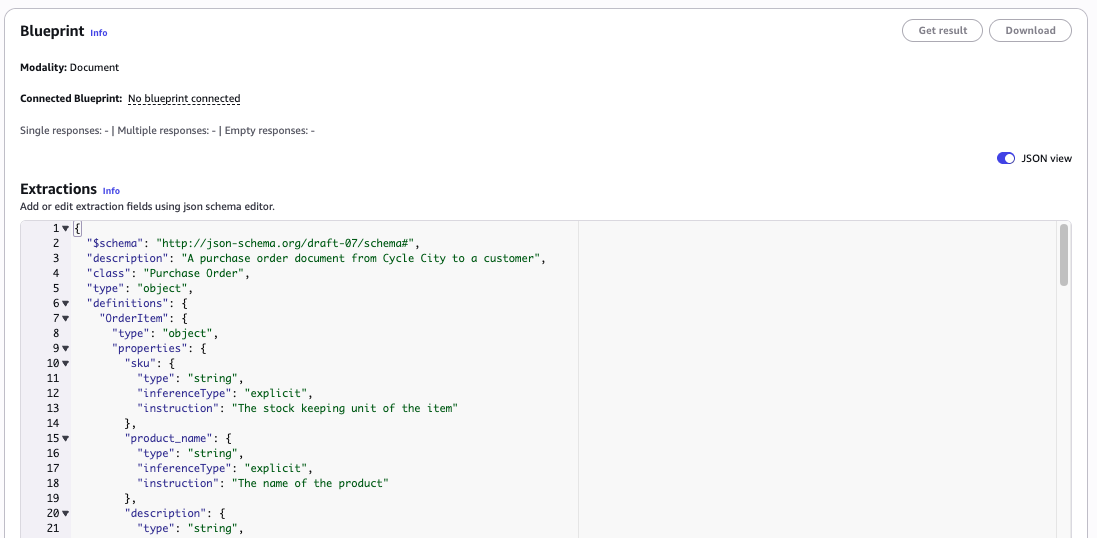
💡Boost extraction accuracy in minutes without fine-tuning using new automated blueprint optimization.
⚡ 30-Second TL;DR
What Changed
Automatic refinement of blueprint extraction instructions
Why It Matters
This feature drastically reduces the time-to-market for document processing applications by automating the prompt engineering and instruction tuning process.
What To Do Next
Use the BDA console to upload 5-10 labeled documents and trigger the blueprint optimization workflow to improve your current extraction pipelines.
Key Points
- •Automatic refinement of blueprint extraction instructions
- •Requires only 3-10 example documents with ground truth
- •Eliminates the need for separate model fine-tuning
- •Accessible via Amazon Bedrock console or API
🧠 Deep Insight
Background and context from public sources — not the original article. 24 sources cited.
🔑 Enhanced Key Takeaways
- •Amazon Bedrock Data Automation (BDA) is a multimodal service designed to process unstructured content including documents, images, video, and audio through a unified API.
- •The blueprint instruction optimization refines natural language instructions for each extraction field by analyzing discrepancies between BDA's initial inference results and user-provided ground truth examples.
- •BDA leverages specialized Amazon Titan Multimodal Embeddings and built-in foundation models to perform tasks like classification, entity extraction, and query-based extraction without requiring manual template creation.
- •Upon completion of the optimization process, users receive detailed evaluation metrics, including exact match rates and F1 scores, to assess the blueprint's accuracy against their ground truth data.
- •BDA integrates seamlessly with Amazon Knowledge Bases for Retrieval-Augmented Generation (RAG) applications and can be orchestrated with other AWS services like S3, Lambda, and Step Functions for end-to-end document processing workflows.
📊 Competitor Analysis▸ Show
| Feature / Service | Amazon Bedrock Data Automation (BDA) | Amazon Textract | Google Document AI | Azure AI Document Intelligence |
|---|---|---|---|---|
| Core Function | Multimodal content processing (documents, images, audio, video) with GenAI for insights and custom extraction via blueprints. Focus on variable, complex documents. | Specialized ML models for OCR, forms, tables, handwriting, and specific document types (invoices, receipts). Excels at high-volume, standardized documents. | Broad document processing ecosystem, strong for invoices, forms, IDs, statements. Semantic understanding, layout-aware parsing. | Enterprise-grade document processing, strong for dense PDFs, multi-column layouts, regulated workflows. Seamless Microsoft ecosystem integration. |
| Customization/Optimization | Blueprint instruction optimization with 3-10 examples (no model fine-tuning). | Custom Queries (natural language prompts), Custom Extraction (requires training). | Custom processors via Workbench, specialized parsers. | Custom models, prebuilt models for specific document types. |
| Pricing (Document Extraction) | Standard Output: $0.010/page. Custom Output: $0.040/page (plus incremental for >30 fields). | Basic OCR: ~$1.50/1,000 pages. Form Extraction: ~$50/1,000 pages. | Basic OCR: ~$1.50/1,000 pages (can drop to $0.60/1,000 pages at high volume). Form Parser: ~$30/1,000 pages. | Tiered pricing, potentially 15% savings for >1M pages annually vs. AWS Textract. |
| Benchmarks (Independent) | Not directly available for this specific feature, but BDA aims for industry-leading accuracy at lower cost. | Average 94.2% accuracy (100 documents). 76.3% for low-quality scans. 71.2% for handwriting. | Average 95.8% accuracy (100 documents). 81.2% for low-quality scans. 74.8% for handwriting. | Slightly enhanced capacity for diverse layouts, 10% faster throughput for complex multi-page documents vs. AWS Textract. |
| Integration | Deep integration with Amazon Bedrock Knowledge Bases, S3, Lambda, Step Functions, Amazon Q Business. | Deep integration with S3, Lambda, Comprehend, A2I. | Strong ecosystem around invoices and adjacent document types, integrates with GCP services. | Integrates across Power Automate, SharePoint, Azure services. |
🛠️ Technical Deep Dive
- Underlying Models: BDA utilizes specialized Amazon Titan Multimodal Embeddings and built-in foundation models for intelligent processing.
- Optimization Mechanism: The blueprint instruction optimization works by comparing BDA's initial extraction results with user-provided ground truth. It then iteratively refines the natural language instructions defined for each field within the blueprint to improve accuracy. This process is an automated form of prompt engineering refinement, distinct from full model fine-tuning.
- Multimodal Processing: BDA supports various modalities including documents (scanned/digital PDFs, Word files, JPEG/PNG), images, audio, and video, extracting text, handwriting, layout, tables, and key-value pairs.
- Output and Explainability: It provides structured, normalized data in a consistent JSON schema, incorporating visual grounding with confidence scores for explainability and built-in hallucination mitigation.
- Document Handling: Supports processing of large documents, up to 3,000 pages, and can extract embedded hyperlinks.
- Workflow Integration: Designed for serverless and integrated architecture, it scales automatically and can be integrated into event-driven workflows using AWS services like S3, Lambda, and Step Functions.
🔮 Future ImplicationsAI analysis grounded in cited sources
⏳ Timeline
📎 Sources (24)
Factual claims are grounded in the sources below. Forward-looking analysis is AI-generated interpretation.
Weekly AI Recap
Read this week's curated digest of top AI events →
👉Related Updates
AI-curated news aggregator. All content rights belong to original publishers.
Original source: AWS Machine Learning Blog ↗
This is a summary, not the original. Read the source, or get the weekly briefing.
The weekly digest
One email a week. Unsubscribe anytime.