OpenEvidence Scales Trusted Healthcare AI on Vercel
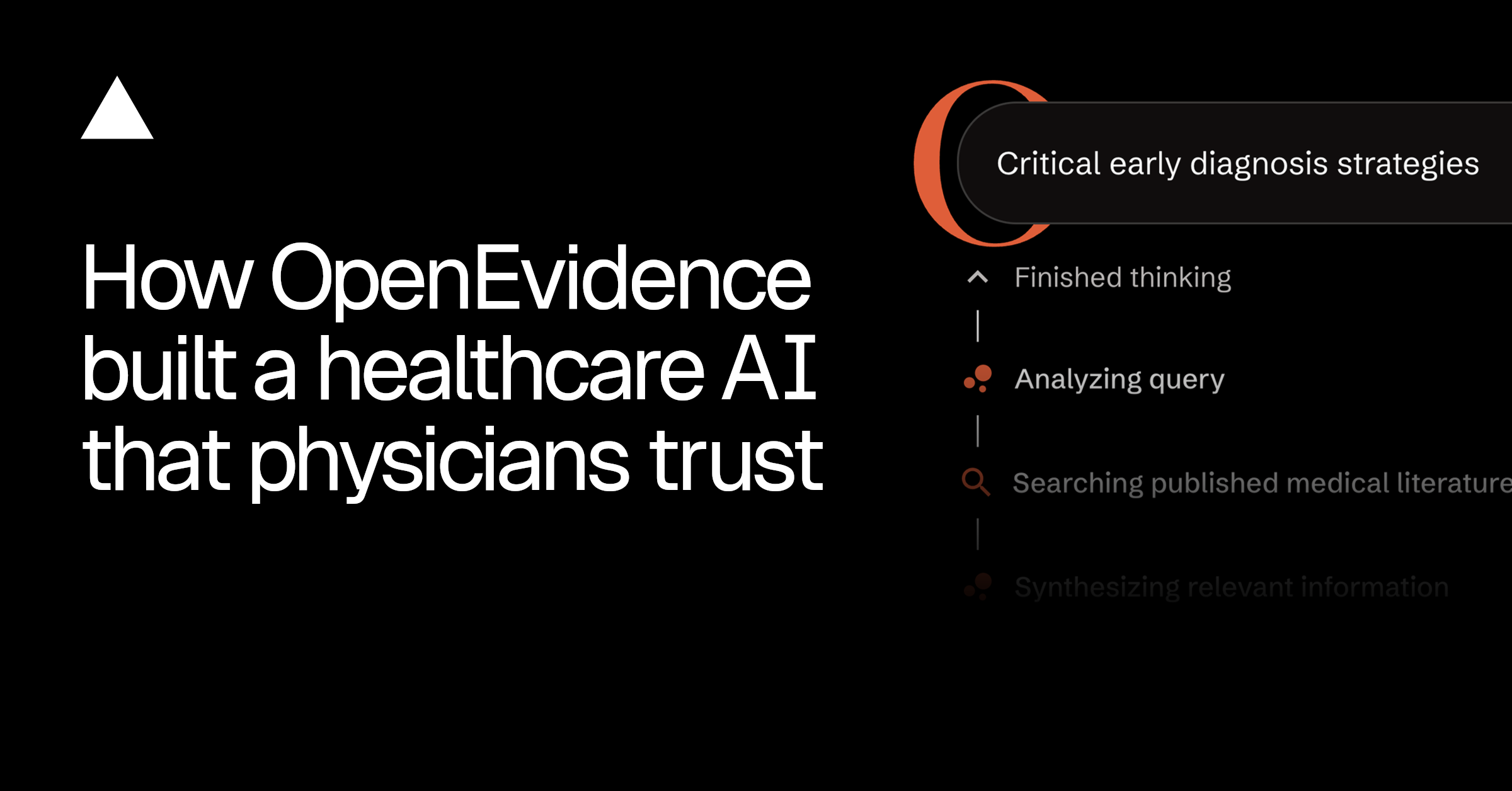
💡Vercel auto-scales healthcare AI for 20M consultations—no babysitting needed
⚡ 30-Second TL;DR
What Changed
Handled 2M TikTok views traffic surge without scaling intervention on Vercel
Why It Matters
Showcases Vercel enabling high-stakes AI apps to scale reliably for small teams, reducing infra overhead in healthcare AI. Highlights shift to trusted, production-ready deployments for clinical tools.
What To Do Next
Deploy your Next.js AI frontend on Vercel to test automatic scaling and preview branches.
Key Points
- •Handled 2M TikTok views traffic surge without scaling intervention on Vercel
- •Next.js frontend enables 5-min production deploys and preview URLs per branch
- •Supports 20M clinical consultations in Jan 2026 for over half of US physicians
- •Hybrid stack: Python/GCP backend for ML, Vercel frontend for reliability
🧠 Deep Insight
Background and context from public sources — not the original article. 6 sources cited.
🔑 Enhanced Key Takeaways
- •OpenEvidence raised $250 million in Series D funding in January 2026 at a $12 billion valuation, becoming the most valuable healthcare AI company.[1][2][6]
- •The platform uses a multi-AI agentic architecture with proprietary medically-specialized models for clinical sub-specialties, coordinated by a central conductor AI.[1]
- •OpenEvidence secured first official AI partnerships with New England Journal of Medicine, American Medical Association, National Comprehensive Cancer Network, and American College of Cardiology.[1]
- •Founded in 2022 by Daniel Nadler (ex-Kensho) and Zachary Ziegler, it relies on advertising revenue, surpassing $100M annualized last year, and claims >40% US physician usage.[2]
📊 Competitor Analysis▸ Show
| Feature | OpenEvidence | OpenAI ChatGPT Health | Anthropic Claude Healthcare |
|---|---|---|---|
| Training Data | Medical journals/partners only | General + HIPAA | General + HIPAA |
| Physician Adoption | >40% US physicians, 20M+ consultations | Emerging | Emerging |
| Revenue Model | Advertising | Subscription? | Subscription? |
| Specialization | Multi-agent sub-specialty models | General health | General health |
🛠️ Technical Deep Dive
- •Multi-AI agentic architecture: Central 'conductor' AI routes physician questions to proprietary models specialized in distinct clinical sub-specialties, mimicking hospital expert teams.[1]
- •Trained exclusively on medical journals and data from partners like NEJM and AMA, avoiding open internet for higher accuracy and trust.[1][2]
🔮 Future ImplicationsAI analysis grounded in cited sources
⏳ Timeline
📎 Sources (6)
Factual claims are grounded in the sources below. Forward-looking analysis is AI-generated interpretation.
- businesswire.com — Openevidence Raises $250 Million to Build Medical Superintelligence for Doctors
- hlth.com — Openevidence Doubles Valuation to 12bn As Physician Adoption Accelerates 2026 01 22
- statnews.com — Openevidence Medical Super Intelligence Jpm Conference
- fiercehealthcare.com — Openevidence Clinches 250m Series D Rapidly Growing Its Reach Doctors
- refreshmiami.com — Openevidence Lands 250m to Further Develop the AI Doctors Already Rely on
- advisory.com — Around the Nation
Weekly AI Recap
Read this week's curated digest of top AI events →
👉Related Updates
AI-curated news aggregator. All content rights belong to original publishers.
Original source: Vercel News ↗
This is a summary, not the original. Read the source, or get the weekly briefing.
Weekly AI briefing
One email a week. Unsubscribe anytime.