OpenClaw Gives AI True Frontend
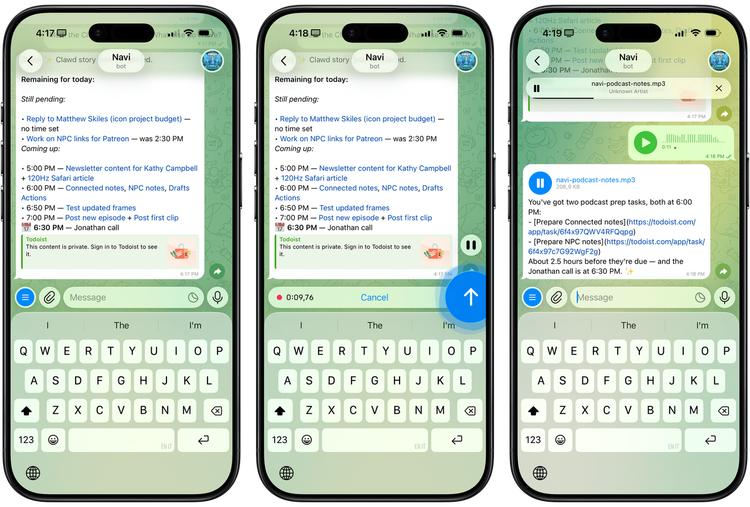
💡OpenClaw hacks chat apps into proactive Agents—redefines AI UX for builders (100k stars)
⚡ 30-Second TL;DR
What Changed
Integrates into existing chat apps for zero-threshold access
Why It Matters
Lowers AI adoption barriers by embedding in daily tools, potentially turning apps into slow APIs for Agents. Accelerates shift to proactive assistants, influencing product design across industries.
What To Do Next
Deploy OpenClaw on Telegram using its GitHub repo to test proactive task automation.
Key Points
- •Integrates into existing chat apps for zero-threshold access
- •Proactive triggers like periodic 'surprise me' for ongoing tasks
- •100k GitHub stars in short time; founder Peter Steinberger hired by OpenAI
- •Treats LLMs as backends, OpenClaw as user-facing Agent frontend
🧠 Deep Insight
Background and context from public sources — not the original article. 9 sources cited.
🔑 Enhanced Key Takeaways
- •OpenClaw runs a local gateway that connects to LLMs like Claude, ChatGPT, or local models via Ollama using user-provided API keys, while bridging to messaging apps and local tools.[3]
- •It features over 100 modular AgentSkills from ClawHub for tasks like GitHub integration, web automation, and smart home control, with self-improvement by generating new skills via conversation.[3][5]
- •Recent updates added vision and video analysis capabilities, plus Kilo Gateway for model switching and self-hosting, enabling multimodal workflows like video summarization on local hardware.[2]
📊 Competitor Analysis▸ Show
| Feature | OpenClaw | CrewAI |
|---|---|---|
| Primary Focus | Personal automation with persistent memory and messaging integrations | Role-based multi-agent collaboration |
| Deployment | Local self-hosted with cloud LLM APIs | Framework for structured workflows |
| Pricing | Free open-source (bring your own API key) | Free open-source |
| Key Strength | Proactive tasks, 100+ skills, multimodal updates | Beginner-friendly multi-agent orchestration |
🛠️ Technical Deep Dive
- •Local gateway acts as control plane, connecting outbound to LLMs (e.g., Anthropic Claude Opus recommended for long-context) and inbound to messaging channels like Telegram, WhatsApp.[3][4]
- •Built-in tools include shell execution, file system access, Chrome CDP browser control, cron jobs for heartbeat scheduler, webhooks, and multi-agent sessions with isolated workspaces.[3][4]
- •Persistent memory via 'Memories' file accumulating user patterns; 'Soul' file customizes personality; modular skills in Markdown/TypeScript from ClawHub; model failover for reliability.[1][3][6]
- •Security features: SecureClaw (55 OWASP checks), ClawBands (tool call approval), Aquaman (credential proxy), APort Guardrails (40+ blocked patterns).[4]
🔮 Future ImplicationsAI analysis grounded in cited sources
⏳ Timeline
📎 Sources (9)
Factual claims are grounded in the sources below. Forward-looking analysis is AI-generated interpretation.
- turingcollege.com — Openclaw
- youtube.com — Watch
- pacgenesis.com — What Is Openclaw AI Everything You Need to Know About the Open Source AI Agent That Actually Does Things
- mindstudio.ai — What Is Openclaw AI Agent
- digitalocean.com — What Is Openclaw
- permiso.io — Inside the Openclaw Ecosystem AI Agents with Privileged Credentials
- crowdstrike.com — What Security Teams Need to Know About Openclaw AI Super Agent
- modernmomplaybook.substack.com — Openclaw Security Guide 2026 How
- twimlai.com — AI Trends 2026 Openclaw Agents Reasoning Llms
Weekly AI Recap
Read this week's curated digest of top AI events →
👉Related Updates

AI-curated news aggregator. All content rights belong to original publishers.
Original source: 虎嗅 ↗
This is a summary, not the original. Read the source, or get the weekly briefing.
Weekly AI briefing
One email a week. Unsubscribe anytime.