OpenAI Updates Privacy Policy to Introduce Ads in ChatGPT
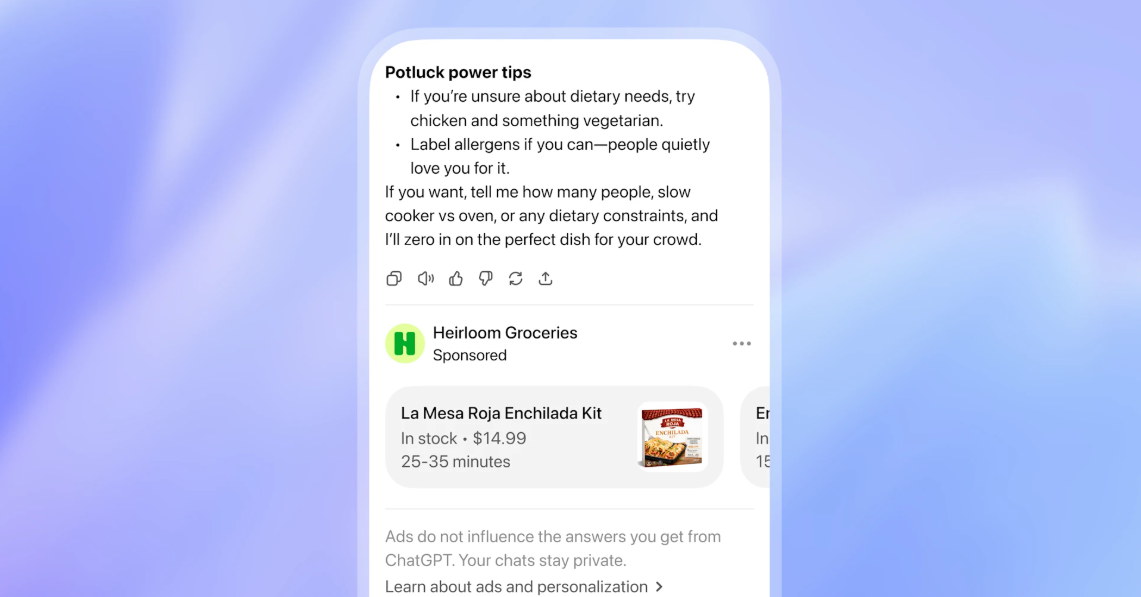
💡OpenAI is shifting its business model; learn how ad integration in ChatGPT impacts user privacy and platform usage.
⚡ 30-Second TL;DR
What Changed
OpenAI updated its privacy policy on June 10 regarding ad integration.
Why It Matters
This shift marks a significant change in OpenAI's monetization strategy for its consumer-facing products. It may influence how developers and businesses anticipate future ad-driven features in AI interfaces.
What To Do Next
Review your current usage of ChatGPT free tiers and assess how potential ad-tracking might affect your data privacy workflows.
Key Points
- •OpenAI updated its privacy policy on June 10 regarding ad integration.
- •The ad-supported model will apply to free and 'Go' plan users.
- •The new policy terms are scheduled to take effect on June 22.
🧠 Deep Insight
Background and context from public sources — not the original article. 17 sources cited.
🔑 Enhanced Key Takeaways
- •OpenAI's updated privacy policy for EU users, effective June 2, 2026, mandates that ads will only be served to users who explicitly opt-in, relying on consent as the legal basis for processing personal data under GDPR.
- •Users on Free and 'Go' plans who consent to personalized ads will receive them based on past chats, memory, and ad history, while those who do not consent will see generic, contextual ads based on conversation context, location, and time.
- •The ad-supported model has been piloted in the U.S. since February 2026, and has since expanded to the U.K., Australia, New Zealand, and Canada, with further international expansion planned.
- •Paid tiers, including Plus, Pro, Business, Enterprise, and Education plans, will remain ad-free, offering an incentive for users to upgrade for an uninterrupted experience.
- •OpenAI has established 'strict trust principles' for ads, ensuring they are visually and technically separate from model answers, conversations are not shared with advertisers, and sensitive topics like health or politics will not display ads.
📊 Competitor Analysis▸ Show
| Chatbot | Ad Status | Pricing Model | Key Integrations / Ecosystem | Unique Selling Points |
|---|---|---|---|---|
| OpenAI ChatGPT | Ads on Free & Go plans; opt-in for personalized ads. | Free (with ads), Go ($8/month with ads), Plus ($20/month, ad-free), Pro ($200/month, ad-free), Business, Enterprise, Education (ad-free). | Custom GPTs, API access. | Broad accessibility, strong general-purpose AI, custom GPTs. |
| Google Gemini | Reportedly coming in 2026; currently no ads in chats, but testing ads in Search's AI Mode. | Free (core features), Gemini Advanced (paid tier). | Deep integration with Google Workspace (Gmail, Docs, Calendar, Drive, Keep, Tasks). | Seamless integration with Google services, multimodal capabilities. |
| Microsoft Copilot | Pioneering advertising on generative AI experiences, including search ads since its release. | Free access to core chat, web search, image generation; Copilot Pro or enterprise licenses for deeper Microsoft 365 integration. | Deep integration with Microsoft 365 (Word, Excel, PowerPoint, Outlook, Teams), Windows, Azure OpenAI Service. | Enterprise focus, extensive integration with Microsoft ecosystem, specialized 'copilots' for various tasks. |
| Anthropic Claude | Public, explicit commitment to keeping ads out of conversations altogether. | Free tier, Claude Pro (paid tier). | Focus on safety and helpfulness. | Strong emphasis on safety and ethical AI, longer context windows for complex tasks. |
🛠️ Technical Deep Dive
- Ads are visually and technically separated from model answers and are clearly labeled as sponsored content.
- OpenAI utilizes marketing and ad-tracking cookies by default for free users to monitor user behavior for targeted advertising and to share limited identifiers with selected third-party marketing partners.
- User conversations with ChatGPT are maintained as private and are not shared with advertisers; advertisers only receive aggregated performance metrics such as total views or clicks.
- Ad personalization for Free and Go users, if consented, leverages information like ads previously interacted with and context from ongoing chats, without advertisers directly accessing personal details or chat history.
- OpenAI is developing its own campaign management platform, which operates similarly to traditional Google Ads, supporting CPC (Cost Per Click) and CPM (Cost Per Mille) campaigns, real-time bidding auctions, and second-price auctions.
- A conversion tracking system, implemented via a conversion pixel, can be installed on advertiser websites to measure post-click actions and campaign effectiveness.
- Sensitive topics, including health, politics, mental health, and conversations exhibiting vulnerable user-model interactions, are explicitly excluded from ad placements.
- Initial ad tests are concentrated on consumer verticals such as lifestyle, household goods, local services, travel, and digital products or education, with a planned gradual expansion into financial, healthcare, and legal services categories following manual review.
🔮 Future ImplicationsAI analysis grounded in cited sources
⏳ Timeline
📎 Sources (17)
Factual claims are grounded in the sources below. Forward-looking analysis is AI-generated interpretation.
Weekly AI Recap
Read this week's curated digest of top AI events →
👉Related Updates

AI-curated news aggregator. All content rights belong to original publishers.
Original source: ITmedia AI+ (日本) ↗
This is a summary, not the original. Read the source, or get the weekly briefing.
The weekly digest
One email a week. Unsubscribe anytime.