OpenAI Launches Codex Migration Campaign for Enterprise Users
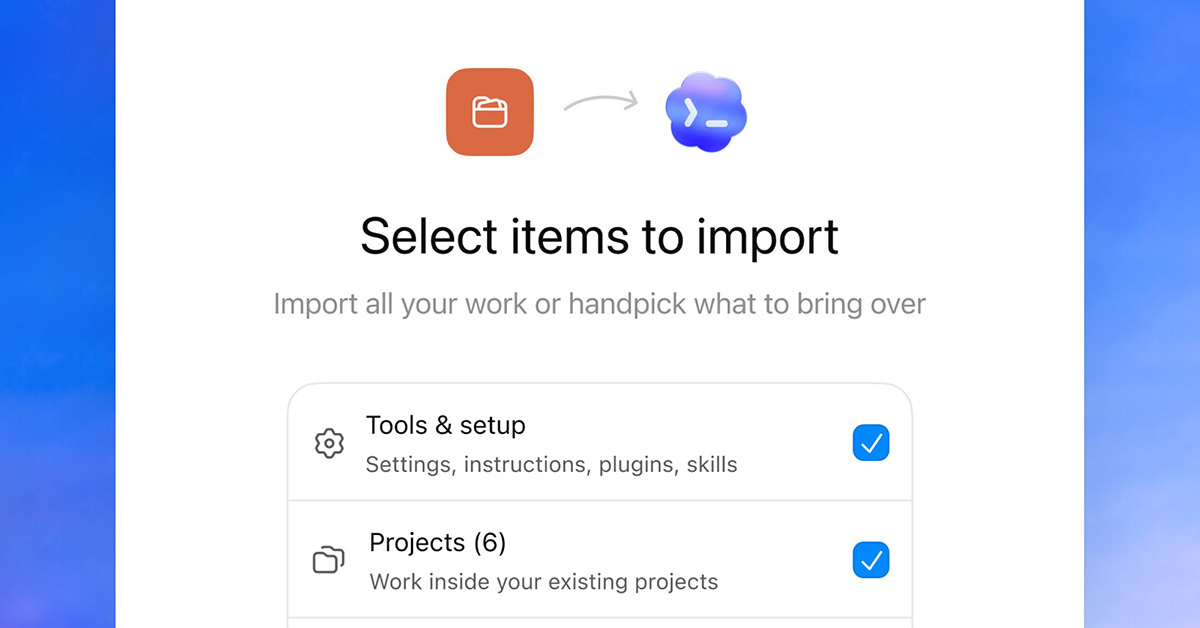
Leverage this limited-time offer to benchmark OpenAI's coding capabilities against your current dev tools for free.
30-Second TL;DR
What Changed
New enterprise customers receive 2 months of free access to Codex.
Why It Matters
This pricing strategy lowers the barrier for enterprises to test OpenAI's coding capabilities against their current workflows. It may trigger competitive pricing responses from other AI coding assistant providers.
What To Do Next
If your team uses a different coding assistant, request a demo of Codex now to leverage the 2-month free trial for a side-by-side performance comparison.
Key Points
- •New enterprise customers receive 2 months of free access to Codex.
- •The campaign is designed to incentivize switching from rival coding tools.
- •OpenAI is aggressively targeting the enterprise developer market.
Deep Insight
Background and context from public sources — not the original article. 34 sources cited.
Enhanced Key Takeaways
- •The migration campaign includes a limited-time offer providing $100 in credits for each new Codex-only team member, up to $500 per team, specifically for ChatGPT Business workspaces to encourage adoption.
- •OpenAI has introduced flexible pay-as-you-go pricing for "Codex-only seats" within ChatGPT Business and Enterprise plans, allowing teams to access Codex without a fixed seat fee and track costs based on token consumption.
- •This aggressive enterprise push aligns with OpenAI's broader 2026 strategic focus on "practical adoption," aiming to integrate AI into operational workflows rather than just experimental deployments, supported by the newly launched OpenAI Deployment Company.
- •Codex has evolved significantly from its 2021 iteration as a code completion tool to a full autonomous software engineering agent (launched in May 2025) capable of executing high-level development tasks, including writing features, fixing bugs, running tests, and proposing pull requests within a secure cloud sandbox.
- •OpenAI is actively expanding partnerships with major global consulting and systems integration firms (e.g., Accenture, Capgemini, McKinsey) and launching "Codex Labs" to embed specialists directly within customer organizations to facilitate deep integration and deployment of Codex.
Competitor Analysis
- OpenAI Codex
- Autonomous AI coding agent, multi-surface (CLI, IDE, web, desktop), computer operation, plugins/automations.
- GitHub Copilot Enterprise
- AI pair programmer, real-time code completion, chat, PR summarization, agentic (Copilot Workspace), deep Microsoft ecosystem integration.
- Amazon Q Developer (CodeWhisperer)
- AI-powered code generation, native AWS service integration, security scanning, IP indemnity.
- Anthropic Claude Code
- Agentic CLI coding tool, autonomous codebase navigation, multi-file editing, runs in terminal.
- Google Gemini Code Assist
- Agentic development platform, multimodal understanding (text, images, audio, video, code), integrated with Google ecosystem.
- OpenAI Codex
- Large-scale transformer, descended from GPT-3, fine-tuned for code; powered by
codex-1(o3 derivative), uses GPT-5.x-Codex models. - GitHub Copilot Enterprise
- Uses GPT-4 for Copilot X features; supports multiple leading LLMs for optimization.
- Amazon Q Developer (CodeWhisperer)
- Machine learning service, tuned for AWS services.
- Anthropic Claude Code
- Powered by Claude Opus 4.7 and Sonnet.
- Google Gemini Code Assist
- Powered by Gemini models.
- OpenAI Codex
- Up to ~192k tokens.
- GitHub Copilot Enterprise
- 128,000 tokens across main models.
- Amazon Q Developer (CodeWhisperer)
- Up to 200,000 tokens.
- Anthropic Claude Code
- Enhanced 500k context window in Claude Sonnet 4.
- Google Gemini Code Assist
- Multimodal understanding across complex documents and code repositories.
- OpenAI Codex
- Included in ChatGPT Business ($20-$25/user/month annually or pay-as-you-go for Codex-only seats), Enterprise (custom). API: e.g.,
gpt-5.1-codex-miniat $0.25 input / $2.00 output per 1M tokens. - GitHub Copilot Enterprise
- Business: $19/user/month; Enterprise: $39/user/month. Moving to usage-based AI Credits billing on June 1, 2026.
- Amazon Q Developer (CodeWhisperer)
- Pro: $19/user/month (includes 1,000 agentic requests, 4,000 lines of code transformation). Free for individuals.
- Anthropic Claude Code
- Usage-based / Subscription tiers (Pro/Max subscriptions).
- Google Gemini Code Assist
- Integrated with Google Cloud/Gemini platform; specific enterprise pricing not detailed in search results.
- OpenAI Codex
- 70.2% accuracy with multiple retries on internal tasks; 85% on SWE-Bench (8 attempts). GPT-5.3-Codex improved SWE-Bench Pro.
- GitHub Copilot Enterprise
- 35% average acceptance rate for AI code suggestions (across all languages).
- Amazon Q Developer (CodeWhisperer)
- Not explicitly detailed in search results, but tuned for AWS.
- Anthropic Claude Code
- Claude Opus 4 leads in coding performance on SWE-bench and Terminal-bench.
- Google Gemini Code Assist
- Not explicitly detailed in search results.
| Feature/Category | OpenAI Codex | GitHub Copilot Enterprise | Amazon Q Developer (CodeWhisperer) | Anthropic Claude Code | Google Gemini Code Assist |
|---|---|---|---|---|---|
| Core Capability | Autonomous AI coding agent, multi-surface (CLI, IDE, web, desktop), computer operation, plugins/automations. | AI pair programmer, real-time code completion, chat, PR summarization, agentic (Copilot Workspace), deep Microsoft ecosystem integration. | AI-powered code generation, native AWS service integration, security scanning, IP indemnity. | Agentic CLI coding tool, autonomous codebase navigation, multi-file editing, runs in terminal. | Agentic development platform, multimodal understanding (text, images, audio, video, code), integrated with Google ecosystem. |
| Model Architecture | Large-scale transformer, descended from GPT-3, fine-tuned for code; powered by codex-1 (o3 derivative), uses GPT-5.x-Codex models. | Uses GPT-4 for Copilot X features; supports multiple leading LLMs for optimization. | Machine learning service, tuned for AWS services. | Powered by Claude Opus 4.7 and Sonnet. | Powered by Gemini models. |
| Context Window | Up to ~192k tokens. | 128,000 tokens across main models. | Up to 200,000 tokens. | Enhanced 500k context window in Claude Sonnet 4. | Multimodal understanding across complex documents and code repositories. |
| Pricing (Enterprise) | Included in ChatGPT Business ($20-$25/user/month annually or pay-as-you-go for Codex-only seats), Enterprise (custom). API: e.g., gpt-5.1-codex-mini at $0.25 input / $2.00 output per 1M tokens. | Business: $19/user/month; Enterprise: $39/user/month. Moving to usage-based AI Credits billing on June 1, 2026. | Pro: $19/user/month (includes 1,000 agentic requests, 4,000 lines of code transformation). Free for individuals. | Usage-based / Subscription tiers (Pro/Max subscriptions). | Integrated with Google Cloud/Gemini platform; specific enterprise pricing not detailed in search results. |
| Benchmarks/Performance | 70.2% accuracy with multiple retries on internal tasks; 85% on SWE-Bench (8 attempts). GPT-5.3-Codex improved SWE-Bench Pro. | 35% average acceptance rate for AI code suggestions (across all languages). | Not explicitly detailed in search results, but tuned for AWS. | Claude Opus 4 leads in coding performance on SWE-bench and Terminal-bench. | Not explicitly detailed in search results. |
Technical Deep Dive
- Model Architecture: Codex is built on a large-scale transformer neural network architecture, a descendant of GPT-3, extensively fine-tuned for code understanding and generation.
- Core Model: The current implementation is powered by
codex-1, a version of OpenAI'so3AI reasoning model specifically optimized for software engineering tasks. It also leverages more advanced Codex-specific models like GPT-5.3-Codex, GPT-5.2-Codex, GPT-5.1-Codex, andcodex-mini-latest, alongside general-purpose frontier models like GPT-5.5 and GPT-5.4. - Context Management: Codex boasts a massive context window, up to approximately 192,000 tokens, enabling it to ingest and reason about large codebases, including multiple files or an entire repository's context.
- Execution Environment: It operates as a cloud-based software engineering agent that runs tasks within a secure, isolated cloud sandbox environment. This allows it to compile, execute code, run tests, linters, and issue shell commands without directly interacting with production infrastructure.
- Agentic Capabilities: The system employs a sophisticated agent loop architecture that orchestrates interactions between users, language models, and various tools. This iterative process manages inference calls, tool execution, and conversation state to perform high-level development tasks autonomously.
- Multi-Surface Access: Codex is accessible through multiple interfaces, including a Command Line Interface (CLI), Integrated Development Environment (IDE) extensions (for VS Code, Cursor, Windsurf, JetBrains, Apple's Xcode), a web application, and dedicated macOS/Windows desktop applications.
- App Server Architecture: OpenAI has published a detailed architecture for the Codex App Server, a bidirectional JSON-RPC protocol that decouples the core agent logic from its various client surfaces, ensuring a single, stable API powers all Codex experiences.
- Advanced Features: Technical achievements include stateless request handling for Zero Data Retention compliance, strategic prompt caching for performance optimization, automatic context window management through intelligent compaction, and robust handling of multi-turn conversations.
- Computer Use Capability: Codex can operate a computer by seeing, clicking, and typing across applications, bypassing traditional API limits and acting as a universal automation engine.
- Controlled Internet Access: It offers toggleable internet access with per-domain allow lists, enabling tasks to fetch external documentation or packages securely.
Future ImplicationsAI analysis grounded in cited sources
Timeline
- 2021-08OpenAI introduces original Codex model, a GPT-3 descendant, powering GitHub Copilot.
- 2023-03OpenAI deprecates original Codex models from its API; GitHub Copilot transitions to GPT-4.
- 2025-05OpenAI launches a new, autonomous Codex as a full software engineering agent.
- 2025-06OpenAI releases significant upgrades to Codex, including best-of-n solutions, controlled internet access, and a `codex-mini` pricing tier.
- 2025-12OpenAI ships GPT-5.2-Codex, a new coding model optimized for multi-file work and defensive cybersecurity.
- 2026-01OpenAI's CFO outlines the company's 2026 focus on 'practical adoption' in enterprise and a shift towards value-based pricing.
- 2026-02OpenAI publishes detailed architecture for the Codex App Server, decoupling core logic from client surfaces.
- 2026-04OpenAI introduces pay-as-you-go pricing for Codex-only seats and offers $100 credits for new team members in ChatGPT Business workspaces.
- 2026-05OpenAI launches the OpenAI Deployment Company, backed by over $4 billion, to embed AI engineers directly into customer environments.
Sources (34)
Factual claims are grounded in the sources below. Forward-looking analysis is AI-generated interpretation.
Weekly AI Recap
Read this week's curated digest of top AI events →
Related Updates
AI-curated news aggregator. All content rights belong to original publishers.
Original source: ITmedia AI+ (日本) ↗
This is a summary, not the original. Read the source, or get the weekly briefing.
The weekly digest
One email a week. Unsubscribe anytime.