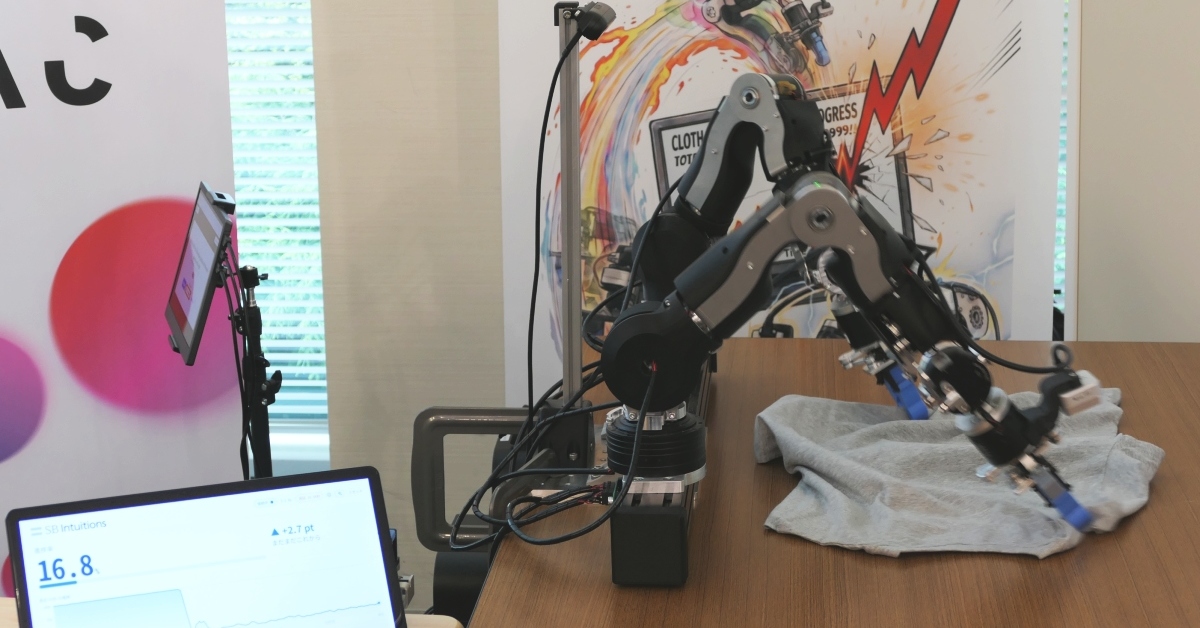
OakFruit Unveils 'Instinct-Driven' Embodied AI Paradigm

💡A novel bottom-up approach to embodied AI that challenges traditional robotics control architectures.
⚡ 30-Second TL;DR
What Changed
Introduces a bottom-up approach to embodied intelligence.
Why It Matters
This research could simplify how robots handle complex, unstructured environments by mimicking biological instinct rather than relying solely on pre-programmed logic.
What To Do Next
Follow OakFruit's research papers to understand how their instinct-driven model handles sensor fusion compared to traditional RL methods.
Key Points
- •Introduces a bottom-up approach to embodied intelligence.
- •Focuses on 'instinct-driven' mechanisms for robot decision-making.
- •Aims to create a new paradigm for autonomous robotic behavior.
🧠 Deep Insight
Background and context from public sources — not the original article. 10 sources cited.
🔑 Enhanced Key Takeaways
- •The 'instinct-driven' paradigm for embodied AI emphasizes a bottom-up, developmental approach, starting with low-level behaviors and sensorimotor learning, rather than relying solely on predefined cognitive models or top-down instructions.
- •This approach views cognition as emerging from continuous interaction between a physical agent and its environment, challenging traditional instruction-driven paradigms in human-robot collaboration.
- •The integration of AI foundation models and multimodal large models (MLMs) is crucial for enhancing the cognitive and operational capabilities of embodied AI, enabling better perception, interaction, and reasoning in dynamic environments.
- •Key technical advancements supporting this paradigm include sim-to-real transfer, imitation learning, and foundation-model pre-training on video, which collectively accelerate robot learning and enable robust real-world capabilities from simulated training.
- •Embodied AI systems, particularly those with instinct-driven mechanisms, are expected to exhibit human-like adaptability, versatility, and autonomy, moving beyond rigid, rules-based automation towards more agile, software-defined processes.
🛠️ Technical Deep Dive
- Bottom-Up Architecture: Focuses on developing intelligence from basic sensorimotor interactions and reflexes, gradually building towards more complex cognitive functions, akin to biological development.
- Multimodal Data Integration: Requires scaling up multimodal data (vision, language, pressure, temperature) to train AI foundation models, enabling comprehensive environmental understanding, especially in open-world scenarios.
- Continuous Learning and Adaptation: Systems are designed for automatic data collection and continuous learning, allowing them to adapt to diverse and evolving tasks over time.
- Foundation Models for Embodied Agents: Utilizes Multi-modal Large Models (MLMs) and World Models (WMs) as promising architectures to provide robust perception, interaction, and reasoning capabilities for embodied agents.
- Distributed Computing (e.g., Robot-to-Cloud): Architectures like Huawei's R2C protocol distribute computing tasks across end, edge, and cloud tiers to manage large-scale AI model training, real-time inference, and low-latency motion control, optimizing power consumption and responsiveness.
- Zero Embodiment Gap: Emphasizes training AI on the specific sensors and actuators of the robot it will control, often leveraging teleoperations and simulations to generate high-quality data for real-world understanding.
- Neuromorphic Computing Potential: Explores neuromorphic systems for embodied intelligence due to their potential superiority in power consumption, speed, and accuracy compared to conventional AI approaches.
🔮 Future ImplicationsAI analysis grounded in cited sources
📎 Sources (10)
Factual claims are grounded in the sources below. Forward-looking analysis is AI-generated interpretation.
Weekly AI Recap
Read this week's curated digest of top AI events →
👉Related Updates

AI-curated news aggregator. All content rights belong to original publishers.
Original source: 量子位 ↗
This is a summary, not the original. Read the source, or get the weekly briefing.
The weekly digest
One email a week. Unsubscribe anytime.