NVIDIA’s AI Chip Moat Faces a Siege
💡Cloud giants and AI labs are building alternatives, but NVIDIA’s software and supply-chain advantages remain formidable.
⚡ 30-Second TL;DR
What Changed
NVIDIA still controls roughly 90% of the AI accelerator market, while AMD’s data-center revenue reached $6.7 billion after growing more than 100%.
Why It Matters
The competitive landscape is shifting from a single-GPU market toward a mix of GPUs, inference accelerators, and customer-specific ASICs. Developers may gain more hardware options and negotiating leverage, but fragmented software stacks and continued NVIDIA dependence will complicate migration.
What To Do Next
Benchmark one representative inference service on NVIDIA CUDA, AMD ROCm, and a cloud TPU or custom-ASIC instance before committing your next capacity expansion.
Key Points
- •NVIDIA still controls roughly 90% of the AI accelerator market, while AMD’s data-center revenue reached $6.7 billion after growing more than 100%.
- •Google, Amazon, and Meta are developing custom ASICs and increasingly exploring sales beyond their own cloud platforms.
- •OpenAI is co-developing the Jalapeno chip with Broadcom, while Anthropic is contracting for accelerators from Google, Amazon, and AMD.
- •Around 150 companies are reportedly developing more than 200 AI semiconductor designs, especially for inference workloads.
- •NVIDIA’s high-end accelerators sell for roughly $30,000 per chip and carry margins near 75%, intensifying incentives for alternatives.
🧠 Deep Insight
Background and context from public sources — not the original article. 11 sources cited.
🔑 Enhanced Key Takeaways
- •NVIDIA's market share has shifted from the previously cited 90% to approximately 75% as of August 2026, reflecting the maturation of alternative silicon options.
- •The total addressable market for data center AI semiconductors is forecasted to reach $563 billion by 2028, with networking components projected to capture 21% of that total.
- •NVIDIA has officially entered full production of the 'Groq 3 LPX' accelerator, a specialized chip designed specifically for high-speed token generation in agentic AI workflows.
- •Sovereign AI initiatives, involving multi-gigawatt national infrastructure projects, have emerged as a primary demand driver, diversifying NVIDIA's customer base beyond traditional hyperscalers.
- •NVIDIA's valuation is currently under intense investor scrutiny, with a price-to-sales ratio of 21, significantly higher than the 4x sector average, ahead of the August 2026 earnings report.
📊 Competitor Analysis▸ Show
| Feature | NVIDIA (Blackwell/GB200) | AMD (Instinct MI300X) | Hyperscaler ASICs (e.g., AWS Trainium) |
|---|---|---|---|
| Primary Focus | General Purpose AI/Training | High-Memory Training/Inference | Cost-Optimized Inference |
| Software Ecosystem | CUDA (Industry Standard) | ROCm (Open Source) | Proprietary/Cloud-Specific |
| Market Position | Premium/Dominant | Performance/Value | Vertical Integration |
🛠️ Technical Deep Dive
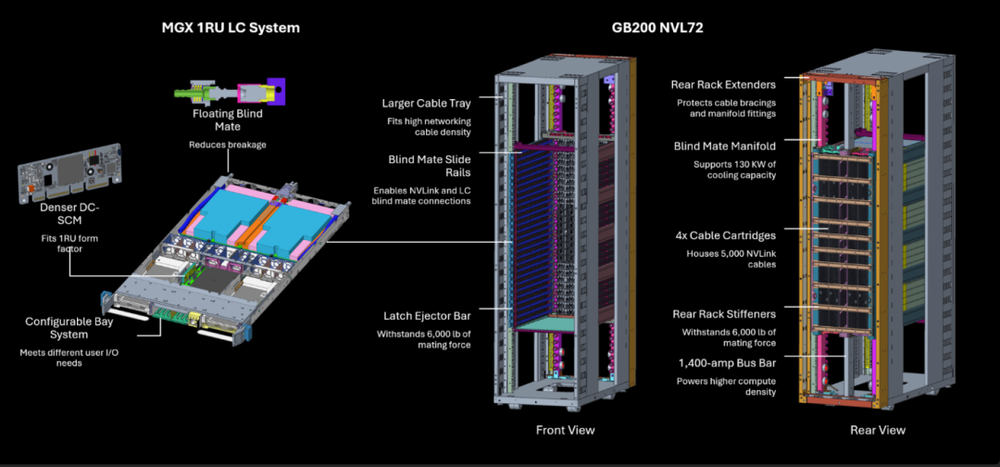
- Blackwell (GB200) architecture utilizes a multi-die design to overcome reticle limits, integrating high-bandwidth memory (HBM3e) for massive throughput.
- Groq 3 LPX utilizes a specialized architecture optimized for low-latency token generation, specifically targeting agentic AI inference rather than large-scale model training.
- Networking components are increasingly integrated into the AI stack, with NVIDIA's InfiniBand and Ethernet solutions now accounting for a critical portion of the data center performance profile.
- Supply chain constraints for the Blackwell ramp-up have been resolved, allowing for high-volume shipments of the GB200 platform as of Q3 2026.
🔮 Future ImplicationsAI analysis grounded in cited sources
⏳ Timeline
📎 Sources (11)
Factual claims are grounded in the sources below. Forward-looking analysis is AI-generated interpretation.
Weekly AI Recap
Read this week's curated digest of top AI events →
👉Related Updates
AI-curated news aggregator. All content rights belong to original publishers.
Original source: 虎嗅 ↗
This is a summary, not the original. Read the source, or get the weekly briefing.
Weekly AI briefing
One email a week. Unsubscribe anytime.