AI Data Centers Turn to Water Cooling
💡A 120 kW AI rack makes air cooling obsolete—see the liquid and immersion systems replacing it.
⚡ 30-Second TL;DR
What Changed
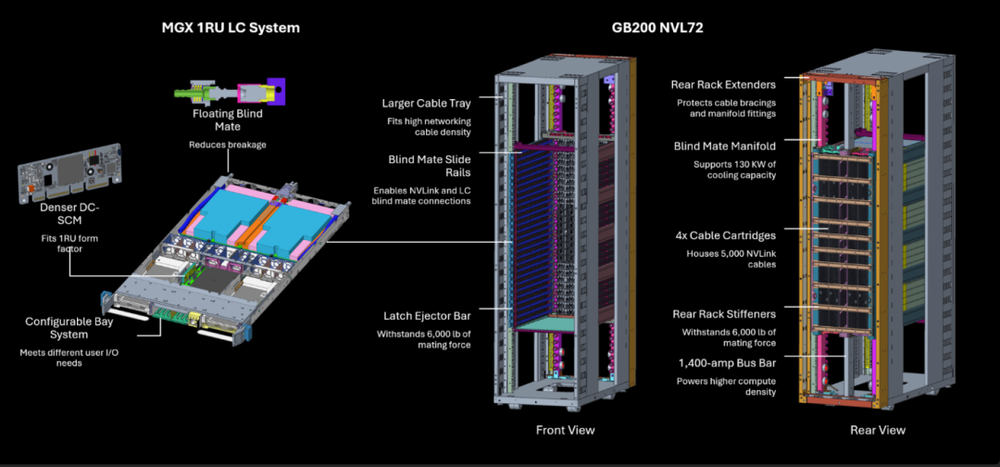
NVIDIA GB200 NVL72 can integrate 72 GPUs and 36 CPUs in a single rack weighing about 1.3 tons.
Why It Matters
Cooling is becoming a core constraint for AI infrastructure deployment, affecting rack design, facility construction, maintenance procedures, and data-center location. Liquid cooling also creates new opportunities for suppliers of cold plates, connectors, CDUs, pumps, heat exchangers, and outdoor heat-rejection equipment.
What To Do Next
Add rack-level thermal design to your next AI deployment plan and compare cold-plate, rear-door, and immersion cooling against GPU power density and facility water capacity.
Key Points
- •NVIDIA GB200 NVL72 can integrate 72 GPUs and 36 CPUs in a single rack weighing about 1.3 tons.
- •Cold-plate liquid cooling transfers heat from GPUs and CPUs into treated water or water-based coolant.
- •Liquid-cooling quick connectors allow servers to be safely inserted and removed without spilling coolant.
- •CDUs isolate sensitive server-side coolant loops from building-side cooling systems while managing flow, pressure, air, and leaks.
- •Two-phase immersion cooling submerges entire servers in nonconductive fluorinated fluid that boils and condenses in a closed loop.
🧠 Deep Insight
Background and context from public sources — not the original article. 11 sources cited.
🔑 Enhanced Key Takeaways
- •Liquid cooling market penetration in data centers is projected to grow from 3% in 2021 to 37% by the end of 2026.
- •Direct-to-chip cooling technology is currently the industry standard, capable of removing 60–80% of the heat generated by high-performance AI accelerators.
- •The industry is transitioning its primary sustainability metric from Power Usage Effectiveness (PUE) to Water Usage Effectiveness (WUE) to address environmental concerns.
- •Cold plate cooling currently holds a 70% market share within the liquid cooling sector due to its high compatibility with existing server infrastructure.
- •Modern AI data center designs are rapidly scaling, with current deployments reaching 900 kW per rack and future designs targeting 2.2 MW per rack.
📊 Competitor Analysis▸ Show
| Company | Cooling Specialization | Market Focus |
|---|---|---|
| Vertiv | Integrated Infrastructure | Large-scale enterprise & hyperscale |
| Schneider Electric | Thermal Management Systems | Global data center cooling |
| CoolIT Systems | Direct-to-Chip Liquid Cooling | High-density server integration |
| Submer | Immersion Cooling | Ultra-high-density & edge |
| LiquidStack | Two-Phase Immersion | High-performance computing |
| Asperitas | Immersion Cooling | Sustainable/low-PUE solutions |
🛠️ Technical Deep Dive
- Direct-to-chip cooling utilizes metal cold plates mounted directly onto CPUs and GPUs to facilitate conductive heat transfer.
- Two-phase immersion cooling leverages the latent heat of vaporization of dielectric fluids to achieve superior heat dissipation compared to single-phase systems.
- CDUs (Coolant Distribution Units) act as the primary interface between the secondary server-side loop and the primary facility-side water loop, providing filtration and pressure regulation.
- Rear-door heat exchangers (RDHx) function as passive or active radiators mounted on the back of server racks to capture heat rejected into the air before it enters the room.
- Dielectric fluids used in immersion cooling are engineered to be non-conductive and chemically inert to prevent electrical shorts and component corrosion.
🔮 Future ImplicationsAI analysis grounded in cited sources
⏳ Timeline
📎 Sources (11)
Factual claims are grounded in the sources below. Forward-looking analysis is AI-generated interpretation.
Weekly AI Recap
Read this week's curated digest of top AI events →
👉Related Updates


AI-curated news aggregator. All content rights belong to original publishers.
Original source: 虎嗅 ↗
This is a summary, not the original. Read the source, or get the weekly briefing.
Weekly AI briefing
One email a week. Unsubscribe anytime.