Nvidia Unveils OpenClaw Strategy

💡Nvidia's $1T AI chip forecast + must-have OpenClaw strategy revealed.
⚡ 30-Second TL;DR
What Changed
Jensen Huang projects $1T AI chip sales through 2027
Why It Matters
Nvidia reinforces its AI chip market leadership with ambitious forecasts, urging businesses to adopt tailored AI strategies. This could accelerate enterprise AI adoption while intensifying competition in hardware.
What To Do Next
Watch Nvidia GTC keynote replay to learn OpenClaw strategy details.
Key Points
- •Jensen Huang projects $1T AI chip sales through 2027
- •Introduced 'OpenClaw strategy' for all companies
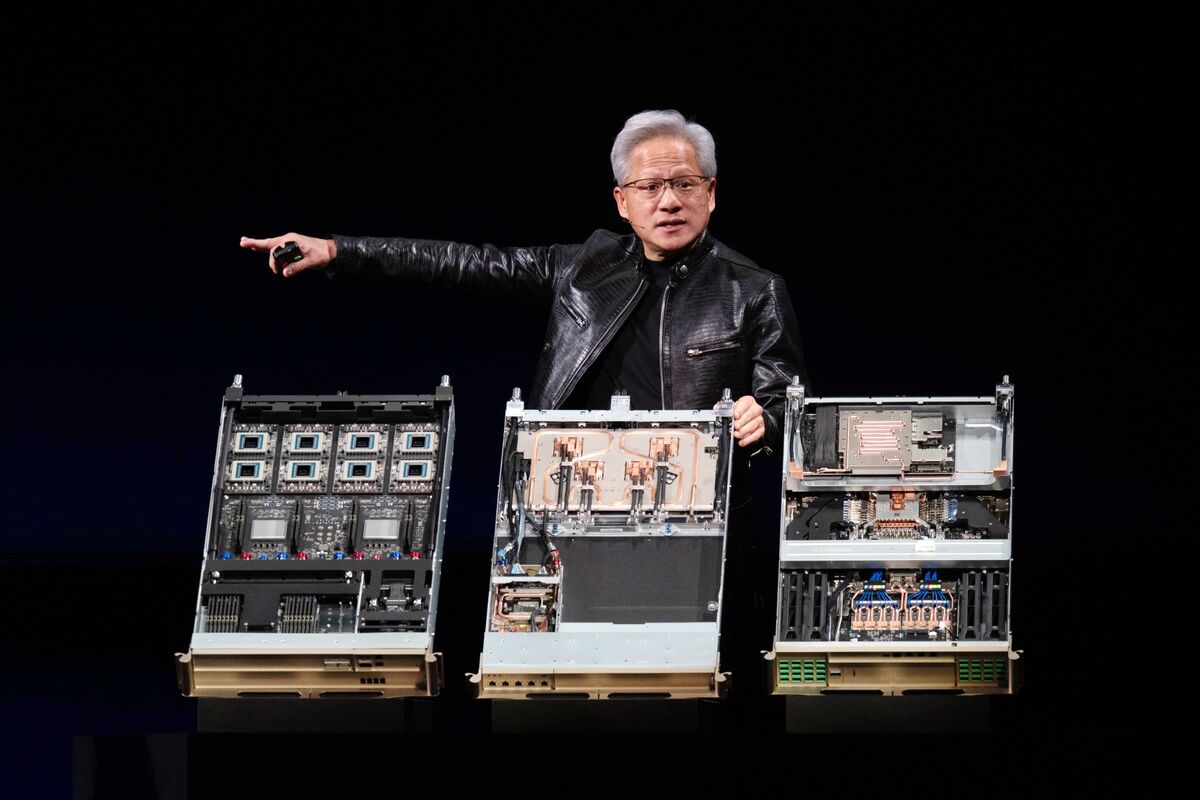
- •2.5-hour GTC keynote in signature leather jacket
- •Closed with rambling Olaf robot demo
🧠 Deep Insight
Background and context from public sources — not the original article. 12 sources cited.
🔑 Enhanced Key Takeaways
- •OpenClaw is an open-source 'agentic operating system' that reached 318,000 GitHub stars in 60 days, establishing a standardized middleware for autonomous AI agents to reason, plan, and execute multi-step tasks.
- •The 'Vera Rubin' R100 GPU features 288GB of HBM4 memory and 22TB/s bandwidth, enabling a 10x reduction in inference token costs and 5x faster FP4 performance compared to the Blackwell architecture.
- •Nvidia introduced 'NemoClaw' and 'OpenShell' as a proprietary security stack to provide sandboxed execution and policy guardrails, specifically addressing 'ClawJacked' zero-click exploits found in unchaperoned agent deployments.
- •The Olaf robot demo utilized the new 'Newton' physics engine and 'Kamino' simulator to achieve 'Zero-Shot Physical Intuition,' allowing the 33-pound autonomous snowman to balance on unstable surfaces like moving boats.
📊 Competitor Analysis▸ Show
| Feature | Nvidia Rubin (R100) | AMD Instinct MI400 | Groq 3 LPU (Rack) |
|---|---|---|---|
| Memory | 288GB HBM4 | 256GB HBM4 | 128GB SRAM (Aggregate) |
| Memory Bandwidth | 22 TB/s | 18 TB/s | 640 TB/s (Scale-up) |
| FP4 Compute | 50 PFLOPS | 32 PFLOPS | Ultra-low latency (N/A) |
| Interconnect | NVLink 6 (3.6 TB/s) | Infinity Fabric 4.0 | Direct-to-SRAM Fabric |
| Process Node | TSMC 3nm (N3P) | TSMC 3nm | TSMC 4nm |
🛠️ Technical Deep Dive
- •Rubin R100 Architecture: Built on TSMC 3nm process with 336 billion transistors and a 6th-gen Transformer Engine.
- •Vera CPU: Features 88 'Olympus' cores with spatial multi-threading (176 threads), delivering 2x the performance of the previous Grace CPU.
- •NVLink 6 Switch: Provides 3.6TB/s all-to-all bidirectional bandwidth per GPU for massive scale-up in agentic AI factories.
- •Newton Physics Engine: A GPU-accelerated physics solver co-developed with Disney Research and Google DeepMind to bridge the 'sim-to-real' gap for expressive robotics.
- •Jetson Thor SoC: The robotic 'brain' inside Olaf, delivering 800 TFLOPS of 8-bit floating point performance with an integrated functional safety processor.
🔮 Future ImplicationsAI analysis grounded in cited sources
⏳ Timeline
📎 Sources (12)
Factual claims are grounded in the sources below. Forward-looking analysis is AI-generated interpretation.
Weekly AI Recap
Read this week's curated digest of top AI events →
👉Related Updates

AI-curated news aggregator. All content rights belong to original publishers.
Original source: TechCrunch AI ↗
This is a summary, not the original. Read the source, or get the weekly briefing.
Weekly AI briefing
One email a week. Unsubscribe anytime.