Nvidia Targets More Compute Within Fixed Power Budgets
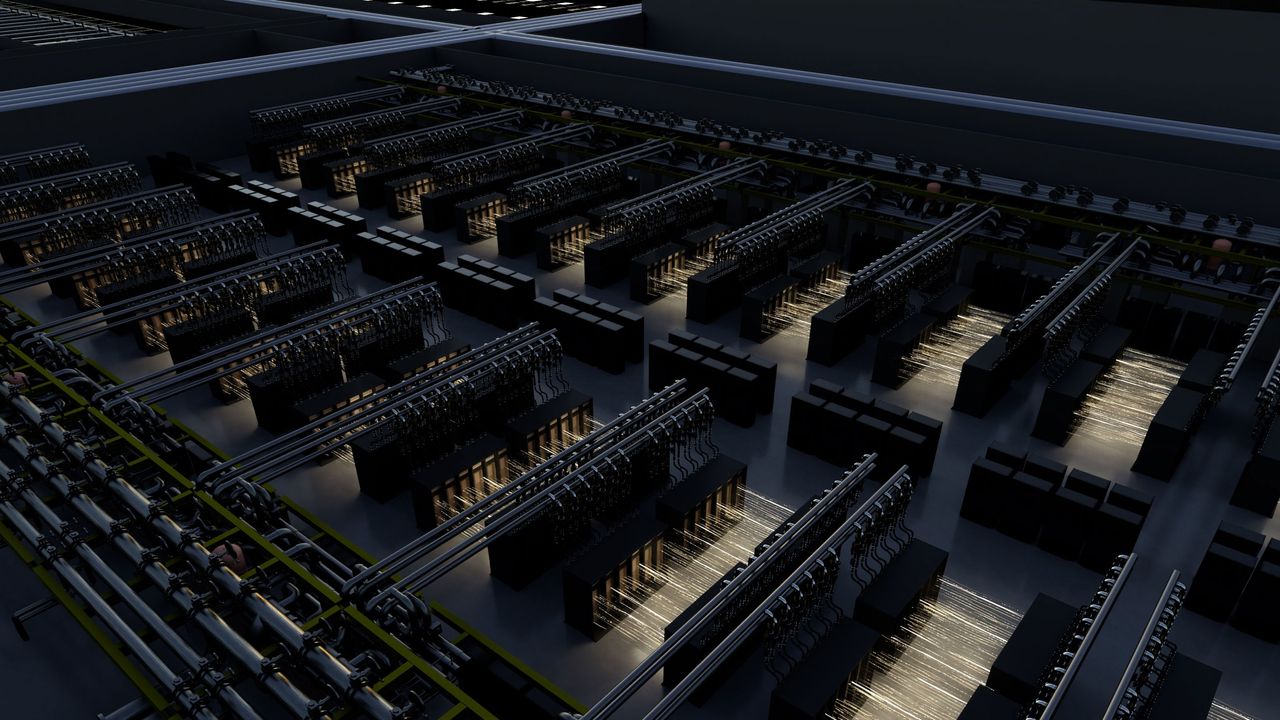
💡Nvidia’s power-management strategy could determine how much AI compute fits inside today’s data centers.
⚡ 30-Second TL;DR
What Changed
Nvidia treats facility power as a hard limit on data-center capacity
Why It Matters
Power-aware infrastructure could let AI operators deploy more useful compute without immediately expanding facility power capacity. This makes site-level power management increasingly important for scaling GPU clusters and AI workloads.
What To Do Next
Add a 100MW-style facility power constraint to your AI cluster capacity model and evaluate whether power-aware scheduling can increase usable GPU throughput.
Key Points
- •Nvidia treats facility power as a hard limit on data-center capacity
- •DSX MaxLPS aims to maximize compute under fixed site power budgets
- •Vera Rubin NVL72 was evaluated against an example 100MW facility budget
🧠 Deep Insight
Background and context from public sources — not the original article. 8 sources cited.
🔑 Enhanced Key Takeaways
- •DSX MaxLPS enables data center operators to provision up to 40% more GPUs within an existing megawatt power budget by managing power distribution at the GPU, rack, and workload levels.
- •The Vera Rubin NVL72 platform achieves a 30x increase in work-per-watt efficiency compared to previous generations, specifically targeting lower costs per million tokens.
- •Nvidia has transitioned to 800 VDC (Volts Direct Current) power architectures for its AI factories to minimize conversion losses and scale compute in power-constrained environments.
- •The hardware is optimized for 45°C liquid-cooling inlet temperatures, allowing facilities to utilize 'free cooling' methods and reduce dependence on energy-intensive mechanical chillers.
- •Nvidia is integrating grid-responsive infrastructure through partnerships with firms like Lancium, allowing AI data centers to dynamically adjust power consumption based on real-time electrical grid conditions.
📊 Competitor Analysis▸ Show
| Feature | Nvidia Vera Rubin NVL72 | Competitor (General) |
|---|---|---|
| Power Architecture | 800 VDC Native | Standard AC/48V DC |
| Cooling Inlet Temp | 45°C (High-temp) | 20-30°C (Standard) |
| Efficiency Metric | 30x Work-per-Watt | Varies by generation |
| Power Management | DSX MaxLPS (Full-stack) | Manual/Rack-level only |
🛠️ Technical Deep Dive
- DSX MaxLPS: Implements software-defined power steering to dynamically balance energy loads across the entire AI factory infrastructure.
- NVFP4 Quantization: Utilizes 4-bit precision to significantly reduce memory footprint and increase throughput for large-scale AI models.
- Fused CUDA Kernels: Employs technologies like MegaMoE to combine computation and communication operations, ensuring higher GPU utilization rates.
- Power Distribution: Shifts from traditional AC power delivery to 800 VDC to improve efficiency in high-density AI clusters.
- Cooling: Designed for high-temperature liquid cooling loops (45°C) to eliminate the need for traditional chiller-based cooling systems.
🔮 Future ImplicationsAI analysis grounded in cited sources
⏳ Timeline
📎 Sources (8)
Factual claims are grounded in the sources below. Forward-looking analysis is AI-generated interpretation.
Weekly AI Recap
Read this week's curated digest of top AI events →
👉Related Updates

AI-curated news aggregator. All content rights belong to original publishers.
Original source: Tom's Hardware ↗
This is a summary, not the original. Read the source, or get the weekly briefing.
Weekly AI briefing
One email a week. Unsubscribe anytime.