Nvidia offers AI startups compute now, pay later
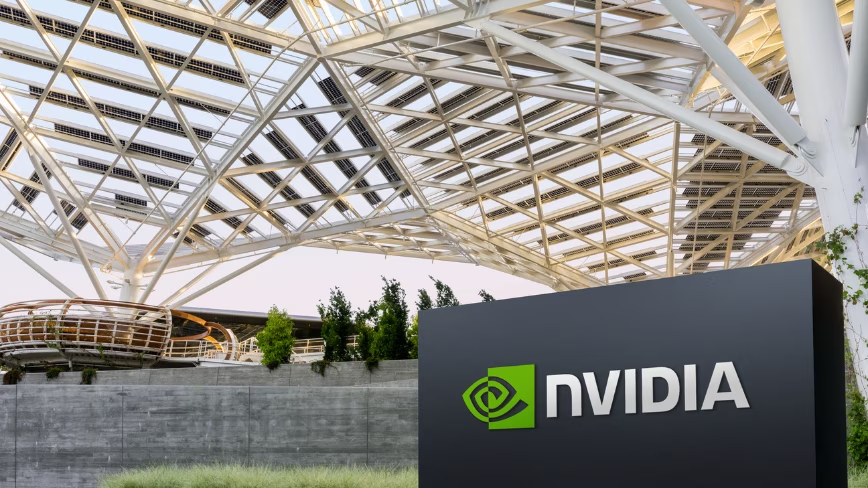
Lower your infrastructure burn rate; find out if your startup qualifies for Nvidia's new compute credit model.
30-Second TL;DR
What Changed
Nvidia shifts payment model to revenue-sharing and credit-support
Why It Matters
This move will likely accelerate the growth of AI startups by removing the primary bottleneck of infrastructure costs. It strengthens Nvidia's dominance by embedding their hardware deeper into the startup ecosystem.
What To Do Next
Check if your cloud provider is participating in Nvidia's new credit program to reduce your monthly GPU overhead.
Key Points
- •Nvidia shifts payment model to revenue-sharing and credit-support
- •Designed to help startups access GPUs without massive upfront capital
- •Targets AI cloud providers to expand the ecosystem
Deep Insight
AI-generated analysis for this event — not the original article.
Enhanced Key Takeaways
- •Nvidia's initiative leverages the 'Nvidia Inception' program, which provides startups with technical training, go-to-market support, and hardware discounts as a prerequisite for these credit-based models.
- •The program specifically targets GPU-as-a-Service (GPUaaS) providers, enabling them to act as intermediaries that absorb initial infrastructure costs while passing compute access to startups.
- •This strategy effectively creates a 'compute-backed' currency, where Nvidia's hardware acts as the underlying asset for venture-debt-like financing arrangements.
- •The model is designed to mitigate the 'GPU famine' by incentivizing smaller cloud providers to scale their infrastructure using Nvidia's H100 and Blackwell-class clusters without immediate cash outlays.
- •Nvidia is integrating this financial model with its 'DGX Cloud' platform, allowing startups to transition seamlessly from credit-based access to dedicated, enterprise-grade private instances as they scale.
Competitor Analysis
- Nvidia (Credit/Rev-Share)
- Revenue-sharing/Deferred payment
- AWS (Startup Credits)
- Grant-based credits
- Google Cloud (AI Credits)
- Grant-based credits
- Nvidia (Credit/Rev-Share)
- Exclusive Nvidia H100/Blackwell
- AWS (Startup Credits)
- Mixed (Nvidia/Trainium/Inferentia)
- Google Cloud (AI Credits)
- Mixed (Nvidia/TPU)
- Nvidia (Credit/Rev-Share)
- High (Scales with revenue)
- AWS (Startup Credits)
- Low (Fixed credit caps)
- Google Cloud (AI Credits)
- Low (Fixed credit caps)
- Nvidia (Credit/Rev-Share)
- AI-native startups/GPUaaS
- AWS (Startup Credits)
- General cloud adoption
- Google Cloud (AI Credits)
- General cloud adoption
| Feature | Nvidia (Credit/Rev-Share) | AWS (Startup Credits) | Google Cloud (AI Credits) |
|---|---|---|---|
| Primary Model | Revenue-sharing/Deferred payment | Grant-based credits | Grant-based credits |
| Hardware Access | Exclusive Nvidia H100/Blackwell | Mixed (Nvidia/Trainium/Inferentia) | Mixed (Nvidia/TPU) |
| Flexibility | High (Scales with revenue) | Low (Fixed credit caps) | Low (Fixed credit caps) |
| Target | AI-native startups/GPUaaS | General cloud adoption | General cloud adoption |
Technical Deep Dive
- The credit-support model utilizes Nvidia's proprietary 'Base Command' software stack to monitor and meter GPU utilization in real-time for revenue-sharing calculations.
- Implementation involves the deployment of 'Nvidia-Certified Systems' at partner data centers, ensuring strict hardware parity for the credit-backed compute.
- The revenue-sharing mechanism is enforced via smart contracts on private ledgers, automating the distribution of compute fees between the startup, the cloud provider, and Nvidia.
- Integration with the 'Nvidia AI Enterprise' software suite is mandatory for participants, ensuring that the compute credits are used on optimized, containerized AI workloads.
Future ImplicationsAI analysis grounded in cited sources
Timeline
- 2016-09Launch of Nvidia Inception program to support AI startups.
- 2023-03Introduction of DGX Cloud to provide browser-based access to supercomputing.
- 2024-03Unveiling of the Blackwell architecture to significantly increase compute density.
- 2025-06Expansion of GPU-as-a-Service partnerships to address global compute shortages.
Weekly AI Recap
Read this week's curated digest of top AI events →
Related Updates


AI-curated news aggregator. All content rights belong to original publishers.
Original source: The Next Web (TNW) ↗
This is a summary, not the original. Read the source, or get the weekly briefing.
The weekly digest
One email a week. Unsubscribe anytime.