NVIDIA Launches Groq 3 LPU for 35x AI Boost
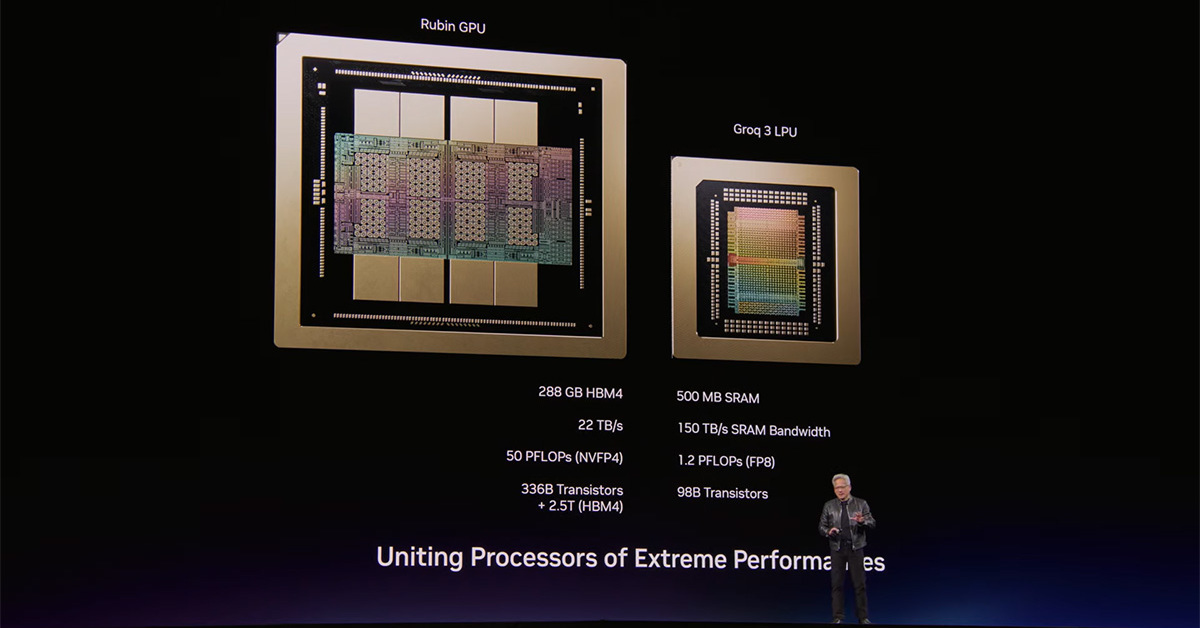
💡NVIDIA's Groq 3 LPU + Vera Rubin: 35x inference throughput over Blackwell—key for AI scaling
⚡ 30-Second TL;DR
What Changed
NVIDIA reveals Vera Rubin platform with 7 new chips in full production
Why It Matters
This launch promises massive inference efficiency gains, enabling cost-effective scaling of agentic AI applications for enterprises and developers.
What To Do Next
Monitor NVIDIA partner announcements for Vera Rubin systems to benchmark Groq 3 LPU inference performance.
Key Points
- •NVIDIA reveals Vera Rubin platform with 7 new chips in full production
- •Groq 3 LPU is inference-optimized chip for agentic AI
- •Combination yields up to 35x throughput vs Blackwell
- •Partner systems available H2 2024
🧠 Deep Insight
Background and context from public sources — not the original article. 7 sources cited.
🔑 Enhanced Key Takeaways
- •Rubin GPU delivers 50 petaFLOPS of NVFP4 inference performance, 5x higher than Blackwell's GB200, with 288 GB HBM4 memory and 22 TB/s bandwidth[1][2][3].
- •Vera CPU features 88 custom Arm-compatible Olympus cores with up to 1.2 TB/s LPDDR5X memory bandwidth for agentic reasoning and data movement[1][2][4].
- •Platform introduces third-generation Transformer Engine with adaptive compression and rack-scale confidential computing across CPU, GPU, and NVLink[4][5].
- •NVL72 rack-scale system provides 3.6 exaflops inference with 260 TB/s NVLink 6 bandwidth; partners like Microsoft and CoreWeave deploying at scale[2][5].
🛠️ Technical Deep Dive
- •Rubin GPU integrates 224 Streaming Multiprocessors (SMs) with fifth-generation Tensor Cores for NVFP4/FP8, expanded SFUs for attention/activation/sparse compute[1].
- •Second-generation NVLink-C2C offers 1.8 TB/s coherent bandwidth between Vera CPU and Rubin GPU, unifying LPDDR5X/HBM4 as single address space[1].
- •Spectrum-X Ethernet and BlueField-4 DPU with SSD enable low-latency KV-cache storage; NIXL supports zero-copy GPU-NIC transfers via InfiniBand GPUDirect Async[1][3].
- •Second-generation RAS Engine provides proactive maintenance, real-time health checks; modular tray designs for 18x faster serviceability vs Blackwell[4].
- •Rubin CPX GPU variant uses 128 GB GDDR7; NVLink 6 switch delivers 3.6 TB/s GPU-to-GPU bandwidth, scaling to 28.8 TB/s in NVL144[3].
🔮 Future ImplicationsAI analysis grounded in cited sources
⏳ Timeline
📎 Sources (7)
Factual claims are grounded in the sources below. Forward-looking analysis is AI-generated interpretation.
- developer.nvidia.com — Inside the Nvidia Rubin Platform Six New Chips One AI Supercomputer
- rdworldonline.com — Nvidia Unveils Vera Rubin Architecture at Ces As Wall Street Wrestles with Ais Bubble Question
- Tom's Hardware — Nvidias Vera Rubin Platform in Depth Inside Nvidias Most Complex AI and Hpc Platform to Date
- NVIDIA — Rubin
- nvidianews.nvidia.com — Rubin Platform AI Supercomputer
- chiplog.io — A Deep Dive Into Nvidia Rubin Cpx
- youtube.com — Watch
Weekly AI Recap
Read this week's curated digest of top AI events →
👉Related Updates
AI-curated news aggregator. All content rights belong to original publishers.
Original source: ITmedia AI+ (日本) ↗
This is a summary, not the original. Read the source, or get the weekly briefing.
Weekly AI briefing
One email a week. Unsubscribe anytime.