NVIDIA Launches Halos for Robotics Functional Safety

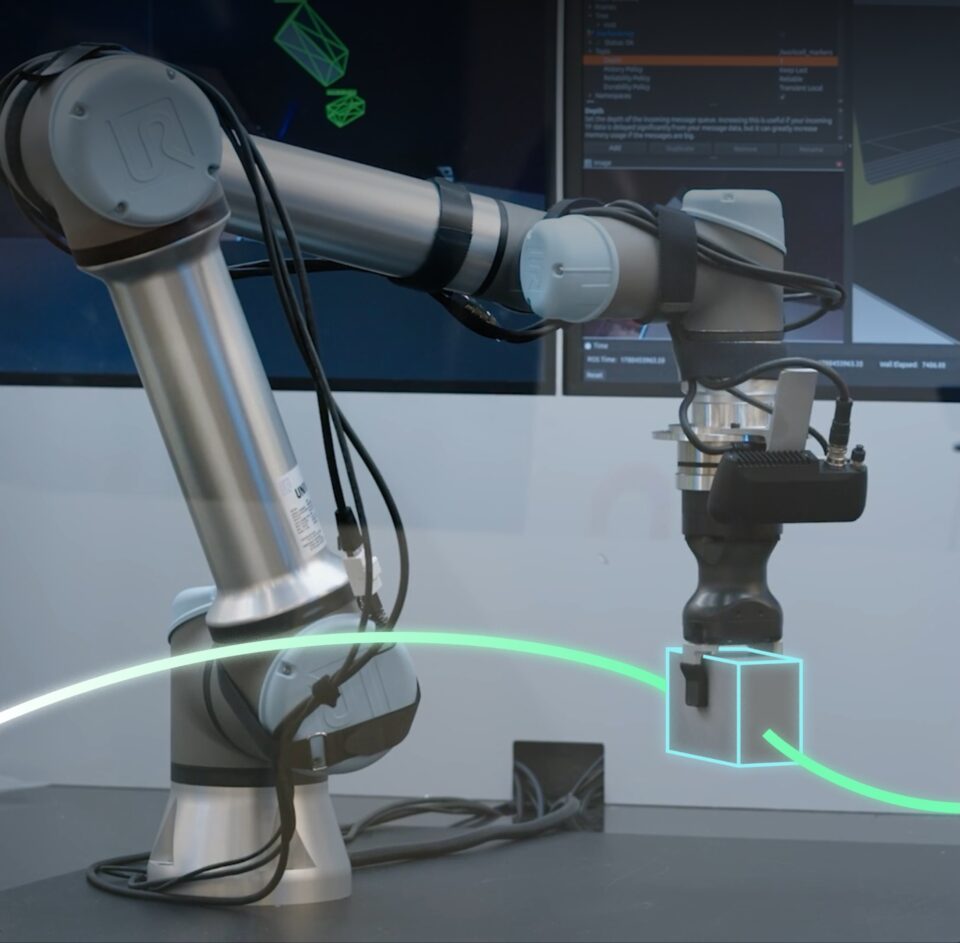
Learn how NVIDIA is solving the critical safety challenges for deploying autonomous robots in human-shared spaces.
30-Second TL;DR
What Changed
Provides a full-stack functional safety framework for autonomous robots.
Why It Matters
This system bridges the gap between traditional rigid safety standards and the flexibility required for modern autonomous robots. It is a critical step toward deploying robots in human-centric, unstructured workspaces.
What To Do Next
Review the NVIDIA Halos documentation to understand how to integrate functional safety layers into your existing robot perception stack.
Key Points
- •Provides a full-stack functional safety framework for autonomous robots.
- •Addresses safety challenges in unstructured environments where robots move outside of cages.
- •Enables AI-driven safety protocols for physical AI applications.
Deep Insight
AI-generated analysis for this event — not the original article.
Enhanced Key Takeaways
- •Halos integrates directly with the NVIDIA Isaac robotics platform, leveraging the Isaac Perceptor and Isaac Manipulator stacks to bridge the gap between perception and safety-rated execution.
- •The framework utilizes a 'safety-certified' software stack that adheres to ISO 10218 and ISO 13849 standards, which are critical for deploying autonomous mobile robots (AMRs) in human-occupied spaces.
- •It incorporates a deterministic safety monitor that runs independently of the primary AI perception stack, ensuring that if the AI encounters an anomaly, the robot defaults to a 'safe state' without requiring a full system reboot.
- •Halos supports hardware-accelerated safety zones, allowing developers to define dynamic, real-time geofencing that adjusts based on the robot's velocity and payload weight.
- •The system includes a simulation-based validation tool within NVIDIA Omniverse, enabling developers to stress-test safety protocols against millions of edge-case scenarios before physical deployment.
Competitor Analysis
- NVIDIA Halos
- AI-driven unstructured environments
- Siemens Safety Integrated
- Industrial PLC integration
- ABB SafeMove
- Robotic arm safety
- Rockwell Automation GuardLogix
- Factory floor safety controllers
- NVIDIA Halos
- Native/Full-stack
- Siemens Safety Integrated
- Limited
- ABB SafeMove
- Moderate
- Rockwell Automation GuardLogix
- Low
- NVIDIA Halos
- ISO 10218/13849
- Siemens Safety Integrated
- SIL 3 / PLe
- ABB SafeMove
- PLd / Cat 3
- Rockwell Automation GuardLogix
- SIL 3 / PLe
- NVIDIA Halos
- Dynamic/Unstructured
- Siemens Safety Integrated
- Structured/Factory
- ABB SafeMove
- Structured/Cell-based
- Rockwell Automation GuardLogix
- Structured/Fixed
| Feature | NVIDIA Halos | Siemens Safety Integrated | ABB SafeMove | Rockwell Automation GuardLogix |
|---|---|---|---|---|
| Primary Focus | AI-driven unstructured environments | Industrial PLC integration | Robotic arm safety | Factory floor safety controllers |
| AI Integration | Native/Full-stack | Limited | Moderate | Low |
| Safety Certification | ISO 10218/13849 | SIL 3 / PLe | PLd / Cat 3 | SIL 3 / PLe |
| Environment | Dynamic/Unstructured | Structured/Factory | Structured/Cell-based | Structured/Fixed |
Technical Deep Dive
- Architecture: Utilizes a dual-path design consisting of a high-performance AI path for navigation and a low-latency, deterministic safety path for emergency stop and speed monitoring.
- Middleware: Built on top of ROS 2 (Robot Operating System) with custom safety-rated middleware extensions to ensure message integrity.
- Hardware Requirements: Requires NVIDIA Jetson Orin or Thor modules to handle the concurrent processing of perception data and safety-rated logic.
- Safety Logic: Implements a 'Safety-Rated Monitored Stop' (SMS) and 'Safely-Limited Speed' (SLS) protocol that triggers within milliseconds of sensor input detection.
- Sensor Fusion: Supports multi-modal input from LiDAR, depth cameras, and ultrasonic sensors, processed through a safety-certified perception pipeline.
Future ImplicationsAI analysis grounded in cited sources
Timeline
- 2022-03NVIDIA announces Isaac Nova Orin, a compute platform for autonomous mobile robots.
- 2023-03Introduction of NVIDIA Isaac Perceptor for advanced 3D perception in robotics.
- 2024-03NVIDIA unveils Project GR00T, a foundation model for humanoid robot development.
- 2025-01Expansion of Isaac platform to include specialized safety-rated software modules.
- 2026-06Official launch of NVIDIA Halos for functional safety in physical AI.
Weekly AI Recap
Read this week's curated digest of top AI events →
Related Updates
AI-curated news aggregator. All content rights belong to original publishers.
Original source: NVIDIA Developer Blog ↗
This is a summary, not the original. Read the source, or get the weekly briefing.
The weekly digest
One email a week. Unsubscribe anytime.