JD.com plans to replace 700,000 couriers with robots
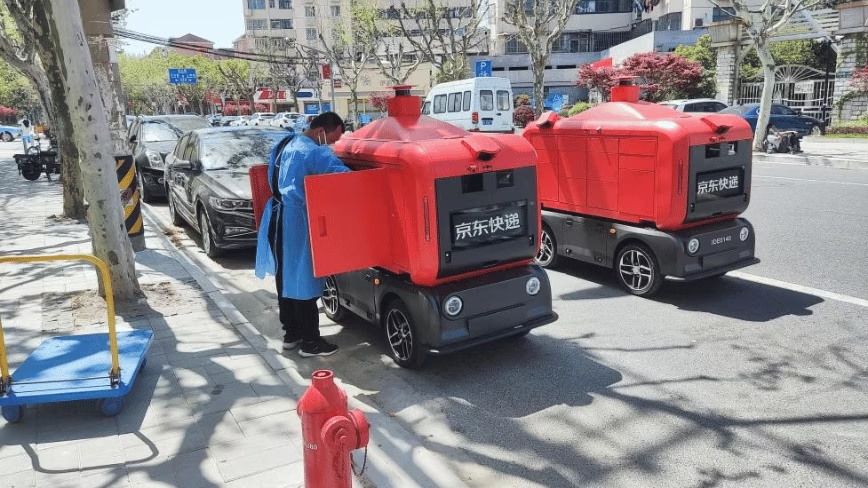
💡A major shift in embodied AI: JD.com plans to replace 700,000 human couriers with robots.
⚡ 30-Second TL;DR
What Changed
JD.com aims to fully automate its delivery workforce using robotics.
Why It Matters
This highlights the rapid advancement of embodied AI in logistics, suggesting that large-scale autonomous delivery fleets are becoming a viable enterprise strategy.
What To Do Next
Analyze the integration of computer vision and pathfinding algorithms in autonomous delivery systems to understand current limitations in unstructured environments.
Key Points
- •JD.com aims to fully automate its delivery workforce using robotics.
- •The transition targets 700,000 courier roles currently filled by humans.
- •This represents a rare, direct admission of automation replacing blue-collar jobs by a major tech leader.
🧠 Deep Insight
AI-generated analysis for this event — not the original article.
🔑 Enhanced Key Takeaways
- •JD.com's automation strategy is heavily integrated with its 'JD Logistics' division, which focuses on 'unmanned warehouses' and drone delivery networks in rural China.
- •The company has faced significant regulatory scrutiny regarding labor rights and the social impact of mass automation in the Chinese logistics sector.
- •JD.com utilizes a proprietary 'Autonomous Delivery Vehicle' (ADV) fleet that operates at Level 4 autonomy in specific urban zones.
- •The transition is part of a broader 'Retail as a Service' (RaaS) strategy, aiming to monetize logistics infrastructure by offering it to third-party merchants.
- •Despite the goal of full automation, JD.com has historically maintained a large human workforce to handle complex 'last-mile' scenarios that current robotics cannot navigate.
📊 Competitor Analysis▸ Show
| Feature | JD.com (JD Logistics) | Amazon (Amazon Robotics) | Alibaba (Cainiao) |
|---|---|---|---|
| Primary Focus | End-to-end autonomous logistics | Warehouse automation & Prime Air | Data-driven logistics platform |
| Delivery Robots | Proprietary ADV fleet | Scout (limited deployment) | Xiaomanlv (last-mile) |
| Labor Strategy | Direct replacement goal | Augmentation/Co-bot focus | Ecosystem-based automation |
🛠️ Technical Deep Dive
- JD.com utilizes a multi-layered sensor fusion architecture combining LiDAR, ultrasonic sensors, and high-definition cameras for 360-degree obstacle detection.
- The ADV fleet operates on a cloud-based 'Brain' system that manages real-time path planning and traffic coordination for thousands of units simultaneously.
- Delivery robots employ V2X (Vehicle-to-Everything) communication protocols to interact with smart traffic lights and building access systems.
- Warehouse automation relies on AGVs (Automated Guided Vehicles) and robotic arms equipped with computer vision for high-speed parcel sorting and palletizing.
🔮 Future ImplicationsAI analysis grounded in cited sources
⏳ Timeline
Weekly AI Recap
Read this week's curated digest of top AI events →
👉Related Updates

AI-curated news aggregator. All content rights belong to original publishers.
Original source: The Next Web (TNW) ↗
This is a summary, not the original. Read the source, or get the weekly briefing.
The weekly digest
One email a week. Unsubscribe anytime.