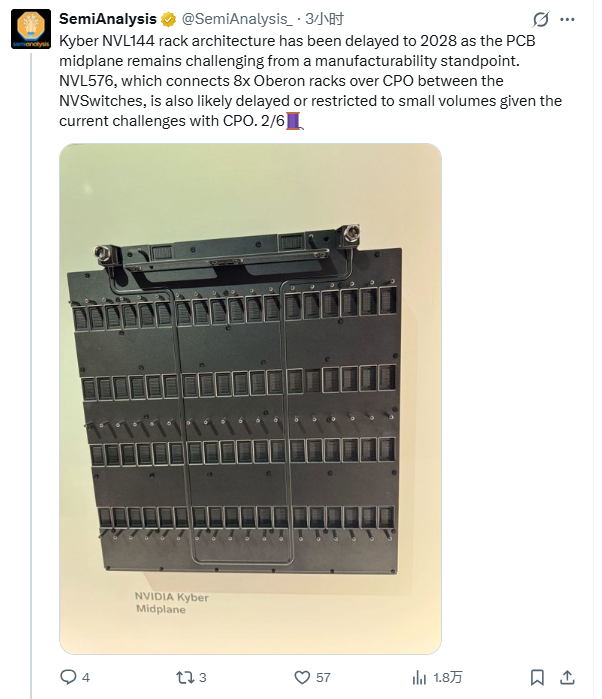
NVIDIA Kyber AI Rack System Delayed to 2028
💡NVIDIA's hardware roadmap delay could impact your AI infrastructure scaling strategy for 2027.
⚡ 30-Second TL;DR
What Changed
Kyber NVL144 rack system delayed by one year to 2028
Why It Matters
The delay may disrupt data center expansion plans for hyperscalers relying on NVIDIA's latest hardware. It highlights potential supply chain vulnerabilities in the high-end AI infrastructure market.
What To Do Next
Adjust your long-term infrastructure procurement forecasts and evaluate alternative compute availability for 2027.
Key Points
- •Kyber NVL144 rack system delayed by one year to 2028
- •Manufacturing bottlenecks in critical circuit boards identified as the root cause
- •Raises concerns about NVIDIA's aggressive annual hardware release roadmap
🧠 Deep Insight
AI-generated analysis for this event — not the original article.
🔑 Enhanced Key Takeaways
- •The delay specifically impacts the integration of high-bandwidth memory (HBM4) which is critical for the Rubin Ultra architecture's performance targets.
- •Supply chain analysts indicate that the bottleneck involves advanced substrate materials required for the high-density interconnects in the NVL144 rack design.
- •NVIDIA is reportedly shifting engineering resources to prioritize the Blackwell Ultra refresh to bridge the revenue gap created by the Kyber delay.
- •Industry partners have noted that the complexity of the liquid cooling infrastructure required for the Kyber rack has exceeded initial thermal management projections.
- •The delay has triggered a re-evaluation of NVIDIA's 'one-year cadence' strategy, with institutional investors expressing concerns over the sustainability of such rapid hardware iterations.
📊 Competitor Analysis▸ Show
| Feature | NVIDIA Kyber NVL144 | AMD Instinct MI400 Series | Intel Gaudi 4/5 |
|---|---|---|---|
| Architecture | Rubin Ultra (Arm-based) | CDNA Next | Falcon Shores |
| Interconnect | NVLink Switch System | Infinity Fabric | Xe Link |
| Status | Delayed to 2028 | On-track for 2027 | Expected 2027 |
🛠️ Technical Deep Dive
- The Kyber NVL144 architecture utilizes a disaggregated rack design to support up to 144 interconnected GPUs in a single domain.
- It incorporates HBM4 memory stacks, which require new bonding techniques that have contributed to the reported manufacturing yield issues.
- The system relies on a proprietary optical interconnect fabric to manage the massive bandwidth requirements between GPU nodes.
- Thermal design power (TDP) per rack is estimated to exceed 100kW, necessitating advanced direct-to-chip liquid cooling solutions.
🔮 Future ImplicationsAI analysis grounded in cited sources
⏳ Timeline
Weekly AI Recap
Read this week's curated digest of top AI events →
👉Related Updates



AI-curated news aggregator. All content rights belong to original publishers.
Original source: cnBeta (Full RSS) ↗
This is a summary, not the original. Read the source, or get the weekly briefing.
Weekly AI briefing
One email a week. Unsubscribe anytime.