Nvidia expands humanoid robot research beyond Unitree
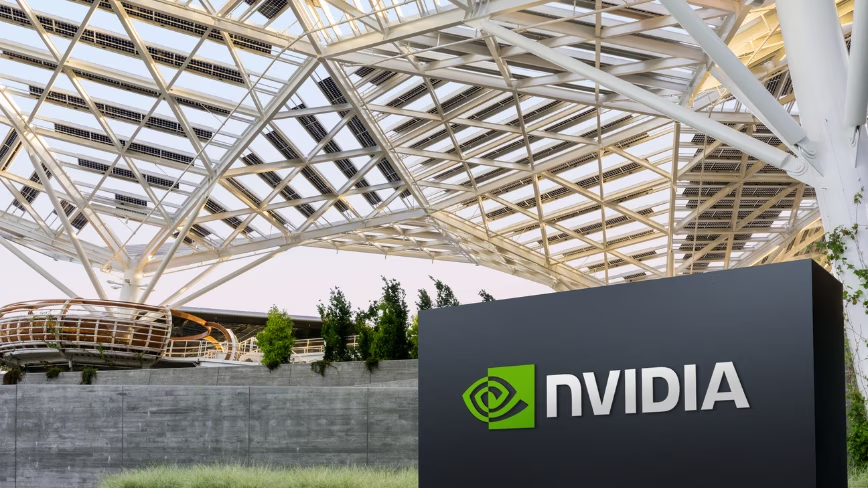
💡Nvidia is positioning its chips as the standard brain for the global humanoid robotics industry.
⚡ 30-Second TL;DR
What Changed
Nvidia is adopting a multi-vendor strategy for its humanoid robot research platform.
Why It Matters
This signals Nvidia's intent to become the standard 'brain' for the robotics industry, similar to its dominance in AI data centers. It lowers the barrier for hardware manufacturers to enter the humanoid space.
What To Do Next
Explore the Nvidia Isaac robotics platform documentation to understand how to integrate your own hardware with their AI compute stacks.
Key Points
- •Nvidia is adopting a multi-vendor strategy for its humanoid robot research platform.
- •The current research prototype combines a Unitree body, Sharpa hands, and an Nvidia computing brain.
- •Nvidia intends to scale this collaborative model for future robotics development.
🧠 Deep Insight
Background and context from public sources — not the original article. 18 sources cited.
🔑 Enhanced Key Takeaways
- •Nvidia's new Isaac GR00T Reference Humanoid Robot is an open design integrating Unitree's H2 Plus body, Sharpa Wave tactile hands, and Nvidia's Jetson Thor for onboard AI compute, along with the Isaac GR00T software platform.
- •Nvidia's broader strategy is to become the foundational hardware and software provider for the humanoid robotics industry, offering platforms like Jetson Thor and Project GR00T, rather than manufacturing the robots themselves.
- •The company is actively expanding its collaborations beyond China, seeking partnerships with humanoid robot developers in the U.S., Europe, and South Korea to build a global robotics ecosystem.
- •The Isaac GR00T platform provides an end-to-end stack for humanoid robot development, encompassing open foundation models (like GR00T N1), simulation tools (Isaac Sim), synthetic data generation, and high-performance edge computing with Jetson Thor.
- •The reference design features a Unitree H2 Plus humanoid chassis with 31 degrees of freedom and dual Sharpa Wave tactile five-finger hands, each providing 22 degrees of freedom, totaling 75 degrees of freedom for the robot.
🛠️ Technical Deep Dive
- NVIDIA Isaac GR00T Platform: An open reference platform designed for general-purpose humanoid robots.
- Core Components: Includes open data and data pipelines, an open robot foundation model, simulation frameworks, middleware, CUDA-X accelerated runtime libraries, and NVIDIA Jetson Thor for real-time robot inference and control.
- Isaac GR00T N1 Foundation Model: Introduced on March 18, 2025, this flagship model supports generalized humanoid robot reasoning and skills.
- Input: Processes multimodal inputs such as language, images, and proprioceptive data to perform manipulation tasks in diverse environments.
- Training: Trained on extensive humanoid datasets, combining real-world, synthetic, and internet-scale video data, and is adaptable through post-training.
- Availability: Models are hosted on Hugging Face under the OpenMDW-1.1 license.
- Isaac Sim: Built on NVIDIA Omniverse, it is a scalable and physically accurate robotics simulation application.
- Capabilities: Features photorealistic rendering with RTX technology, precise physics powered by PhysX, and enables synthetic data generation for AI training and virtual environment testing. It supports both graphical and headless modes for efficient batch processing.
- Isaac ROS: A collection of hardware-accelerated ROS 2 packages that leverage NVIDIA GPUs to enhance performance for perception, navigation, and manipulation tasks.
- Isaac Lab: An open-source robot learning framework facilitating rapid iteration, skill reuse across different robot embodiments, and policy validation within Isaac Sim before deployment to physical hardware.
- NVIDIA Jetson Thor: A computing platform purpose-built for humanoid robots, expected to launch in mid-2025.
- Architecture: Based on the Blackwell architecture.
- Features: Integrates high-performance GPU cores, advanced sensor fusion, and a power-efficient design to enable real-time vision, speech processing, and decision-making.
- Performance: The Jetson AGX Thor T5000 configuration offers 128 GB memory and up to 2,070 FP4 teraflops of AI compute.
- Unitree H2 Plus: The humanoid chassis used in the reference design, standing nearly 6 feet tall and weighing 150 pounds, with 31 degrees of freedom.
- Sharpa Wave Hands: Dual tactile five-finger robotic hands, each providing 22 degrees of freedom. They feature over 1,000 tactile pixels per fingertip, sub-millimeter precision, and 6-dimensional force sensing.
- Technology: Incorporates proprietary Dynamic Tactile Array (DTA) technology.
- Sharpa's AI: Utilizes CraftNet, a Vision-Tactile-Language-Action (VTLA) model for anthropomorphic dexterous manipulation.
🔮 Future ImplicationsAI analysis grounded in cited sources
⏳ Timeline
📎 Sources (18)
Factual claims are grounded in the sources below. Forward-looking analysis is AI-generated interpretation.
Weekly AI Recap
Read this week's curated digest of top AI events →
👉Related Updates


AI-curated news aggregator. All content rights belong to original publishers.
Original source: The Next Web (TNW) ↗
This is a summary, not the original. Read the source, or get the weekly briefing.
The weekly digest
One email a week. Unsubscribe anytime.