Nvidia Expands Its Data-Center Power Bets
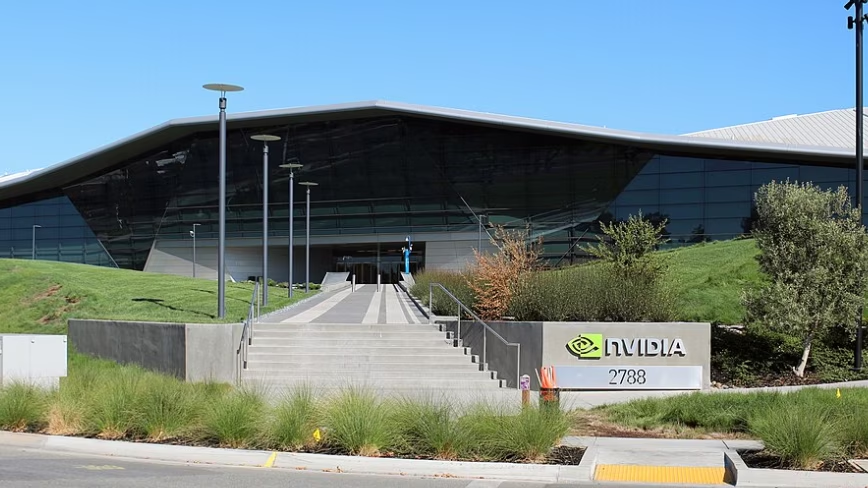
💡Nvidia's third infrastructure investment signals that power access—not GPUs alone—is shaping AI expansion.
⚡ 30-Second TL;DR
What Changed
Nvidia acquired a minority stake in Cloverleaf Infrastructure.
Why It Matters
Nvidia's activity suggests that access to power and suitable sites is becoming a strategic bottleneck for AI data-center expansion. Greater competition for energy and capacity could affect cloud availability, deployment timelines, and infrastructure costs.
What To Do Next
Add regional power availability, grid-connection timelines, and data-center land costs to your next AI infrastructure capacity plan.
Key Points
- •Nvidia acquired a minority stake in Cloverleaf Infrastructure.
- •Cloverleaf helps data-center operators secure land and electricity.
- •The deal is reportedly Nvidia's third investment in a land-and-power company this month.
🧠 Deep Insight
Background and context from public sources — not the original article. 8 sources cited.
🔑 Enhanced Key Takeaways
- •Nvidia has established a $500 billion financing platform in partnership with major financial institutions like BlackRock, Blackstone, and KKR to mobilize capital for AI compute infrastructure.
- •The company is implementing an 800 VDC power architecture to minimize energy conversion stages and increase efficiency in high-density AI data centers.
- •Nvidia is collaborating with SB Energy at the PORTS-Pike Technology Campus in Ohio to secure dedicated power and land capacity specifically for OpenAI-hosted compute.
- •The 'XFRA' project is testing the use of residential 'stranded power' by deploying liquid-cooled Blackwell-based compute nodes in home environments.
- •Nvidia is developing rack-scale systems and the Vera CPU in collaboration with SpaceXAI to optimize AI compute for the unique thermal and power constraints of orbital environments.
🛠️ Technical Deep Dive
- 800 VDC Power Architecture: Designed to reduce power conversion stages compared to traditional AC systems, improving overall energy efficiency for high-density AI clusters.
- MGX-compatible 800 VDC Power Racks: Modular hardware slated for late 2026 deployment, allowing retrofitting of existing data centers for high-density compute without full electrical overhauls.
- Liquid-cooled compute nodes: Compact units featuring Blackwell GPUs designed for non-traditional environments like residential settings to utilize stranded power.
- Vera CPU: Specialized processor architecture developed for rack-scale systems, optimized for extreme thermal and power constraints found in space-based AI infrastructure.
🔮 Future ImplicationsAI analysis grounded in cited sources
⏳ Timeline
📎 Sources (8)
Factual claims are grounded in the sources below. Forward-looking analysis is AI-generated interpretation.
Weekly AI Recap
Read this week's curated digest of top AI events →
👉Related Updates


AI-curated news aggregator. All content rights belong to original publishers.
Original source: The Next Web (TNW) ↗
This is a summary, not the original. Read the source, or get the weekly briefing.
Weekly AI briefing
One email a week. Unsubscribe anytime.