NVIDIA and LG Group Partner to Build AI Factory
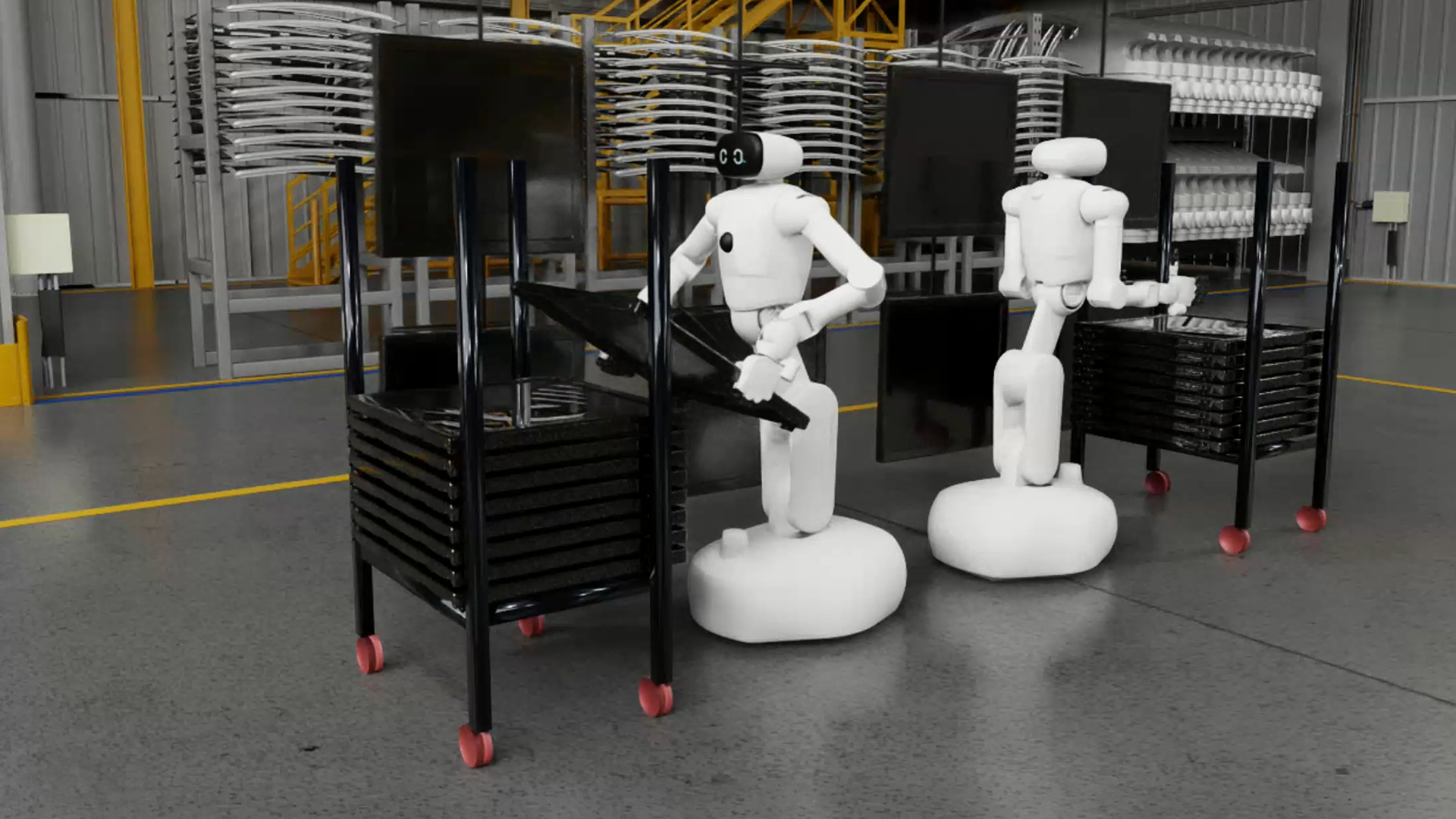
💡Learn how LG is leveraging NVIDIA's infrastructure to scale physical AI and robotics in industrial manufacturing.
⚡ 30-Second TL;DR
What Changed
Construction of a dedicated AI factory for LG Group's business units
Why It Matters
This partnership signals a major shift for large-scale industrial conglomerates moving toward vertical integration of AI hardware and physical robotics. It highlights the growing demand for private, high-performance AI infrastructure in the manufacturing and mobility sectors.
What To Do Next
Evaluate NVIDIA's Omniverse and AI Enterprise platforms if your organization is scaling physical AI or robotics simulations.
Key Points
- •Construction of a dedicated AI factory for LG Group's business units
- •Focus on physical AI, robotics, and autonomous driving development
- •Integration of accelerated computing for simulation and validation workflows
🧠 Deep Insight
Background and context from public sources — not the original article. 15 sources cited.
🔑 Enhanced Key Takeaways
- •LG Group Chairman Koo Kwang-mo has designated AI as the group's primary growth driver, backed by significant capital allocation commitments, including investments in physical AI startups like Figure AI, DYNA Robotics, and Skilled AI.
- •The partnership aims to transform all 29 of LG's global factories across 14 countries into AI-powered smart facilities by 2030, utilizing NVIDIA's Omniverse digital twin technology for real-time data connection and AI-driven processes.
- •LG Electronics is integrating NVIDIA's Isaac Sim and Isaac Lab open robotics frameworks into its development workflows to simulate, train, and validate home robots, such as the CLOiD, in physically accurate virtual environments before deployment.
- •LG is exploring the use of NVIDIA Isaac GR00T, an open, reasoning vision-action language model, for its home robots and modular robotics platforms, enabling humanlike reasoning capabilities.
- •LG Group plans to invest in approximately 10,000 NVIDIA Blackwell GPUs for its AI factory, an investment estimated to cost over 700 billion won (approximately $500 million USD), to power its proprietary EXAONE AI model and physical AI initiatives.
🛠️ Technical Deep Dive
- The AI factory infrastructure will incorporate NVIDIA Blackwell accelerated computing, NVIDIA BlueField DPUs, NVIDIA Spectrum-X Ethernet networking, and the NVIDIA AI Enterprise software suite.
- LG Electronics is leveraging NVIDIA Isaac Sim and Isaac Lab open robotics frameworks for the simulation and training of its robots.
- NVIDIA Omniverse is being deployed to create digital twins of LG's smart factories, enabling virtual testing and optimization of production processes.
- LG's CLOiD home robot utilizes NVIDIA's Jetson Thor GPU for on-robot inference and integrates Google's Gemini for robotics for its cognitive functions.
- LG AI Research's proprietary multimodal AI model, EXAONE, which has 300 billion parameters, is expected to be integrated and potentially co-developed with NVIDIA's Nemotron open ecosystem for domain-specific AI models.
- The NVIDIA Enterprise AI Factory validated design provides a full stack of NVIDIA software and ecosystem partner software, specifically optimized for agentic AI workloads.
- NVIDIA's AI factory concept emphasizes dense GPU or accelerator nodes, high-speed networking, scalable storage, and robust power/cooling solutions to sustain continuous AI workloads.
- The collaboration may utilize NVIDIA Enterprise Reference Architectures such as the HGX AI Factory for large-scale model training and fine-tuning, and the RTX PRO AI Factory for smaller to medium inference, generative AI, and industrial AI workloads.
🔮 Future ImplicationsAI analysis grounded in cited sources
⏳ Timeline
📎 Sources (15)
Factual claims are grounded in the sources below. Forward-looking analysis is AI-generated interpretation.
Weekly AI Recap
Read this week's curated digest of top AI events →
👉Related Updates
AI-curated news aggregator. All content rights belong to original publishers.
Original source: NVIDIA Blog ↗
This is a summary, not the original. Read the source, or get the weekly briefing.
The weekly digest
One email a week. Unsubscribe anytime.