Nvidia and Big Tech Support Chinese Open Source
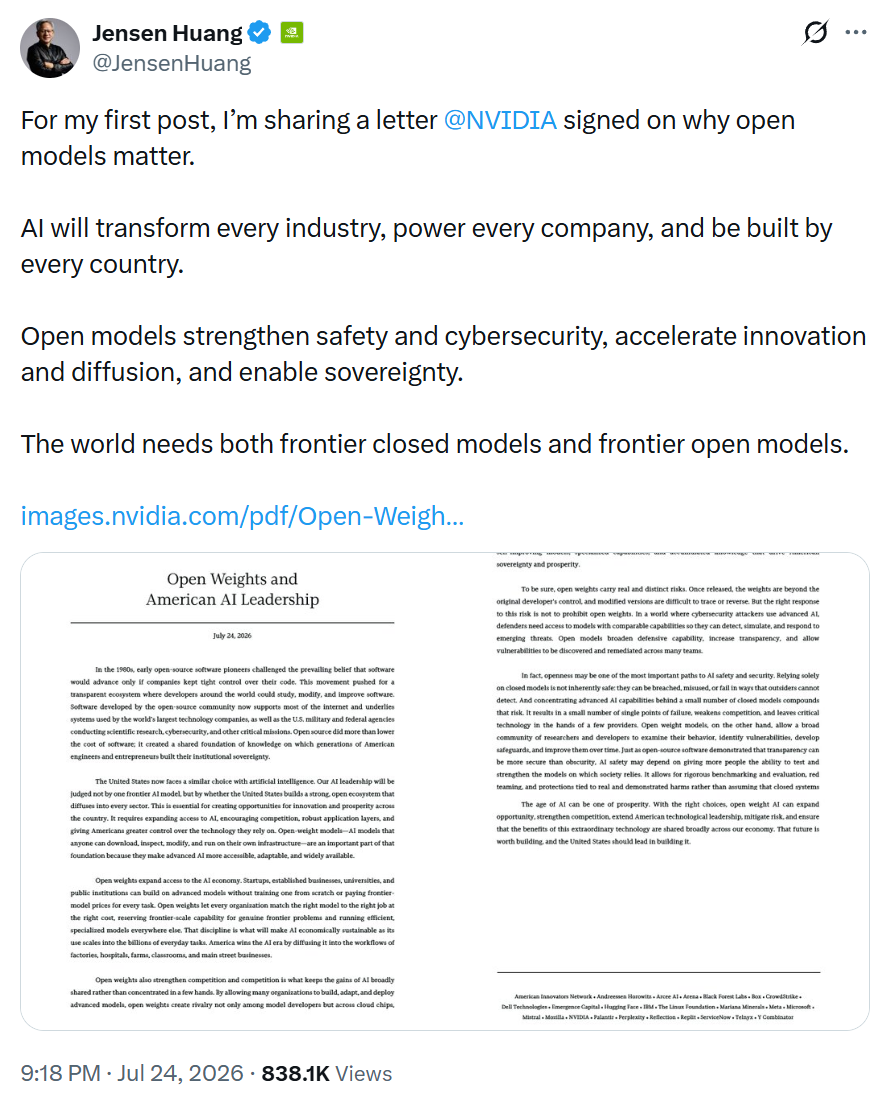
💡Major tech giants are validating Chinese open-source models as key assets for the global AI ecosystem.
⚡ 30-Second TL;DR
What Changed
Nvidia, Microsoft, and Meta endorse Chinese open-source AI
Why It Matters
Signals a potential thaw in AI collaboration discourse and emphasizes the value of open-source models in global innovation.
What To Do Next
Evaluate integrating DeepSeek or Kimi models into your pipeline to leverage their open-source capabilities.
Key Points
- •Nvidia, Microsoft, and Meta endorse Chinese open-source AI
- •DeepSeek and Kimi recognized as positive contributors to global AI
- •Shift in geopolitical narrative regarding AI model openness
🧠 Deep Insight
AI-generated analysis for this event — not the original article.
🔑 Enhanced Key Takeaways
- •The endorsement follows a strategic shift where US tech giants are leveraging high-efficiency, low-cost Chinese open-source models to pressure domestic competitors on pricing and inference efficiency.
- •DeepSeek's architecture has gained traction in Western research circles specifically for its Mixture-of-Experts (MoE) implementation, which demonstrates significantly lower compute requirements for equivalent performance.
- •Regulatory bodies in the US are reportedly monitoring this cross-border collaboration to determine if the adoption of Chinese open-source weights violates existing export control frameworks regarding AI technology transfer.
- •The public support from Nvidia is interpreted by analysts as a move to maintain its hardware dominance by ensuring its GPUs remain the preferred infrastructure for running diverse, high-performing open-source models regardless of origin.
- •Kimi (Moonshot AI) has been integrated into several experimental developer toolchains in the US, serving as a benchmark for long-context window processing capabilities that currently rival top-tier proprietary models.
📊 Competitor Analysis▸ Show
| Feature | DeepSeek-V3 | Llama 3.1 (Meta) | GPT-4o (OpenAI) |
|---|---|---|---|
| Architecture | MoE (Mixture-of-Experts) | Dense Transformer | Proprietary MoE |
| Licensing | Open Weights (Permissive) | Open Weights (Custom) | Closed Source |
| Context Window | 128K+ | 128K | 128K |
| Pricing | Highly Competitive/Free | Free (Self-hosted) | Usage-based (API) |
🛠️ Technical Deep Dive
- DeepSeek utilizes a Multi-head Latent Attention (MLA) mechanism which drastically reduces KV cache memory usage during inference.
- The models employ a DeepSeekMoE architecture that features fine-grained expert segmentation, allowing for more efficient parameter activation compared to traditional sparse models.
- Kimi models are optimized for long-context retrieval, utilizing a proprietary sliding window attention variant that maintains performance across inputs exceeding 200k tokens.
- Training pipelines for these models have demonstrated high hardware utilization efficiency on Nvidia H100 clusters, often achieving higher TFLOPS utilization than comparable Western open-source training runs.
🔮 Future ImplicationsAI analysis grounded in cited sources
⏳ Timeline
Weekly AI Recap
Read this week's curated digest of top AI events →
👉Related Updates



AI-curated news aggregator. All content rights belong to original publishers.
Original source: 钛媒体 ↗
This is a summary, not the original. Read the source, or get the weekly briefing.
The weekly digest
One email a week. Unsubscribe anytime.