New China EV Battery Safety Standards Take Effect
💡Understand how new safety regulations are reshaping the EV battery supply chain and impacting production costs.
⚡ 30-Second TL;DR
What Changed
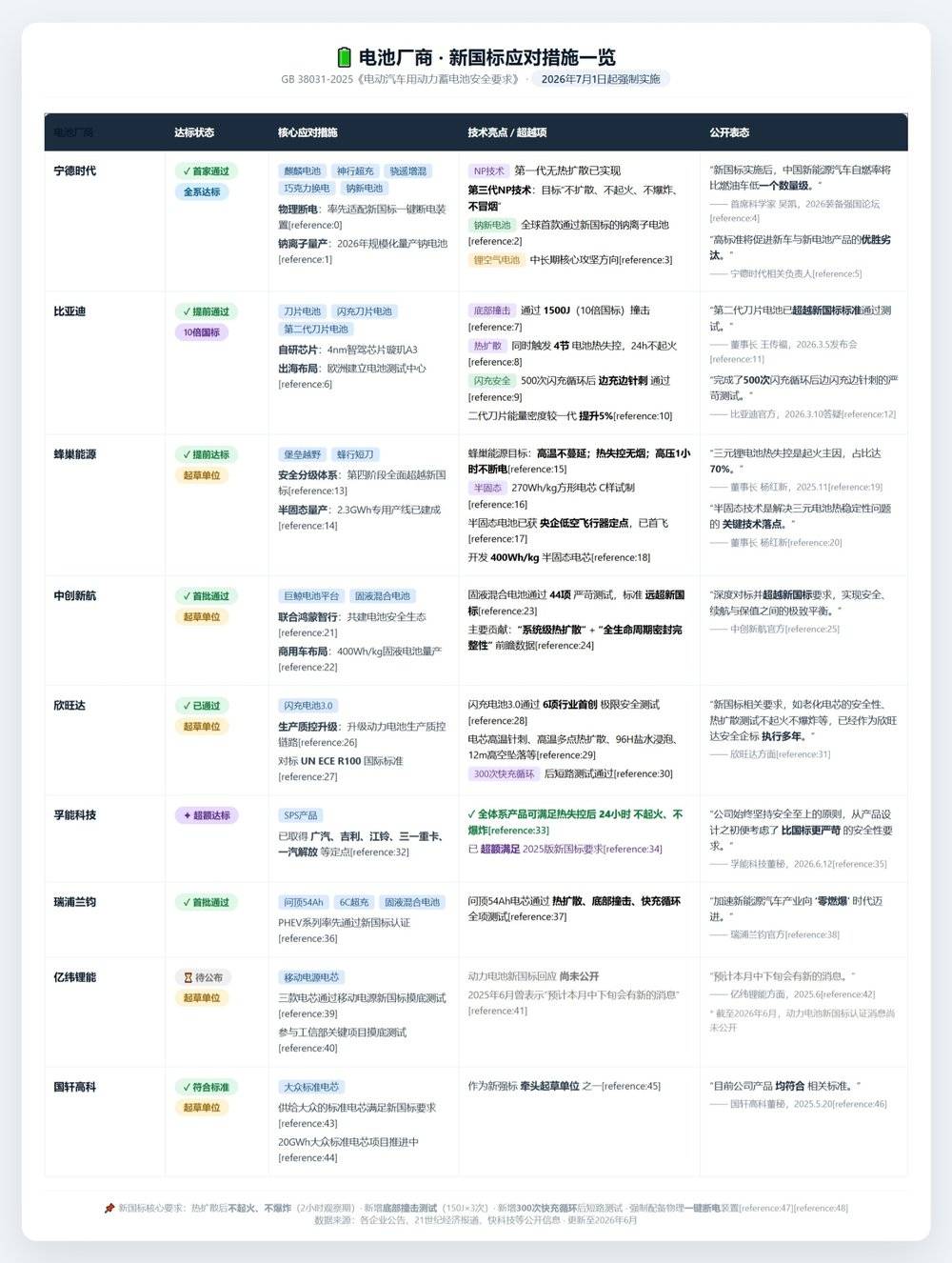
New standard mandates 'no fire/explosion' for 2 hours post-thermal runaway.
Why It Matters
The regulation will likely accelerate the exit of smaller players and force a shift toward higher-quality, safer battery architectures across the industry.
What To Do Next
If you are in the EV supply chain, audit your battery management system (BMS) logic against the new thermal runaway observation requirements.
Key Points
- •New standard mandates 'no fire/explosion' for 2 hours post-thermal runaway.
- •Estimated cost increase of 4,000-6,500 RMB per vehicle due to safety upgrades.
- •Industry consolidation expected as smaller battery manufacturers struggle with compliance costs.
- •Major players like CATL and BYD are leveraging technical reserves to gain market share.
🧠 Deep Insight
AI-generated analysis for this event — not the original article.
🔑 Enhanced Key Takeaways
- •The new standards specifically target the GB 38031-2020 revision, which now incorporates stricter 'thermal propagation' testing protocols that were previously voluntary or less stringent in earlier iterations.
- •Regulatory bodies have introduced a 'traceability system' requirement, mandating that battery manufacturers log thermal management performance data for every pack produced to ensure post-market compliance.
- •Export-oriented manufacturers are aligning these domestic standards with the EU's Battery Regulation (2023/1542) to streamline global supply chains and avoid dual-certification costs.
- •Insurance companies in China are reportedly adjusting premium structures based on these new safety certifications, potentially creating a 'safety premium' for vehicles equipped with compliant battery packs.
- •The Ministry of Industry and Information Technology (MIIT) has established a grace period for existing models, allowing a 12-month transition phase before non-compliant vehicles are barred from the national catalog.
📊 Competitor Analysis▸ Show
| Feature | CATL (Qilin/Shenxing) | BYD (Blade Battery) | Tier 2/3 Manufacturers |
|---|---|---|---|
| Thermal Management | Advanced Liquid Cooling | Integrated Cell-to-Pack | Basic Air/Liquid Cooling |
| Compliance Cost | Low (Scale/R&D) | Low (Vertical Integration) | High (R&D/Re-tooling) |
| Safety Benchmark | Exceeds 2hr threshold | Exceeds 2hr threshold | Struggling to meet 2hr |
| Market Strategy | Premium/High-End | Mass Market/Efficiency | Price Competition |
🛠️ Technical Deep Dive
- Implementation of Aerogel-based thermal insulation layers between cells to prevent heat transfer during runaway events.
- Integration of multi-stage pressure relief valves (PRV) designed to vent gases away from the passenger cabin within milliseconds of cell failure.
- Adoption of AI-driven Battery Management Systems (BMS) that utilize real-time impedance spectroscopy to detect internal shorts before thermal runaway occurs.
- Shift toward high-nickel cathode materials with modified electrolyte additives to increase the onset temperature of exothermic reactions.
🔮 Future ImplicationsAI analysis grounded in cited sources
⏳ Timeline
Weekly AI Recap
Read this week's curated digest of top AI events →
👉Related Updates


AI-curated news aggregator. All content rights belong to original publishers.
Original source: 虎嗅 ↗
This is a summary, not the original. Read the source, or get the weekly briefing.
Weekly AI briefing
One email a week. Unsubscribe anytime.