NEC AI Shrinks 3D Point Clouds 90%
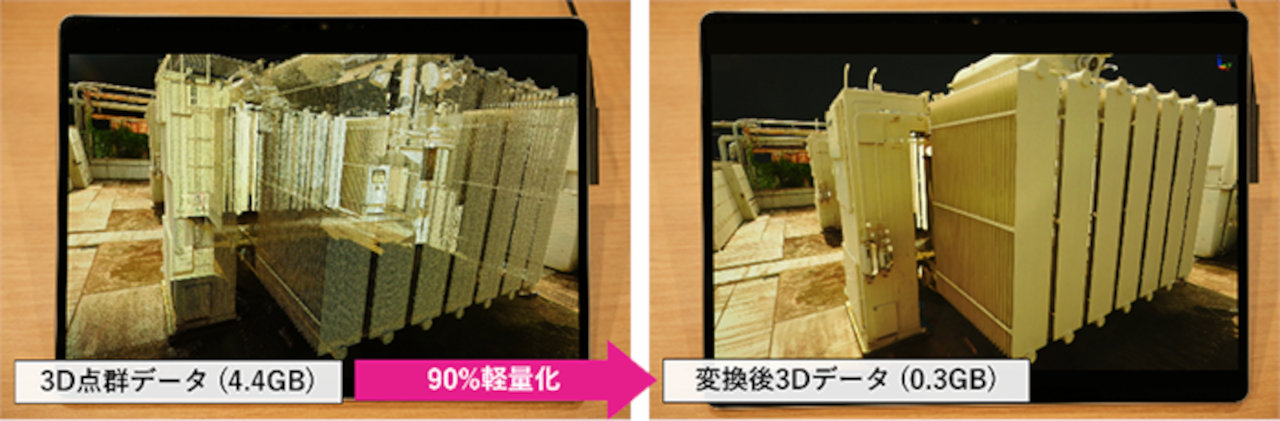
NEC's AI cuts 3D data 90% via Gaussian Splatting—key for CV/3D efficiency.
30-Second TL;DR
What Changed
Proprietary NEC AI combined with Gaussian Splatting
Why It Matters
This breakthrough could slash storage and bandwidth needs for 3D applications in AR/VR, robotics, and autonomous systems. AI practitioners gain a new efficiency benchmark for computer vision pipelines.
What To Do Next
Test Gaussian Splatting libraries like gsplat for 3D data compression in your CV projects.
Key Points
- •Proprietary NEC AI combined with Gaussian Splatting
- •Converts heavy 3D point clouds to lightweight high-fidelity 3D data
- •Achieves 90% data size reduction
- •Eases handling and detail perception of 3D data
Deep Insight
AI-generated analysis for this event — not the original article.
Enhanced Key Takeaways
- •NEC's approach utilizes a novel 'Gaussian Splatting' optimization that specifically targets the redundancy in point cloud spatial distribution, allowing for real-time rendering on edge devices with limited GPU resources.
- •The technology is designed to integrate into NEC's existing 'Digital Twin' infrastructure, aiming to reduce the bandwidth requirements for transmitting high-fidelity 3D assets in industrial IoT and remote maintenance scenarios.
- •Unlike traditional mesh-based compression, this method maintains view-dependent lighting effects and specular reflections, which are often lost when converting point clouds to standard polygon meshes.
Competitor Analysis
- NEC (Gaussian Splatting)
- ~90%
- Traditional Mesh Compression (Draco)
- 50-70%
- Neural Radiance Fields (NeRF)
- Variable (High)
- NEC (Gaussian Splatting)
- High (Real-time)
- Traditional Mesh Compression (Draco)
- High
- Neural Radiance Fields (NeRF)
- Low (Computationally heavy)
- NEC (Gaussian Splatting)
- High (View-dependent)
- Traditional Mesh Compression (Draco)
- Medium (Geometry loss)
- Neural Radiance Fields (NeRF)
- High
- NEC (Gaussian Splatting)
- Industrial Digital Twins
- Traditional Mesh Compression (Draco)
- Web/Mobile 3D Assets
- Neural Radiance Fields (NeRF)
- Cinematic/Static Scenes
| Feature | NEC (Gaussian Splatting) | Traditional Mesh Compression (Draco) | Neural Radiance Fields (NeRF) |
|---|---|---|---|
| Compression Ratio | ~90% | 50-70% | Variable (High) |
| Rendering Speed | High (Real-time) | High | Low (Computationally heavy) |
| Fidelity | High (View-dependent) | Medium (Geometry loss) | High |
| Primary Use Case | Industrial Digital Twins | Web/Mobile 3D Assets | Cinematic/Static Scenes |
Technical Deep Dive
- •Architecture: Utilizes a hybrid model combining a lightweight neural network for feature extraction and a Gaussian Splatting engine for scene representation.
- •Data Processing: Employs a spatial partitioning algorithm to segment point clouds before applying Gaussian parameter optimization, minimizing memory overhead during the training phase.
- •Rendering Pipeline: Optimized for compatibility with standard graphics APIs (Vulkan/OpenGL), allowing the compressed data to be decoded and rendered without specialized proprietary hardware.
- •Loss Function: Implements a custom loss function that balances geometric accuracy (Chamfer distance) with photometric consistency to ensure visual fidelity during compression.
Future ImplicationsAI analysis grounded in cited sources
Timeline
- 2023-08NEC announces expansion of its AI-driven Digital Twin research initiatives.
- 2024-11NEC publishes foundational research on neural-based 3D scene representation.
- 2026-05NEC officially unveils the 90% compression technology for 3D point clouds.
Weekly AI Recap
Read this week's curated digest of top AI events →
Related Updates
AI-curated news aggregator. All content rights belong to original publishers.
Original source: ITmedia AI+ (日本) ↗
This is a summary, not the original. Read the source, or get the weekly briefing.
The weekly digest
One email a week. Unsubscribe anytime.