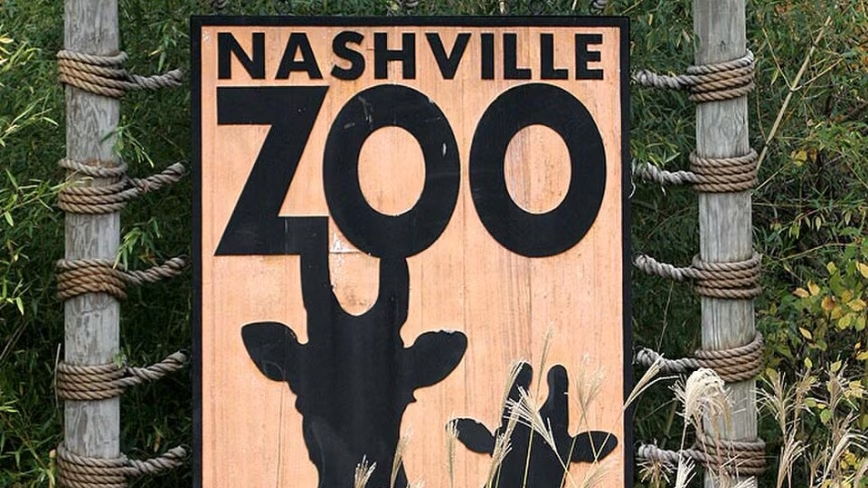
Nashville Zoo fights proposed AI data center construction
💡See how physical infrastructure constraints and environmental concerns are impacting AI data center expansion.
⚡ 30-Second TL;DR
What Changed
DC BLOX proposed a data center 50 yards from animal enclosures
Why It Matters
This highlights the physical infrastructure challenges of the AI boom, specifically the conflict between high-density computing needs and local environmental/zoning regulations.
What To Do Next
When planning infrastructure for large-scale AI training clusters, conduct thorough environmental impact assessments to avoid local regulatory pushback.
Key Points
- •DC BLOX proposed a data center 50 yards from animal enclosures
- •Zoo claims noise and activity could stop endangered leopards from breeding
- •Petition against the project has gathered nearly 300,000 signatures
🧠 Deep Insight
Background and context from public sources — not the original article. 20 sources cited.
🔑 Enhanced Key Takeaways
- •The proposed DC BLOX data center, located at 648 Grassmere Park, involves demolishing two existing office buildings on a 23.5-acre site directly adjacent to the Nashville Zoo's parking lot.
- •Beyond noise, the Nashville Zoo and community members have raised concerns about potential light pollution, significant water consumption, air pollution from emissions (oxides, carbon monoxide, nitrites, particulates), and the strain on local power grids and natural resources.
- •Permit documents and a geotechnical engineering report suggest the project could expand beyond the initially proposed 69,220-square-foot, 10-megawatt facility to include a three-story, 40-megawatt data center building, a substation, parking lots, and a guard house.
- •Nashville's Metro Council is actively considering a moratorium on new data center construction and new ordinances to regulate their placement, which would include distance requirements from sensitive areas like homes, schools, churches, parks, and zoos, as well as mandatory impact studies.
- •DC BLOX has stated that the facility will not be an "AI factory" and commits to using closed-loop or waterless cooling designs to minimize water usage, along with maintaining noise levels to measurable and acceptable standards.
🛠️ Technical Deep Dive
- DC BLOX facilities, including some existing ones, are designed and built to Uptime Institute Tier III requirements, ensuring concurrent maintainability and high resilience.
- The company has received DEEP (Data Center Efficiency Evolution Program) Gold Certification for sustainability practices in its Birmingham data center, which assesses electrical and mechanical systems, airflow management, and processes like recycling and carbon footprint monitoring.
- DC BLOX utilizes hot-aisle/cold-aisle containment for airflow management and has incorporated lithium-ion batteries for Uninterruptible Power Supply (UPS) in some of its advanced regional edge data centers, enhancing efficiency and lifespan compared to traditional VRLA batteries.
- The proposed Nashville data center is initially planned as a single-story, 10-megawatt facility, with potential for a three-story, 40-megawatt expansion.
- Opponents highlight that continuous 24/7 noise from cooling systems and generators in data centers can reach 85-100+ dB, potentially causing long-term hearing risks and disturbing wildlife.
🔮 Future ImplicationsAI analysis grounded in cited sources
⏳ Timeline
📎 Sources (20)
Factual claims are grounded in the sources below. Forward-looking analysis is AI-generated interpretation.
Weekly AI Recap
Read this week's curated digest of top AI events →
👉Related Updates

AI-curated news aggregator. All content rights belong to original publishers.
Original source: The Next Web (TNW) ↗
This is a summary, not the original. Read the source, or get the weekly briefing.
The weekly digest
One email a week. Unsubscribe anytime.