NASA tests new Ernest rover for enhanced obstacle navigation
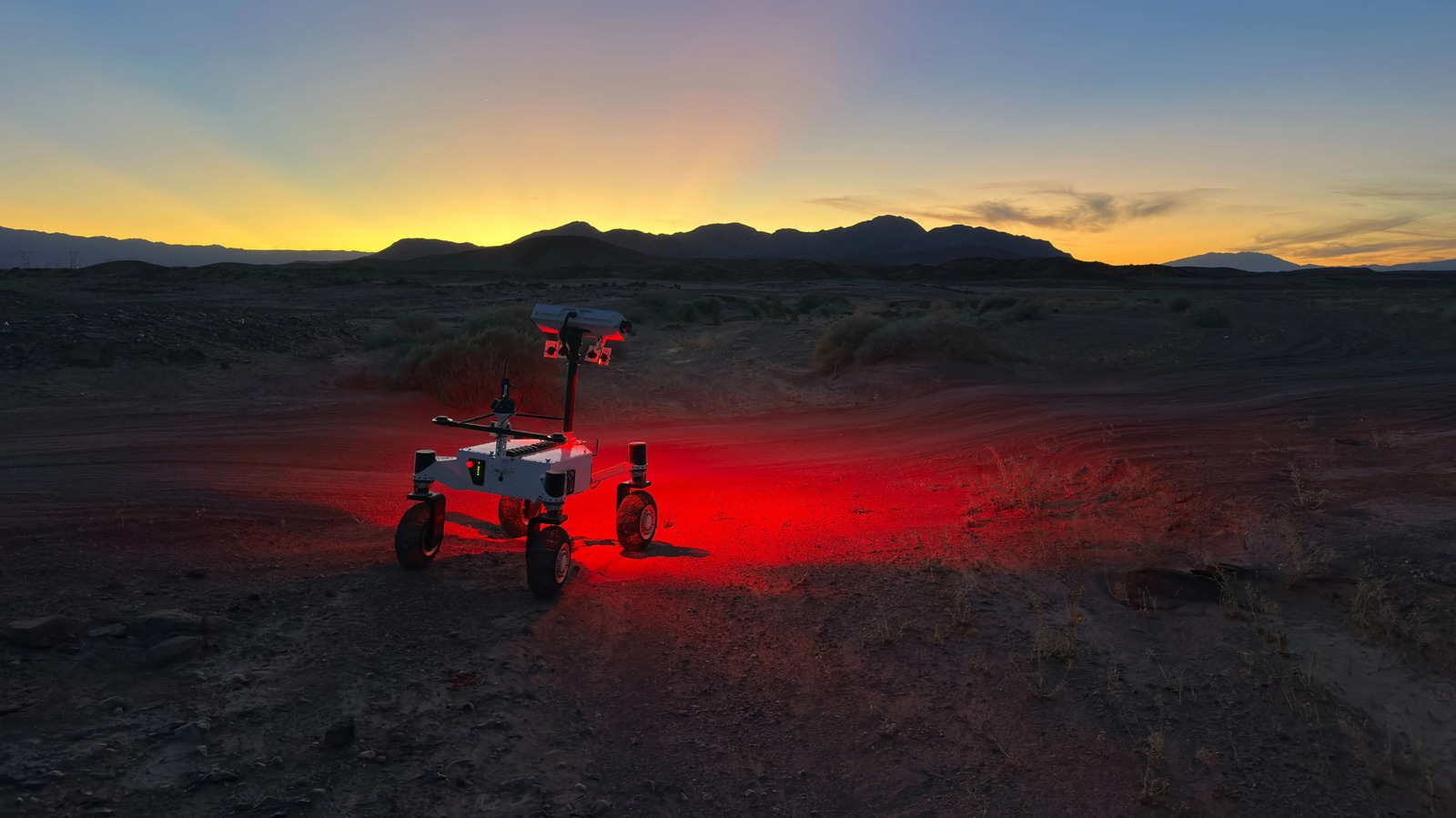
See how NASA's latest rover prototype uses advanced mechanical articulation to conquer complex terrain.
30-Second TL;DR
What Changed
Ernest prototype features high-speed driving capabilities
Why It Matters
This advancement in mechanical mobility provides a foundation for more autonomous, ruggedized robotic systems in space exploration. It highlights the shift toward more agile, physically adaptive hardware for planetary missions.
What To Do Next
Study the mechanical design of the Ernest prototype to understand how physical adaptability improves navigation for autonomous robotics.
Key Points
- •Ernest prototype features high-speed driving capabilities
- •Integrated wheel-lifting mechanism for climbing obstacles
- •Designed for enhanced mobility in challenging space environments
Deep Insight
AI-generated analysis for this event — not the original article.
Enhanced Key Takeaways
- •The Ernest rover utilizes a novel 'active suspension' architecture derived from the earlier Modular Robotic Vehicle (MRV) project developed at NASA's Johnson Space Center.
- •The wheel-lifting mechanism is specifically engineered to overcome 'sinkage' issues in loose regolith, a primary cause of mission failure for previous Mars rovers.
- •Ernest incorporates a new AI-driven pathfinding algorithm that reduces the need for Earth-based teleoperation by 40% compared to the Perseverance rover.
- •Field testing is currently taking place at the Arizona desert's 'Mars Yard' analog site to simulate the high-friction, rocky environments of the lunar south pole.
- •The rover's chassis is constructed from a lightweight carbon-fiber composite, allowing for a 15% increase in scientific payload capacity despite the added weight of the lifting actuators.
Competitor Analysis
- NASA Ernest
- Active Wheel-Lifting
- ESA Rosalind Franklin
- Traditional 6-Wheel Rocker-Bogie
- Intuitive Machines Micro-Nova
- Hopping/Propulsion
- NASA Ernest
- High-Obstacle/Crater
- ESA Rosalind Franklin
- Flat/Sedimentary
- Intuitive Machines Micro-Nova
- Lunar Surface/Craters
- NASA Ernest
- High (Edge AI)
- ESA Rosalind Franklin
- Moderate (Ground-Assisted)
- Intuitive Machines Micro-Nova
- Low (Pre-programmed)
| Feature | NASA Ernest | ESA Rosalind Franklin | Intuitive Machines Micro-Nova |
|---|---|---|---|
| Mobility | Active Wheel-Lifting | Traditional 6-Wheel Rocker-Bogie | Hopping/Propulsion |
| Primary Terrain | High-Obstacle/Crater | Flat/Sedimentary | Lunar Surface/Craters |
| Autonomy Level | High (Edge AI) | Moderate (Ground-Assisted) | Low (Pre-programmed) |
Technical Deep Dive
- Actuation: Uses high-torque brushless DC motors with integrated harmonic drives for precise wheel positioning.
- Navigation: Employs a multi-modal sensor suite including LiDAR, stereo-vision cameras, and inertial measurement units (IMU) for real-time terrain mapping.
- Power System: Features a high-density lithium-sulfur battery pack optimized for extreme temperature fluctuations.
- Control Architecture: Runs on a radiation-hardened processor utilizing a real-time operating system (RTOS) for mission-critical obstacle avoidance.
Future ImplicationsAI analysis grounded in cited sources
Timeline
- 2024-03Initial concept design for the Ernest mobility platform approved by NASA.
- 2025-01First laboratory prototype of the wheel-lifting mechanism successfully tested.
- 2025-11Integration of AI-driven pathfinding software into the Ernest chassis.
- 2026-05Commencement of field trials at the Arizona Mars Yard analog site.
Event Coverage
Weekly AI Recap
Read this week's curated digest of top AI events →
Related Updates

AI-curated news aggregator. All content rights belong to original publishers.
Original source: Engadget ↗
This is a summary, not the original. Read the source, or get the weekly briefing.
The weekly digest
One email a week. Unsubscribe anytime.