Multimodal Embeddings & RAG Guide
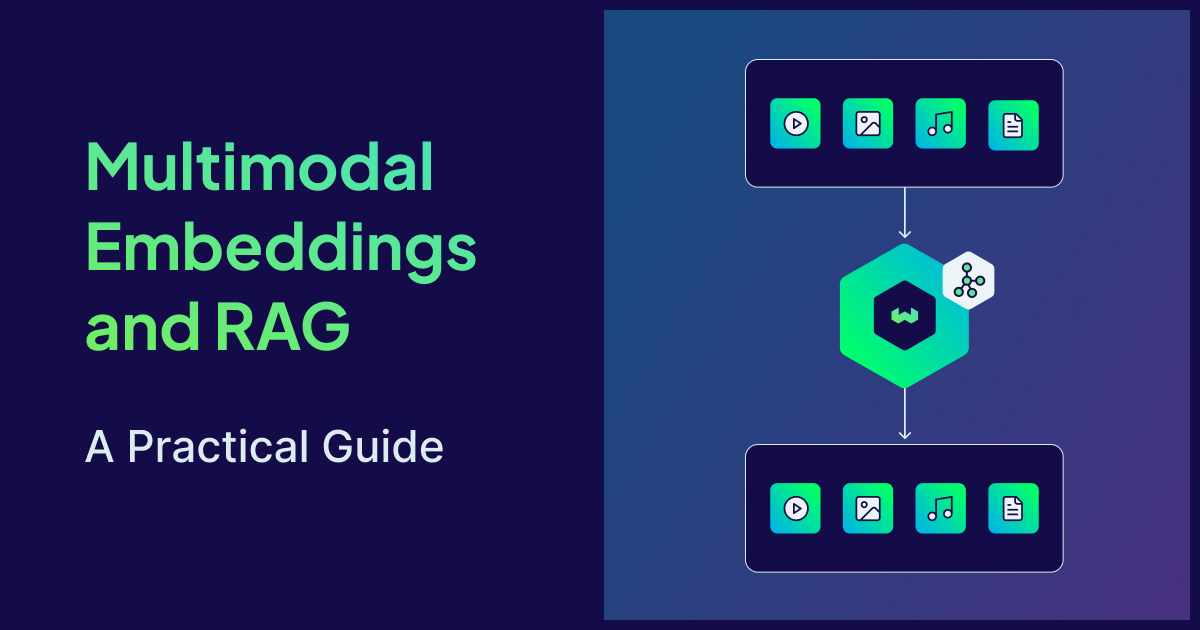
💡Hands-on guide to multimodal RAG with Weaviate & Gemini—build cross-media AI search now.
⚡ 30-Second TL;DR
What Changed
Multimodal embeddings support native cross-modality search
Why It Matters
This guide empowers developers to build advanced multimodal RAG systems efficiently, expanding AI applications beyond text-only data.
What To Do Next
Implement the first RAG example from the Weaviate blog using their client library and Gemini API.
Key Points
- •Multimodal embeddings support native cross-modality search
- •Key intuitions for multimodal AI processing explained
- •Three hands-on RAG implementations with Weaviate and Gemini
🧠 Deep Insight
AI-generated analysis for this event — not the original article.
🔑 Enhanced Key Takeaways
- •Multimodal RAG architectures leverage joint embedding spaces, such as those produced by Google's Gemini or OpenAI's CLIP, to map disparate data types into a shared vector space, allowing for semantic retrieval without modality-specific translation layers.
- •The integration of multimodal models with vector databases like Weaviate facilitates 'image-to-image' or 'text-to-video' retrieval, moving beyond traditional text-based metadata filtering to content-aware semantic search.
- •Implementing multimodal RAG requires addressing the 'modality gap'—the performance discrepancy when querying across different data types—often mitigated by fine-tuning or using contrastive learning objectives during the embedding generation phase.
📊 Competitor Analysis▸ Show
| Feature | Weaviate (Multimodal RAG) | Pinecone (Multimodal) | Milvus (Multimodal) |
|---|---|---|---|
| Architecture | Native vector search with modular integration | Managed vector database with multimodal support | Distributed vector database for high-scale multimodal |
| Pricing | Open-source / Cloud (Usage-based) | Cloud (Usage-based) | Open-source / Cloud (Usage-based) |
| Benchmarks | High performance for complex RAG pipelines | Optimized for low-latency retrieval | Optimized for massive-scale vector datasets |
🛠️ Technical Deep Dive
- Joint Embedding Spaces: Utilizes models that map text, images, and audio into a unified high-dimensional vector space (e.g., 768 or 1024 dimensions) using contrastive loss functions.
- Vector Indexing: Employs HNSW (Hierarchical Navigable Small World) graphs within Weaviate to enable approximate nearest neighbor (ANN) search across multimodal vectors.
- RAG Pipeline: The process involves: 1) Vectorizing the multimodal query; 2) Performing a similarity search in the vector database; 3) Passing retrieved context (images/text) to a multimodal LLM (e.g., Gemini) for final synthesis.
- Modality Alignment: Relies on pre-trained multimodal encoders that have been trained on massive, paired datasets (e.g., image-text pairs) to ensure semantic proximity between different modalities.
🔮 Future ImplicationsAI analysis grounded in cited sources
⏳ Timeline
Weekly AI Recap
Read this week's curated digest of top AI events →
👉Related Updates
AI-curated news aggregator. All content rights belong to original publishers.
Original source: Weaviate Blog ↗
This is a summary, not the original. Read the source, or get the weekly briefing.
The weekly digest
One email a week. Unsubscribe anytime.