mRNA Vaccines Evolve to Outpace Cancer Mutations
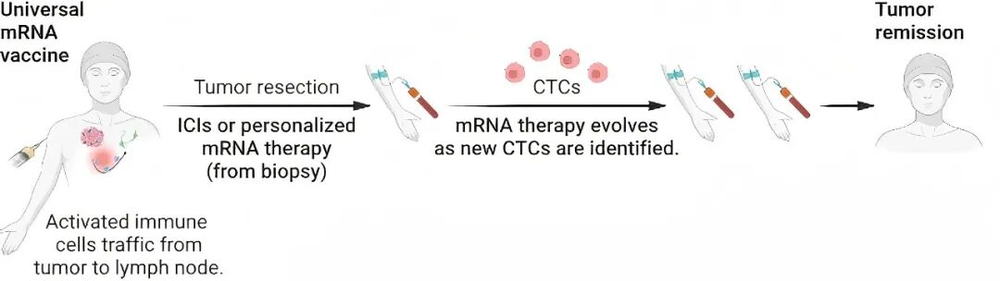
A breakthrough in mRNA vaccine design that uses dynamic data updates to outpace biological evolution.
30-Second TL;DR
What Changed
mRNA vaccines can trigger immune responses without needing tumor-specific antigens by mimicking viral infection signals.
Why It Matters
This paradigm shift moves cancer treatment from static 'kill' strategies to dynamic immune-priming, potentially increasing survival for patients resistant to traditional therapies.
What To Do Next
Explore how dynamic, real-time data feedback loops (like CTC analysis) can be applied to your own adaptive AI model architectures.
Key Points
- •mRNA vaccines can trigger immune responses without needing tumor-specific antigens by mimicking viral infection signals.
- •Real-world data shows COVID-19 mRNA vaccines significantly improved survival rates for cancer patients undergoing immunotherapy.
- •New 'evolutionary' approach uses circulating tumor cells (CTC) to update vaccine targets in real-time, matching tumor evolution.
Deep Insight
Background and context from public sources — not the original article. 29 sources cited.
Enhanced Key Takeaways
- •Non-tumor-specific mRNA vaccines can induce a process called 'epitope spreading,' where the inflammation triggered by the vaccine reveals previously hidden tumor antigens, thereby transforming immunologically 'cold' tumors into inflamed, therapy-responsive microenvironments.
- •The significant survival benefit observed in cancer patients receiving COVID-19 mRNA vaccines while undergoing immunotherapy, particularly for advanced non-small cell lung cancer and metastatic melanoma, has led to the design of a randomized Phase III clinical trial to further investigate this association.
- •Current personalized mRNA cancer vaccines are typically designed by sequencing a patient's resected tumor to identify unique neoantigens, allowing for a tailored immune response against malignant cells, with the entire process from sequencing to vaccine manufacturing potentially completed within a few months.
Competitor Analysis
- Features
- Personalized lipid nanoparticle mRNA cancer vaccine encoding up to 34 neoantigens; administered via intramuscular injection.
- Benchmarks
- Phase IIb trial showed 44% reduction in recurrence or death risk in Stage 3/4 melanoma patients when combined with pembrolizumab. Phase III trials ongoing for adjuvant melanoma, NSCLC, and cutaneous squamous cell carcinoma.
- Pricing
- Over $100,000 per patient (estimated for personalized vaccines).
- Features
- Individualized mRNA cancer vaccine (iNeST platform) encoding up to 20 patient-specific neoantigens; uses unmodified mRNA formulated into lipoplexes, dosed intravenously.
- Benchmarks
- Demonstrated potent immune responses against patient-specific neoantigens in early-phase studies. Phase II trials for pancreatic ductal adenocarcinoma, melanoma, and colorectal cancer. Showed poly-epitopic neoantigen-specific T-cell response in resected stage II/III CRC patients.
- Pricing
- Over $100,000 per patient (estimated for personalized vaccines).
| Company/Product | Features | Benchmarks | Pricing |
|---|---|---|---|
| Moderna (mRNA-4157/V940) | Personalized lipid nanoparticle mRNA cancer vaccine encoding up to 34 neoantigens; administered via intramuscular injection. | Phase IIb trial showed 44% reduction in recurrence or death risk in Stage 3/4 melanoma patients when combined with pembrolizumab. Phase III trials ongoing for adjuvant melanoma, NSCLC, and cutaneous squamous cell carcinoma. | Over $100,000 per patient (estimated for personalized vaccines). |
| BioNTech (autogene cevumeran / BNT122) | Individualized mRNA cancer vaccine (iNeST platform) encoding up to 20 patient-specific neoantigens; uses unmodified mRNA formulated into lipoplexes, dosed intravenously. | Demonstrated potent immune responses against patient-specific neoantigens in early-phase studies. Phase II trials for pancreatic ductal adenocarcinoma, melanoma, and colorectal cancer. Showed poly-epitopic neoantigen-specific T-cell response in resected stage II/III CRC patients. | Over $100,000 per patient (estimated for personalized vaccines). |
Technical Deep Dive
- mRNA Vaccine Mechanism: mRNA vaccines deliver antigen-encoding mRNA, often encapsulated in lipid nanoparticles (LNPs), into antigen-presenting cells (APCs) like dendritic cells. These cells then translate the mRNA into foreign proteins (tumor antigens or neoantigens), which are presented to the immune system to stimulate a potent T-cell response crucial for attacking cancer cells.
- Personalization Process: The development of personalized mRNA cancer vaccines involves taking tumor samples from a patient, performing DNA and RNA sequencing to identify unique tumor-specific neoantigens (mutated proteins), selecting the most immunogenic ones, and then designing mRNA sequences to encode these specific antigens.
- Immune Activation Pathways: mRNA vaccines activate both innate and adaptive immune responses. Innate immunity is triggered through pattern recognition receptors (PRRs) like TLR7/8 and RIG-I, leading to broad immune activation. Dendritic cells, specifically cDC1 and cDC2 subsets, play a critical role in priming T cells to recognize and attack cancer cells.
- Delivery Systems: Lipid nanoparticles (LNPs) are essential for protecting the fragile mRNA molecules from degradation and ensuring their efficient delivery into target cells. Advanced LNP formulations, sometimes with internal fat layers, are being developed to enhance mRNA loading and delivery efficiency.
- Adjuvant Strategies: Researchers are exploring mRNA-encoded adjuvants, such as those encoding IRF8 and NIK, which are involved in antigen presentation and can switch immune cells into a more active state, thereby boosting T-cell responses and enhancing tumor eradication, even without a specific tumor antigen.
Future ImplicationsAI analysis grounded in cited sources
Timeline
- 1990First use of mRNA-encoded proteins for vaccination in mice.
- 1995Development of the first mRNA cancer vaccine, encoding a tumor antigen in mice.
- 2001First human clinical trial for a therapeutic cancer mRNA vaccine using ex vivo dendritic cells.
- 2013Initiation of the first clinical trial for a personalized mRNA-based vaccine against melanoma.
- 2020Approval of COVID-19 mRNA vaccines, significantly accelerating research and development in mRNA oncology.
- 2022-12Moderna and Merck announced positive Phase IIb trial results for personalized mRNA-4157/V940 in melanoma, showing a 44% reduction in recurrence or death risk.
Sources (29)
Factual claims are grounded in the sources below. Forward-looking analysis is AI-generated interpretation.
Weekly AI Recap
Read this week's curated digest of top AI events →
AI-curated news aggregator. All content rights belong to original publishers.
Original source: 虎嗅 ↗
This is a summary, not the original. Read the source, or get the weekly briefing.
The weekly digest
One email a week. Unsubscribe anytime.