MOSS Team Pivots to End-to-End Multimodal Voice AI
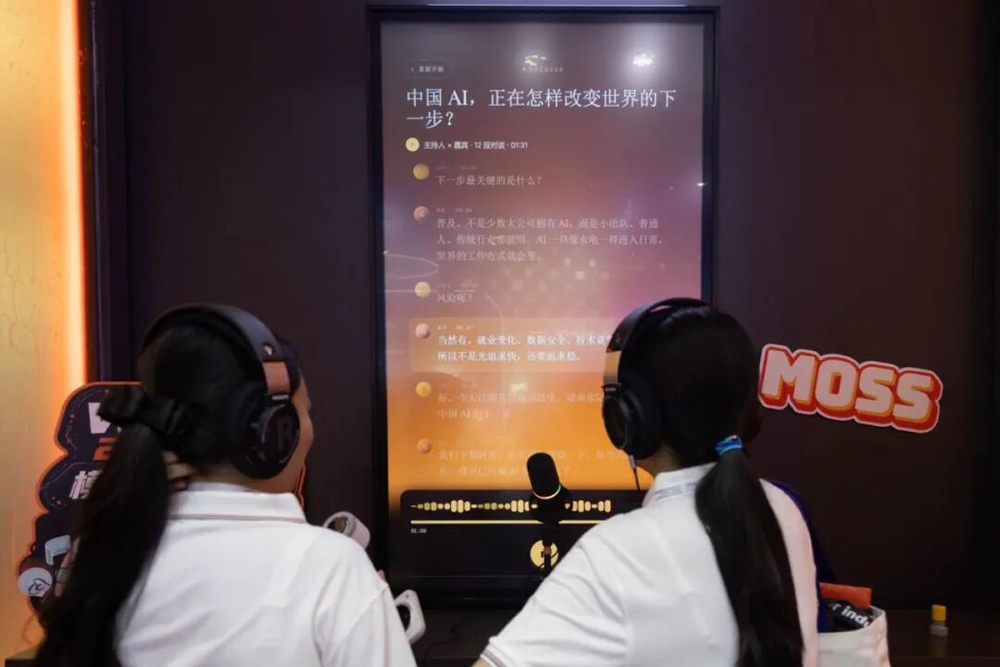
💡Learn why the MOSS team is abandoning text-only models for end-to-end voice to solve real-time interaction latency.
⚡ 30-Second TL;DR
What Changed
Shifted from text-only LLMs to end-to-end voice-first multimodal models to reduce latency and information loss.
Why It Matters
By focusing on end-to-end voice processing, the team aims to solve the latency and emotional nuance issues inherent in traditional cascaded ASR-LLM-TTS pipelines, potentially setting a new standard for AI hardware integration.
What To Do Next
Evaluate the performance trade-offs of end-to-end voice models versus cascaded pipelines when building real-time interactive AI agents for hardware.
Key Points
- •Shifted from text-only LLMs to end-to-end voice-first multimodal models to reduce latency and information loss.
- •Developing 'Situational Intelligence' to allow models to perceive physical environments, emotion, and speaker identity.
- •Product lineup includes MOSS-Transcribe-Diarize, MOSS-Video-Preview, and MOSS-TTS.
- •Adopting a user-centric development approach by prioritizing real-world feedback on latency and performance over pure technical exploration.
🧠 Deep Insight
AI-generated analysis for this event.
🔑 Enhanced Key Takeaways
- •Moss Intelligence was established by Professor Qiu Xipeng and his team from Fudan University, transitioning the academic MOSS project into a commercial entity.
- •The company has secured strategic backing from major Chinese venture capital firms focusing on AGI infrastructure to support the high compute costs of end-to-end multimodal training.
- •The 'Situational Intelligence' framework utilizes a proprietary streaming architecture that processes audio tokens directly without intermediate text conversion, significantly reducing 'time-to-first-token' latency.
- •Moss Intelligence is targeting the enterprise 'Digital Employee' market, specifically focusing on high-stakes sectors like legal transcription and real-time medical diagnostics where speaker diarization accuracy is critical.
- •The team is leveraging a hybrid training strategy that combines large-scale synthetic audio data with real-world acoustic environment datasets to improve robustness in noisy, non-studio conditions.
📊 Competitor Analysis▸ Show
| Feature | Moss Intelligence | OpenAI (Voice Mode) | DeepSeek (Voice) |
|---|---|---|---|
| Architecture | End-to-End Native | End-to-End Native | Text-to-Speech Pipeline |
| Primary Focus | Situational/Physical Context | Conversational Fluidity | Reasoning/Coding |
| Diarization | High-Precision Native | Standard | Limited |
| Market Target | Enterprise/Industrial | Consumer/General | Developer/API |
🛠️ Technical Deep Dive
- Architecture: Utilizes a unified transformer backbone that processes multi-stream inputs (audio, visual, text) into a shared latent space.
- Latency Optimization: Implements a speculative decoding mechanism specifically tuned for audio tokens to maintain sub-200ms response times.
- Diarization Engine: Employs a speaker-embedding module integrated directly into the attention layers, allowing the model to maintain speaker identity across long-form audio sessions.
- Training Data: Employs a multi-stage curriculum learning approach, starting with synthetic speech-to-intent tasks and scaling to complex, multi-speaker situational dialogues.
🔮 Future ImplicationsAI analysis grounded in cited sources
⏳ Timeline
Weekly AI Recap
Read this week's curated digest of top AI events →
👉Related Updates



AI-curated news aggregator. All content rights belong to original publishers.
Original source: 虎嗅 ↗