Momenta IPO Strategy: Beyond Capital
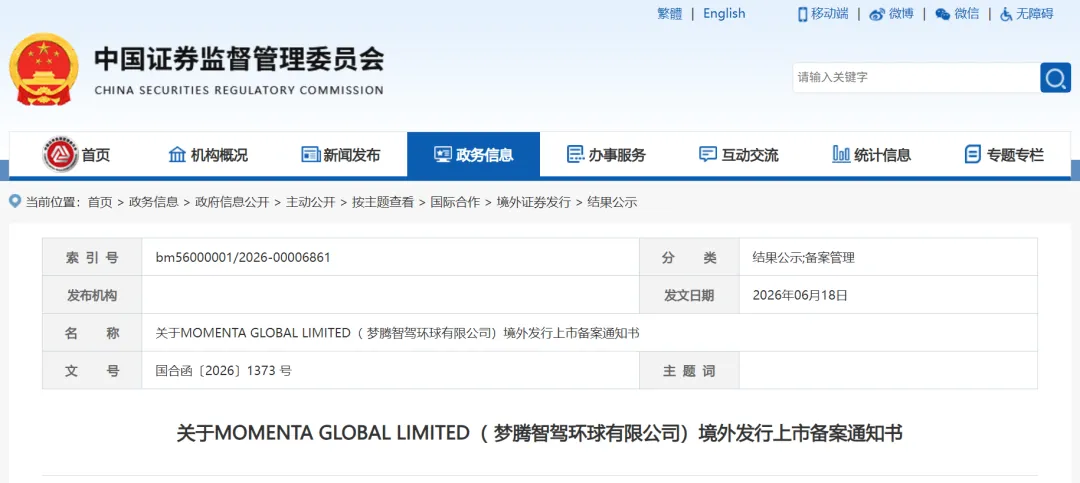
💡Understand how top-tier autonomous driving firms are balancing IPO goals with long-term technical R&D.
⚡ 30-Second TL;DR
What Changed
IPO is not driven by immediate capital requirements
Why It Matters
This signals a shift in how autonomous driving unicorns approach public markets, prioritizing strategic stability over rapid cash injection.
What To Do Next
Monitor Momenta's public filings for insights into their long-term R&D allocation versus operational scaling.
Key Points
- •IPO is not driven by immediate capital requirements
- •Strategic focus remains on long-term autonomous driving development
- •Identified 'strategic inconsistency' as the primary corporate risk
🧠 Deep Insight
AI-generated analysis for this event — not the original article.
🔑 Enhanced Key Takeaways
- •Momenta has adopted a 'Flywheel' strategy, utilizing data from mass-produced vehicles to iteratively improve autonomous driving algorithms, which distinguishes its business model from pure R&D-focused competitors.
- •The company has secured significant strategic investment from major automotive OEMs including SAIC Motor, General Motors, Toyota, and Mercedes-Benz, creating a unique ecosystem of manufacturing partners.
- •Momenta's dual-track product strategy, Mpilot (mass production) and MSD (Momenta Self Driving/L4), is designed to create a data feedback loop that accelerates the transition from L2+ to L4 autonomy.
- •The IPO strategy is widely interpreted by industry analysts as a move to enhance corporate governance and brand credibility in international markets rather than a liquidity-driven event.
- •Momenta has actively expanded its footprint in overseas markets, particularly in Europe and Southeast Asia, to mitigate geopolitical risks associated with the Chinese autonomous driving market.
📊 Competitor Analysis▸ Show
| Feature | Momenta | Pony.ai | WeRide |
|---|---|---|---|
| Primary Strategy | Flywheel (L2+ to L4) | Robotaxi-first | Robotaxi & Autonomous Freight |
| Key OEM Partners | SAIC, GM, Toyota, Mercedes | Toyota | Nissan, Bosch, Yutong |
| Market Focus | Mass production & L4 | Robotaxi operations | Multi-modal autonomous transport |
🛠️ Technical Deep Dive
- Architecture: Utilizes a data-driven, deep learning-based perception stack that emphasizes sensor fusion of LiDAR, cameras, and millimeter-wave radar.
- Training Infrastructure: Employs a massive cloud-based computing platform to process petabytes of driving data collected from mass-produced vehicles to train neural networks.
- Algorithm Approach: Focuses on 'Learning-based Planning' which replaces traditional rule-based decision-making with end-to-end or modular neural network architectures to handle complex urban traffic scenarios.
- Calibration: Implements automated high-precision mapping and localization technologies that do not rely solely on HD maps, allowing for better scalability in diverse geographic regions.
🔮 Future ImplicationsAI analysis grounded in cited sources
⏳ Timeline
Weekly AI Recap
Read this week's curated digest of top AI events →
👉Related Updates

AI-curated news aggregator. All content rights belong to original publishers.
Original source: 钛媒体 ↗
This is a summary, not the original. Read the source, or get the weekly briefing.
Weekly AI briefing
One email a week. Unsubscribe anytime.