MLCC Giants Ride the AI Server Wave
AI servers are reshaping MLCC demand, pricing, inventories, and lead times across the supply chain.
30-Second TL;DR
What Changed
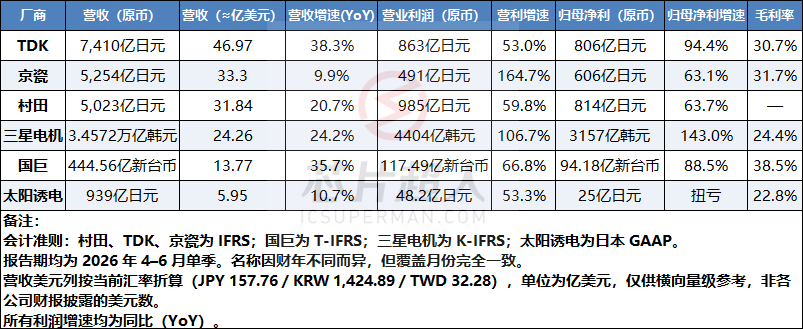
TDK and Yageo posted the strongest revenue growth, up 38.3% and 35.7% year over year.
Why It Matters
AI infrastructure demand is tightening the supply-demand balance for high-capacitance and high-reliability MLCCs. Hardware companies and data-center builders may face longer lead times and higher component costs, while suppliers with advanced AI and automotive portfolios gain pricing power.
What To Do Next
Audit your AI server bill of materials for high-capacitance MLCC dependencies and lock in supply for critical components before lead times deteriorate.
Key Points
- •TDK and Yageo posted the strongest revenue growth, up 38.3% and 35.7% year over year.
- •Murata's capacitor revenue rose 30%, driven by AI servers and automotive applications, while capacitor inventory slightly declined.
- •Samsung Electro-Mechanics' component revenue increased 29%, with MLCC growth concentrated in AI servers, networking, power supplies, ADAS, and xEVs.
- •TDK and Kyocera's overall growth was not attributable entirely to MLCC because energy, battery, semiconductor, magnetic, and one-time businesses also contributed.
- •Murata's B/B ratio rose from 1.24 to 1.34, indicating stronger incoming orders and improving demand visibility.
Deep Insight
AI-generated analysis for this event — not the original article.
Enhanced Key Takeaways
- •The surge in MLCC demand is specifically tied to the transition toward high-voltage and high-temperature requirements in AI server power delivery networks (PDNs), necessitating advanced dielectric materials.
- •Japanese manufacturers are increasingly shifting production capacity toward 'high-end' MLCCs (0201 and 01005 sizes) to maintain margins, leaving the commodity market to Taiwanese and Chinese competitors.
- •Supply chain constraints for specialized raw materials, such as high-purity barium titanate, have become a bottleneck for scaling production of ultra-high-capacitance MLCCs required for AI accelerators.
- •The industry is seeing a shift in procurement strategies where AI server OEMs are moving toward long-term agreements (LTAs) to secure supply, reducing the volatility typically seen in the consumer electronics MLCC market.
- •Murata and TDK have accelerated capital expenditure (CapEx) toward automated 'smart factory' initiatives to improve yield rates for complex, multi-layer components, directly impacting their improved operating profit margins.
Competitor Analysis
- Murata
- Global Leader (High-end)
- Samsung Electro-Mechanics
- Strong Challenger (AI/Auto)
- Yageo
- Mid-to-High Range
- TDK
- Specialized/Magnetic Focus
- Murata
- High (Premium/Custom)
- Samsung Electro-Mechanics
- High (Integrated Solutions)
- Yageo
- Moderate (Volume/Cost)
- TDK
- High (Power/Energy)
- Murata
- ADAS/Powertrain
- Samsung Electro-Mechanics
- xEV/Infotainment
- Yageo
- Aftermarket/Tier 2
- TDK
- Energy/Battery Integration
- Murata
- Very High
- Samsung Electro-Mechanics
- High
- Yageo
- Moderate
- TDK
- High (Niche)
| Feature | Murata | Samsung Electro-Mechanics | Yageo | TDK |
|---|---|---|---|---|
| Market Position | Global Leader (High-end) | Strong Challenger (AI/Auto) | Mid-to-High Range | Specialized/Magnetic Focus |
| AI Server Focus | High (Premium/Custom) | High (Integrated Solutions) | Moderate (Volume/Cost) | High (Power/Energy) |
| Auto Strategy | ADAS/Powertrain | xEV/Infotainment | Aftermarket/Tier 2 | Energy/Battery Integration |
| Pricing Power | Very High | High | Moderate | High (Niche) |
Technical Deep Dive
- MLCCs for AI servers require high capacitance (10uF to 100uF) in small form factors to manage voltage ripple in high-current AI processor power rails.
- Advanced dielectric materials (Class II/X7R/X5R) are being optimized for higher temperature stability (up to 150°C) to withstand the thermal density of AI server racks.
- Implementation of 'Low ESL' (Equivalent Series Inductance) designs is critical to support the rapid transient response times required by next-generation GPUs and NPUs.
- Adoption of thin-layer technology (sub-micron ceramic layers) allows for higher volumetric efficiency, enabling more capacitance in the same footprint.
Future ImplicationsAI analysis grounded in cited sources
Timeline
- 2023-05Industry-wide inventory correction phase begins following post-pandemic demand slump.
- 2024-02Initial signs of recovery in the MLCC market emerge, driven by early AI server infrastructure build-outs.
- 2025-01Major manufacturers announce increased CapEx for high-capacitance MLCC production lines.
- 2026-04Q1 2026 financial reports confirm a decoupling of AI-related component demand from general consumer electronics.
Weekly AI Recap
Read this week's curated digest of top AI events →
AI-curated news aggregator. All content rights belong to original publishers.
Original source: 虎嗅 ↗
This is a summary, not the original. Read the source, or get the weekly briefing.
The weekly digest
One email a week. Unsubscribe anytime.