Microsoft's 5 Keys to Fast AI Agent Adoption
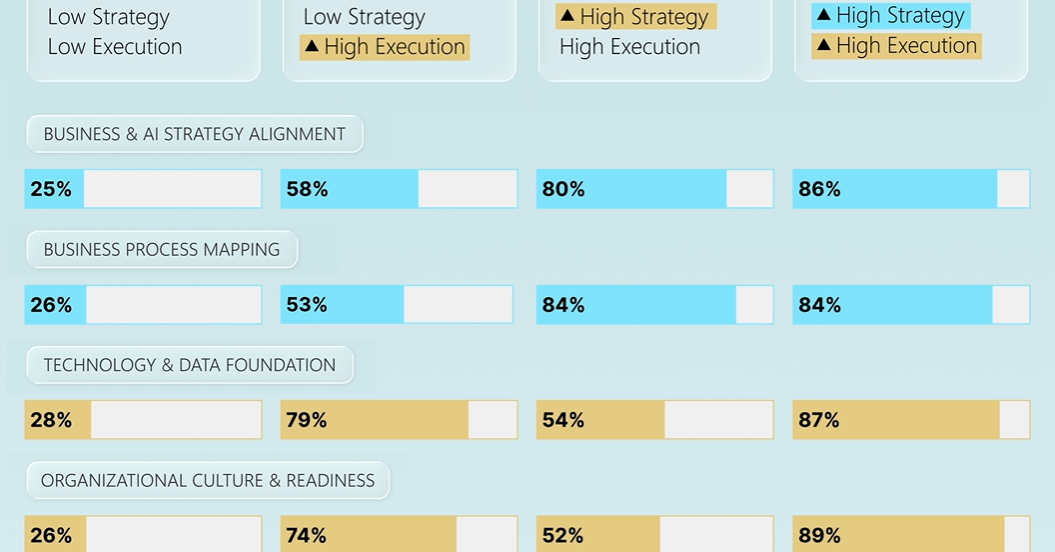
💡Unlock Microsoft's 5 factors for 2.5x faster AI agent deployment
⚡ 30-Second TL;DR
What Changed
Microsoft survey on AI agent readiness
Why It Matters
Enterprises prioritizing these 5 elements gain significant speed advantages in AI agent rollout, potentially boosting productivity and competitiveness.
What To Do Next
Download Microsoft's AI agent readiness report to benchmark your firm's 5 elements.
Key Points
- •Microsoft survey on AI agent readiness
- •Prepared firms deploy 2.5x faster
- •5 elements separate successful adopters
- •Focus on enterprise preparation gaps
🧠 Deep Insight
Background and context from public sources — not the original article. 8 sources cited.
🔑 Enhanced Key Takeaways
- •80% of Fortune 500 companies are actively deploying AI agents built with Microsoft Copilot Studio or Agent Builder, with deployment rates varying significantly by company size (67% for enterprises with 10,000+ employees vs. 50% for companies under 100 employees)[1][3]
- •A critical governance gap exists: while 74% of organizations plan to deploy agentic AI within two years, only 21% report having mature governance models in place, and 29% of employees have already turned to unsanctioned AI agents for work tasks[1][3]
- •Adoption progression shows 32% of organizations are preparing to scale agents and 15% are revisiting strategy after early pilots, with IT and Customer Service leading adoption while Procurement, HR, and Supply Chain lag by 20-23 percentage points[2]
- •Leading industries driving agent deployment include software/technology (16%), manufacturing (13%), financial institutions (11%), and retail (9%), with agents handling complex tasks from proposal drafting to security alert triage and autonomous process execution[3]
🛠️ Technical Deep Dive
- •Microsoft's enterprise identity integration: AI agents receive unique digital identities via Entra ID system, enabling tracking and attribution of all agent actions within corporate networks similar to regular user accounts[4]
- •Agent operational modes: Agents function in assistive modes (responding to user prompts) or autonomous modes (executing tasks with minimal human intervention), with dynamic behavior that includes decision-making, data access, and inter-agent interaction capabilities[3]
- •Microsoft Agent Factory and Copilot Studio Lite: Toolkit programs designed to enable rapid agent customization and deployment, providing context management to reduce hallucinations and improve decision quality in business environments[4]
🔮 Future ImplicationsAI analysis grounded in cited sources
⏳ Timeline
📎 Sources (8)
Factual claims are grounded in the sources below. Forward-looking analysis is AI-generated interpretation.
- digg.com — AI Agent Adoption Statistics in 2026
- Microsoft — Agents Are Here Is Your Company Prepared
- Microsoft — 80 of Fortune 500 Use Active AI Agents Observability Governance and Security Shape the New Frontier
- digitalbricks.ai — 2026 the Year of the AI Agent
- news.microsoft.com — Whats Next in AI 7 Trends to Watch in 2026
- Microsoft — Whats Next in AI
- Microsoft — 2026 Enterprise Trends What Founders Should Prepare for
- victorianchamber.com.au — 7 AI Trends to Watch in 2026 According to Microsoft
Weekly AI Recap
Read this week's curated digest of top AI events →
👉Related Updates

AI-curated news aggregator. All content rights belong to original publishers.
Original source: ITmedia AI+ (日本) ↗
This is a summary, not the original. Read the source, or get the weekly briefing.
Weekly AI briefing
One email a week. Unsubscribe anytime.