Microsoft Urges Passkey Shift
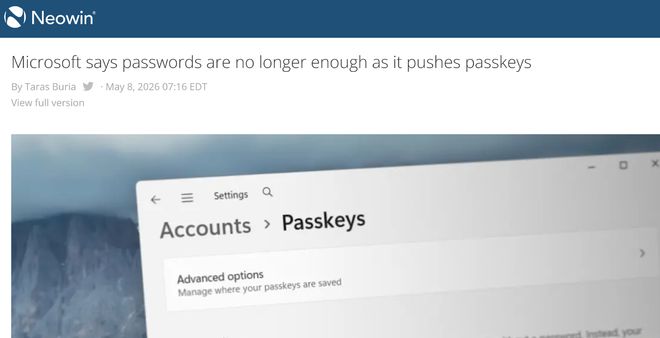
Microsoft's passkey push secures logins for AI apps vs. weak passwords
30-Second TL;DR
What Changed
Initiative launched on first Thursday of May (World Password Day)
Why It Matters
Passkeys could standardize secure auth across AI services, reducing phishing risks for developers building user-facing AI apps.
What To Do Next
Enable passkey authentication in your Microsoft Entra ID for AI app logins.
Key Points
- •Initiative launched on first Thursday of May (World Password Day)
- •Targets users and enterprises for password-to-passkey migration
- •Addresses complex cyber threats to digital identities
Deep Insight
AI-generated analysis for this event — not the original article.
Enhanced Key Takeaways
- •Microsoft is integrating passkey support directly into the Windows Hello framework, allowing users to sync credentials across devices via the Microsoft Account ecosystem.
- •The initiative includes new APIs for enterprise developers to enforce FIDO2-compliant authentication, effectively deprecating legacy multi-factor authentication (MFA) methods like SMS-based codes.
- •Microsoft is partnering with the FIDO Alliance to standardize cross-platform recovery protocols, addressing the primary user concern regarding account lockout when losing a primary device.
Competitor Analysis
- Microsoft (Passkeys)
- Windows/Microsoft Account
- Google (Passkeys)
- Google Password Manager
- Apple (Passkeys)
- iCloud Keychain
- Microsoft (Passkeys)
- FIDO2 / WebAuthn
- Google (Passkeys)
- FIDO2 / WebAuthn
- Apple (Passkeys)
- FIDO2 / WebAuthn
- Microsoft (Passkeys)
- Entra ID Integration
- Google (Passkeys)
- Google Workspace
- Apple (Passkeys)
- Apple Business Manager
| Feature | Microsoft (Passkeys) | Google (Passkeys) | Apple (Passkeys) |
|---|---|---|---|
| Ecosystem Sync | Windows/Microsoft Account | Google Password Manager | iCloud Keychain |
| Primary Standard | FIDO2 / WebAuthn | FIDO2 / WebAuthn | FIDO2 / WebAuthn |
| Enterprise Mgmt | Entra ID Integration | Google Workspace | Apple Business Manager |
Technical Deep Dive
- •Utilizes public-key cryptography where the private key is stored in the device's Trusted Platform Module (TPM) or Secure Enclave.
- •Authentication flow relies on the WebAuthn API, which facilitates a challenge-response handshake between the relying party (server) and the authenticator (client).
- •Supports 'discoverable credentials' (resident keys), allowing the authenticator to store the user's account identifier, removing the need for a username entry step.
- •Implements FIDO Alliance's 'Multi-Device FIDO Credentials' (synced passkeys) to allow credential portability across encrypted cloud backups.
Future ImplicationsAI analysis grounded in cited sources
Timeline
- 2018-04Microsoft announces support for FIDO2 authentication in Windows 10.
- 2021-09Microsoft allows users to remove passwords entirely from their Microsoft Accounts.
- 2023-10Microsoft begins rolling out passkey support for personal Microsoft Accounts on Windows.
- 2025-05Microsoft expands passkey support to Entra ID for enterprise-wide passwordless authentication.
Weekly AI Recap
Read this week's curated digest of top AI events →
Related Updates


AI-curated news aggregator. All content rights belong to original publishers.
Original source: cnBeta (Full RSS) ↗
This is a summary, not the original. Read the source, or get the weekly briefing.
The weekly digest
One email a week. Unsubscribe anytime.