Microsoft Unveils Seven Proprietary AI Models
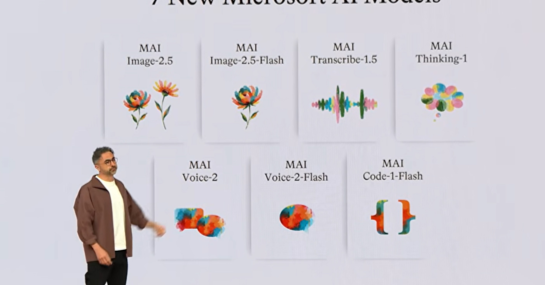
💡Microsoft is diversifying its AI stack with proprietary models. See if these can replace your current API dependencies.
⚡ 30-Second TL;DR
What Changed
Launch of seven distinct proprietary AI models
Why It Matters
This move signals Microsoft's shift toward vertical integration by reducing reliance on third-party model providers for specific tasks. It provides developers with more specialized, Microsoft-native tools for enterprise applications.
What To Do Next
Review the Microsoft AI Models documentation to identify if these proprietary models offer better latency or cost-efficiency for your current workflows compared to OpenAI models.
Key Points
- •Launch of seven distinct proprietary AI models
- •Includes specialized capabilities for image processing
- •Features advanced speech recognition technology
🧠 Deep Insight
Background and context from public sources — not the original article. 19 sources cited.
🔑 Enhanced Key Takeaways
- •The newly launched models are part of the 'MAI' family, encompassing specialized capabilities such as MAI-Thinking-1 for reasoning, MAI-Code-1 for code generation, MAI-Image-2.5 for image generation and editing, MAI-Transcribe-1.5 for transcription, and MAI-Voice-2 for voice generation, along with Flash variants for image and voice models.
- •This initiative marks a strategic pivot for Microsoft to reduce its dependency on external AI partners like OpenAI and Anthropic, aiming for 'long term self-sufficiency' and comprehensive control over its 'AI stack.'
- •MAI-Thinking-1, the flagship reasoning model, is a mid-sized model featuring 35 billion active parameters and a 128K context window, engineered for high efficiency and low token cost, and is currently available in private preview via Microsoft Foundry.
- •MAI-Transcribe-1.5 is touted as the 'best transcription model in the world,' offering state-of-the-art accuracy across 43 languages and reportedly performing five times faster than competing models.
- •Microsoft also introduced smaller 'Aion models' designed to run directly on Windows PCs, indicating a strategic push towards local AI processing to lessen reliance on cloud infrastructure.
📊 Competitor Analysis▸ Show
| Feature/Model | Microsoft MAI Models (e.g., MAI-Thinking-1, MAI-Code-1, MAI-Image-2.5, MAI-Transcribe-1.5) | OpenAI (e.g., GPT models) | Anthropic (e.g., Claude models) | Google (e.g., Nano Banana Pro/2, Gemini Spark) |
|---|---|---|---|---|
| Primary Focus | Reasoning, Coding, Image Gen/Edit, Transcription, Voice Gen, Edge AI | General-purpose LLMs, Code Generation, Image Generation | Reasoning, Code Generation, Conversational AI | General-purpose LLMs, Image Gen, Autonomous Agents |
| Strategic Goal | Long-term self-sufficiency, full AI stack control, cost reduction | Frontier AI research, broad API access, enterprise solutions | Safety-focused AI, enterprise solutions, ethical AI development | Comprehensive AI ecosystem, agentic AI, cloud integration |
| MAI-Thinking-1 Benchmarks | Preferred over Claude Sonnet 4.6 (blind evaluations); matches Claude Opus 4.6 on SWE Bench Pro coding benchmark | GPT-5.4 achieved 59.1% on SWE Bench Pro (as of June 2026) | Claude Sonnet 4.6, Claude Opus 4.6 (51.9% on SWE Bench Pro) | N/A |
| MAI-Code-1 Comparison | Comparable to Haiku, designed for GitHub Copilot & VS Code | Powers GitHub Copilot (historically) | Claude Code (gained ground on GitHub Copilot) | N/A |
| MAI-Image-2.5 Ranking | Ranks second on a leading image-editing leaderboard; third on Arena.AI text-to-image scoreboard | N/A | N/A | Nano Banana Pro (behind MAI-Image-2.5); Nano Banana 2 (ahead of MAI-Image-2.5 on Arena.AI) |
| MAI-Transcribe-1.5 Performance | Claimed 'best in the world,' 5x faster than competitors | N/A | N/A | N/A |
| Agentic AI | Microsoft Scout (personal agent) | N/A | N/A | Gemini Spark (autonomous AI agent) |
| Availability | Private preview (Foundry), integrated into PowerPoint, OneDrive, Copilot, VS Code | Azure OpenAI services, API access | Azure, API access | Google Cloud, API access |
🛠️ Technical Deep Dive
- MAI-Thinking-1: A mid-sized reasoning model with 35 billion active parameters and a 128K context window. It was trained from scratch on commercially licensed data, explicitly without distillation from third-party models.
- MAI-Code-1-Flash: An inference-efficient coding model with 5 billion parameters, specifically tailored for deep integration into GitHub Copilot and Visual Studio Code.
- MAI-Transcribe-1.5: Designed for state-of-the-art accuracy, supporting 43 languages.
- MAI-Voice-2: Offers expanded multilingual support, available in 15 additional languages with multiple voice options.
- Aion Models: These are smaller AI models developed to run directly on Windows PCs, aiming to reduce dependence on cloud-based processing.
- Hardware Integration: Microsoft announced the Surface RTX Spark Dev Box, powered by NVIDIA's RTX Spark chip, capable of delivering up to one petaflop of AI compute and 128 gigabytes of unified memory, designed to run models up to 120 billion parameters locally.
- Operating System Adaptation: Windows is being re-positioned as an agent-native runtime through a new sandboxing system called Microsoft Execution Containers, currently in preview.
- Project Soltera: An Android-based software platform designed for agent-first devices, expanding how AI agents are built, deployed, and experienced.
- Web IQ: A new grounding API suite built upon Bing's index, re-engineered to efficiently extract and package precise information from web documents specifically for AI systems during inference.
🔮 Future ImplicationsAI analysis grounded in cited sources
⏳ Timeline
📎 Sources (19)
Factual claims are grounded in the sources below. Forward-looking analysis is AI-generated interpretation.
Weekly AI Recap
Read this week's curated digest of top AI events →
👉Related Updates
AI-curated news aggregator. All content rights belong to original publishers.
Original source: ITmedia AI+ (日本) ↗
This is a summary, not the original. Read the source, or get the weekly briefing.
The weekly digest
One email a week. Unsubscribe anytime.