Microsoft Restructures Copilot Team Under New Leadership
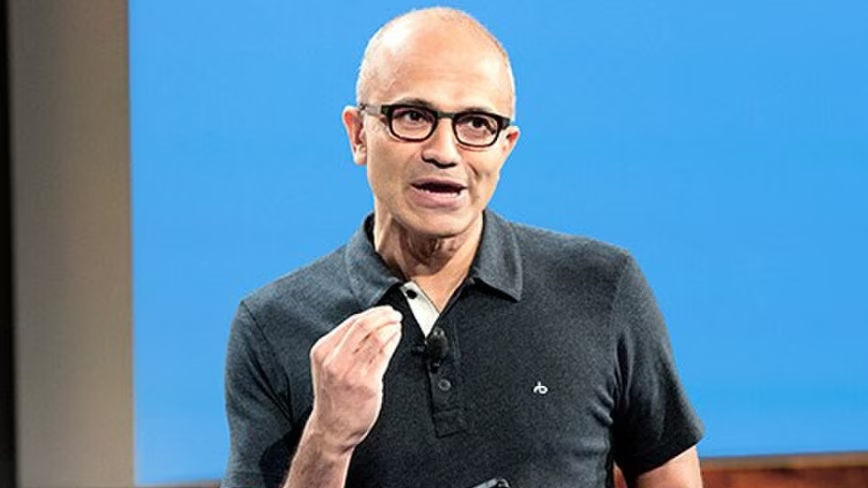
Microsoft is consolidating 11,000 staff to build a Copilot 'super app' with new agentic workflows.
30-Second TL;DR
What Changed
Jacob Andreou now leads a unified team of 11,000 employees for Copilot.
Why It Matters
This consolidation signals a shift toward a more cohesive AI product ecosystem at Microsoft, likely reducing fragmentation for developers and enterprise users. The move toward agentic workflows suggests a major push to move beyond simple chat interfaces.
What To Do Next
Monitor the upcoming 'Autopilot' agentic framework updates to see how they integrate with existing Microsoft Graph and Copilot Studio APIs.
Key Points
- •Jacob Andreou now leads a unified team of 11,000 employees for Copilot.
- •Microsoft is merging consumer and enterprise Copilot divisions to streamline development.
- •The roadmap includes a 'super app' integrating chat, coding, and Autopilot agentic workflows.
Deep Insight
AI-generated analysis for this event — not the original article.
Enhanced Key Takeaways
- •Jacob Andreou previously served as a senior executive at Snap Inc., where he played a pivotal role in the growth of Snapchat's creator ecosystem and product strategy.
- •The restructuring is part of a broader 'Microsoft AI' division reorganization intended to reduce friction between the research-heavy AI Platform team and the product-focused Copilot team.
- •The 'super app' strategy marks a shift away from the previous 'Copilot everywhere' approach, which had been criticized for creating fragmented user experiences across Windows, Office, and Edge.
- •Internal reports suggest the consolidation aims to address significant budget overheads and overlapping headcount that emerged during the rapid expansion of AI teams in 2024 and 2025.
- •The new agentic workflow focus emphasizes 'Autopilot' capabilities, which are designed to perform multi-step tasks autonomously rather than just providing conversational responses.
Competitor Analysis
- Microsoft Copilot
- Enterprise/OS Integration
- Google Gemini
- Ecosystem/Search
- OpenAI ChatGPT
- Reasoning/Agentic
- Anthropic Claude
- Enterprise/Safety
- Microsoft Copilot
- High (Autopilot focus)
- Google Gemini
- Medium (Extensions)
- OpenAI ChatGPT
- High (Operator/Canvas)
- Anthropic Claude
- Medium (Computer Use)
- Microsoft Copilot
- Per-user/Enterprise
- Google Gemini
- Tiered/API
- OpenAI ChatGPT
- Tiered/API
- Anthropic Claude
- Tiered/API
| Feature | Microsoft Copilot | Google Gemini | OpenAI ChatGPT | Anthropic Claude |
|---|---|---|---|---|
| Primary Focus | Enterprise/OS Integration | Ecosystem/Search | Reasoning/Agentic | Enterprise/Safety |
| Agentic Capability | High (Autopilot focus) | Medium (Extensions) | High (Operator/Canvas) | Medium (Computer Use) |
| Pricing Model | Per-user/Enterprise | Tiered/API | Tiered/API | Tiered/API |
Technical Deep Dive
- The unified architecture leverages a shared 'Agentic Orchestration Layer' that manages state across different Microsoft 365 applications.
- Autopilot workflows utilize a proprietary 'Action Graph' which maps user intent to specific API calls within the Microsoft Graph and third-party SaaS connectors.
- The system employs a multi-modal model ensemble, dynamically routing queries between lightweight models for latency-sensitive tasks and frontier models for complex reasoning.
- Implementation relies on a unified telemetry pipeline to train the agentic models on cross-app user behavior, improving task completion rates for multi-step workflows.
Future ImplicationsAI analysis grounded in cited sources
Timeline
- 2023-02Microsoft launches the 'New Bing' with integrated AI chat capabilities.
- 2023-09Microsoft 365 Copilot becomes generally available for enterprise customers.
- 2024-05Microsoft announces Copilot+ PCs, integrating AI hardware acceleration into Windows.
- 2025-01Microsoft expands Copilot agent capabilities to include autonomous task execution.
- 2026-06Microsoft consolidates all Copilot divisions under Jacob Andreou.
Weekly AI Recap
Read this week's curated digest of top AI events →
Related Updates

AI-curated news aggregator. All content rights belong to original publishers.
Original source: The Next Web (TNW) ↗
This is a summary, not the original. Read the source, or get the weekly briefing.
The weekly digest
One email a week. Unsubscribe anytime.