Microsoft Positions Windows 11 as Enterprise AI OS
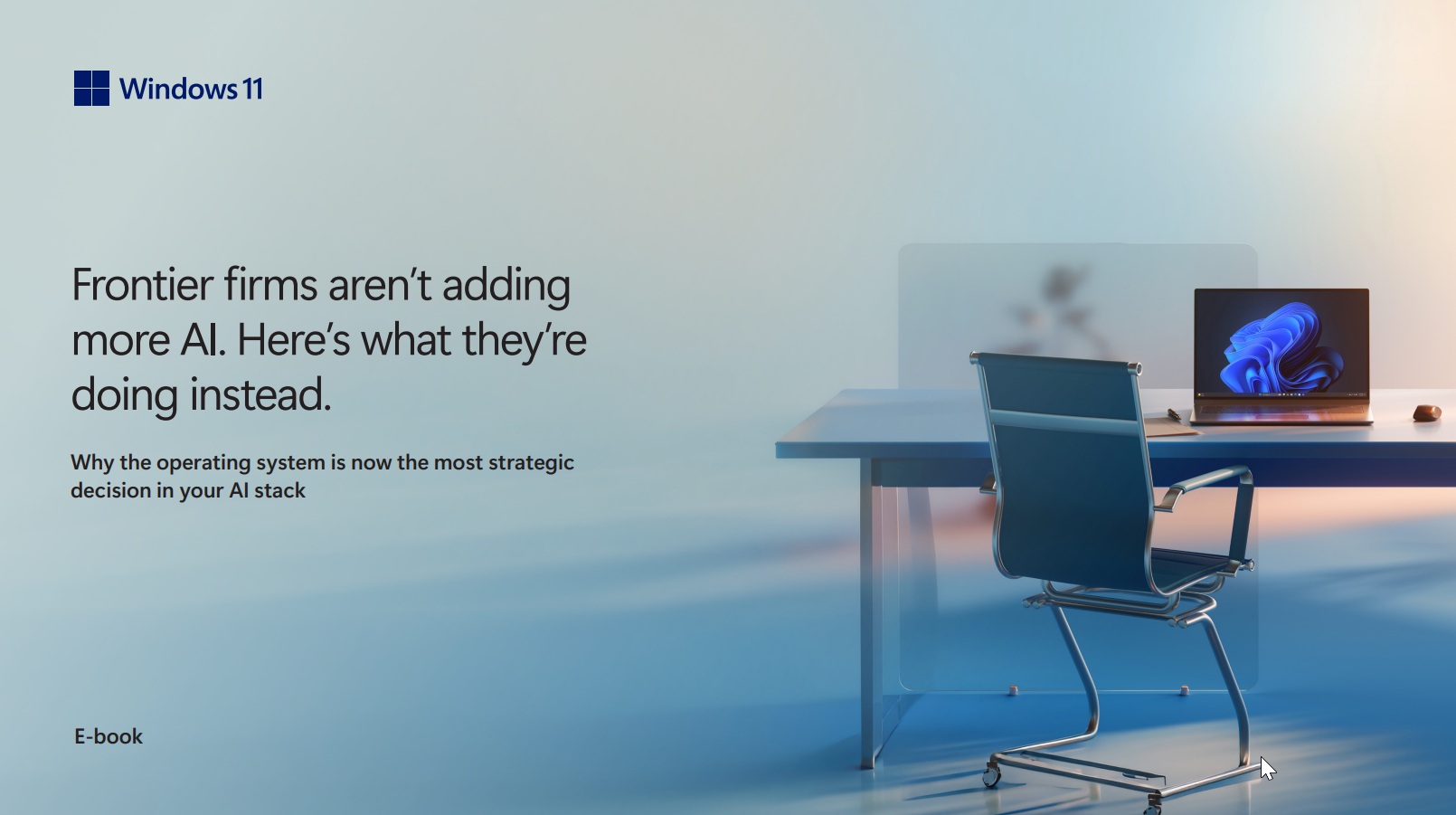
💡Microsoft's push for an 'AI OS' will fundamentally change how enterprise applications interact with the system.
⚡ 30-Second TL;DR
What Changed
Windows 11 redefined as an 'AI Operating System'
Why It Matters
This strategy signals a major shift in how enterprise software will be developed, moving toward OS-native AI capabilities that could disrupt third-party AI tool providers.
What To Do Next
Review your product roadmap to ensure compatibility with native OS-level AI features in Windows 11.
Key Points
- •Windows 11 redefined as an 'AI Operating System'
- •Emphasis on system-level AI integration for enterprise workflows
- •Strategic shift from 'AI tools' to 'AI-native OS' architecture
- •Focus on deep integration within the enterprise AI stack
🧠 Deep Insight
Web-grounded analysis with 20 cited sources.
🔑 Enhanced Key Takeaways
- •Windows 11's advanced AI capabilities, particularly for 'Copilot+ PCs,' necessitate specific hardware requirements, including a Neural Processing Unit (NPU) capable of at least 40 TOPS (trillion operations per second), 16GB of RAM, and 256GB of solid-state storage, indicating a significant hardware shift for full AI integration.
- •Microsoft's AI OS strategy for Windows 11 is deeply integrated across its broader ecosystem, connecting with Microsoft 365, Dynamics 365, and Power Platform, and leveraging Azure for cloud-based AI, enabling intelligent workflows and cross-platform intelligence for enterprises.
- •To support AI development, Microsoft introduced Windows AI Foundry at Build 2025, offering a comprehensive platform with ready-to-use AI APIs for language and vision tasks, tools for fine-tuning models like Phi Silica, and integrations with open-source model catalogs via Foundry Local.
- •The strategy emphasizes a shift towards 'agentic AI,' where AI agents automate complex tasks, orchestrate systems, and provide specialized assistance across various business functions, with tools like Copilot Studio enabling organizations to build custom AI agents.
- •Microsoft is prioritizing enterprise-grade security and governance for AI adoption, implementing a Copilot Control System that provides a centralized framework for monitoring, securing, auditing, and governing AI usage across Microsoft 365, Dynamics 365, Azure, and custom Copilot agents.
🛠️ Technical Deep Dive
- Copilot+ PC Hardware Requirements: Requires a compatible System on a Chip (SoC) with an NPU delivering at least 40 TOPS of AI performance, 16 GB of DDR5/LPDDR5 RAM, and 256 GB SSD or UFS storage.
- Windows AI Foundry: A platform built upon the Windows Copilot Runtime, supporting the AI development lifecycle from model selection and optimization to deployment across CPU, GPU, NPU, and cloud environments.
- Windows ML: Serves as the native AI inferencing runtime on Windows, enabling efficient model deployment across diverse silicon partners including AMD, Intel, NVIDIA, and Qualcomm, supporting CPU, GPU, and NPU architectures.
- Windows AI APIs: A suite of hardware-abstracted APIs powered by Windows ML, offering capabilities for language tasks (e.g., text summarization, rewrite, Phi Silica small language model, LoRA fine-tuning) and vision tasks (e.g., image description, text recognition/OCR, image super-resolution, image segmentation, object erase). New APIs for semantic search and knowledge retrieval also support RAG scenarios.
- Model Context Protocol (MCP): Windows 11 includes native support for MCP, a standardized framework allowing AI agents to interface directly with Windows applications and expose specific functionalities through secure APIs, including an MCP Registry and MCP Servers.
- Copilot Architecture: Comprises a user interface, large language models (LLMs) primarily built on Azure OpenAI services (e.g., GPT-4), and Microsoft Graph. Microsoft Graph provides organizational context from user data (emails, chats, documents) to personalize responses and enhance search capabilities.
- Security Features: Includes Smart App Control, which uses machine learning to analyze and block malicious software, and enhanced Windows Hello biometric authentication. Copilot respects sensitivity labels on data and logs all interactions in the Microsoft unified audit log for governance.
🔮 Future ImplicationsAI analysis grounded in cited sources
⏳ Timeline
📎 Sources (20)
Factual claims are grounded in the sources below. Forward-looking analysis is AI-generated interpretation.
Weekly AI Recap
Read this week's curated digest of top AI events →
👉Related Updates

Google data shows AI isn't replacing workers yet

PACA: Open-source tool for ancient fossil coordinate mapping

First atmosphere detected on habitable-zone exoplanet
Samsung Secures $200B Broadcom AI Infrastructure Deal
AI-curated news aggregator. All content rights belong to original publishers.
Original source: cnBeta (Full RSS) ↗