Microsoft launches Foundry Local for on-device AI execution
💡Reduce AI costs and latency by moving inference from the cloud to the user's device with Microsoft's new tool.
⚡ 30-Second TL;DR
What Changed
Enables local AI processing directly on user terminals
Why It Matters
This shift towards edge AI allows developers to build privacy-focused and cost-predictable applications. It significantly lowers the barrier for offline-capable AI software.
What To Do Next
Evaluate your current cloud-based AI features to see if they can be migrated to Foundry Local to reduce latency and operational costs.
Key Points
- •Enables local AI processing directly on user terminals
- •Eliminates cloud dependency and associated network latency
- •Removes token-based billing models for AI implementation
🧠 Deep Insight
Background and context from public sources — not the original article. 11 sources cited.
🔑 Enhanced Key Takeaways
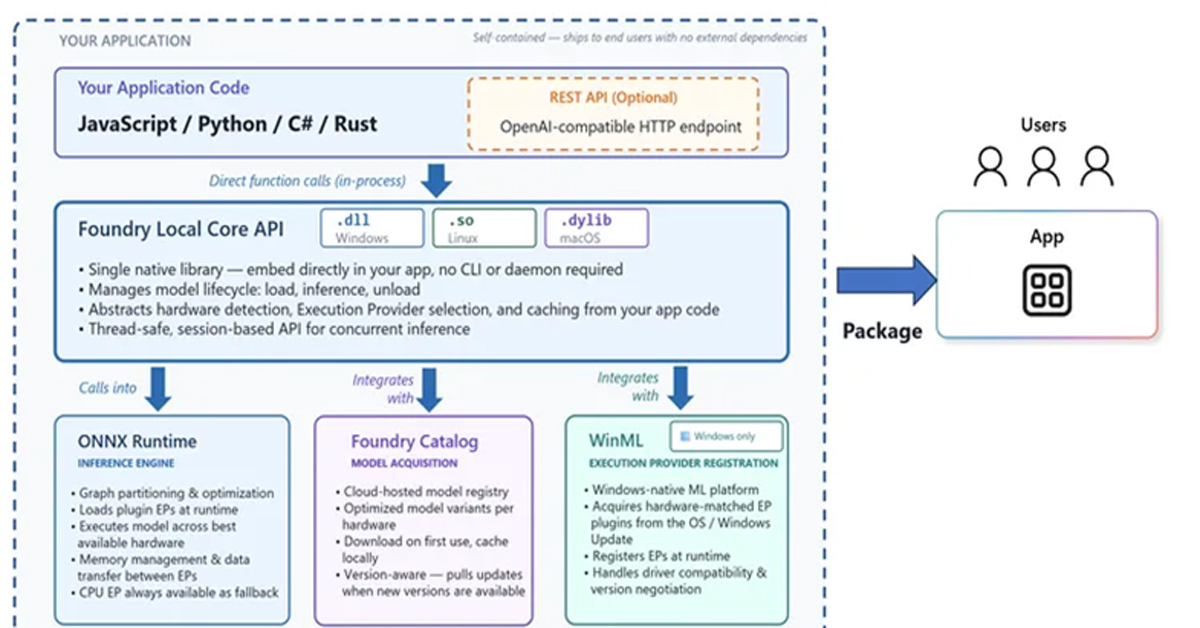
- •Microsoft Foundry Local is an end-to-end local AI solution delivered as a single native library, offering SDKs for C#, JavaScript, Python, and Rust, enabling developers to embed AI directly into their applications.
- •The platform features a curated catalog of optimized open-source models, including various LLMs (e.g., GPT OSS, Qwen, Mistral, Phi) and audio transcription models (e.g., Whisper), which undergo extensive quantization and compression for efficient on-device execution.
- •Foundry Local provides automatic hardware acceleration, intelligently detecting and utilizing available GPUs and NPUs on the user's device, with a seamless fallback to CPU processing when dedicated AI hardware is not present.
- •It exposes an OpenAI-compatible REST API, allowing developers to easily transition between local and cloud-based inference by simply modifying the base URL, thus simplifying hybrid AI deployments.
- •The recent 1.1.0 release of Foundry Local introduced significant new capabilities, including live audio transcription for real-time speech-to-text, text embeddings for semantic search and Retrieval-Augmented Generation (RAG), and a Responses API supporting structured agentic interactions like tool calling and multimodal vision-language input.
📊 Competitor Analysis▸ Show
| Feature/Platform | Microsoft Foundry Local | LM-Kit.NET | Google LiteRT-LM |
|---|---|---|---|
| Primary Function | On-device AI inference runtime | Complete AI development platform (inference, agents, RAG, doc intelligence) | High-performance on-device GenAI runtime for Gemma models |
| Supported OS | Windows, macOS, Linux | .NET compatible (Windows, Linux, macOS) | Android, iOS (Swift API), Web (JavaScript API with WebGPU) |
| SDKs/APIs | C#, JavaScript, Python, Rust SDKs; OpenAI-compatible REST API | .NET SDK; In-process inference | Kotlin/C++ (Android), Swift API (iOS), JavaScript API (Web) |
| Model Format | ONNX (curated catalog, custom models via Olive conversion) | GGUF (broader ecosystem, 60+ curated models) | Optimized Gemma models |
| Hardware Acceleration | Automatic (GPU, NPU, CPU fallback) via ONNX Runtime, WinML (Windows) | GPU acceleration | CPU, GPU, NPU backends (XNNPACK, MLDrift kernels) |
| Pricing Model | No per-token costs, no backend infra to maintain (free SDK/runtime) | Production-ready, generally available (commercial offering implied, no specific pricing found) | Free (SDK/runtime) |
| Key Differentiators | Lightweight runtime (~20MB), curated optimized models, OpenAI-compatible API for cloud-to-edge portability, part of Microsoft's broader AI ecosystem. | Agent orchestration, RAG, document intelligence, text analysis, speech processing, vision built-in. | Optimized for Gemma models, high-performance browser inference with WebGPU, native function-calling, thinking mode for complex tasks. |
🛠️ Technical Deep Dive
- Foundry Local operates as a self-contained native library (.dll on Windows, .so on Linux, .dylib on macOS) loaded in-process by the application, eliminating external service dependencies.
- Its Core API manages the full model lifecycle, including downloading, loading, inference execution, and unloading, while abstracting hardware complexities.
- Inference is powered by ONNX Runtime, with integration into the Foundry Catalog for model acquisition and WinML on Windows for execution provider registration.
- Models from the curated catalog are optimized through quantization and compression for efficient on-device performance and are cached locally after the initial download, enabling offline operation.
- The platform supports an OpenAI-compatible API, allowing developers to use familiar interfaces for local AI interactions.
- SDKs are provided for multiple programming languages: C#, JavaScript, Python, and Rust.
- The 1.1.0 release introduced a WebGPU execution provider plugin (delivered separately) and expanded .NET compatibility by targeting netstandard2.0 for broader framework support.
🔮 Future ImplicationsAI analysis grounded in cited sources
⏳ Timeline
📎 Sources (11)
Factual claims are grounded in the sources below. Forward-looking analysis is AI-generated interpretation.
Weekly AI Recap
Read this week's curated digest of top AI events →
👉Related Updates
AI-curated news aggregator. All content rights belong to original publishers.
Original source: ITmedia AI+ (日本) ↗
This is a summary, not the original. Read the source, or get the weekly briefing.
The weekly digest
One email a week. Unsubscribe anytime.