Meta and Tesla Use Human Data to Train AI Agents
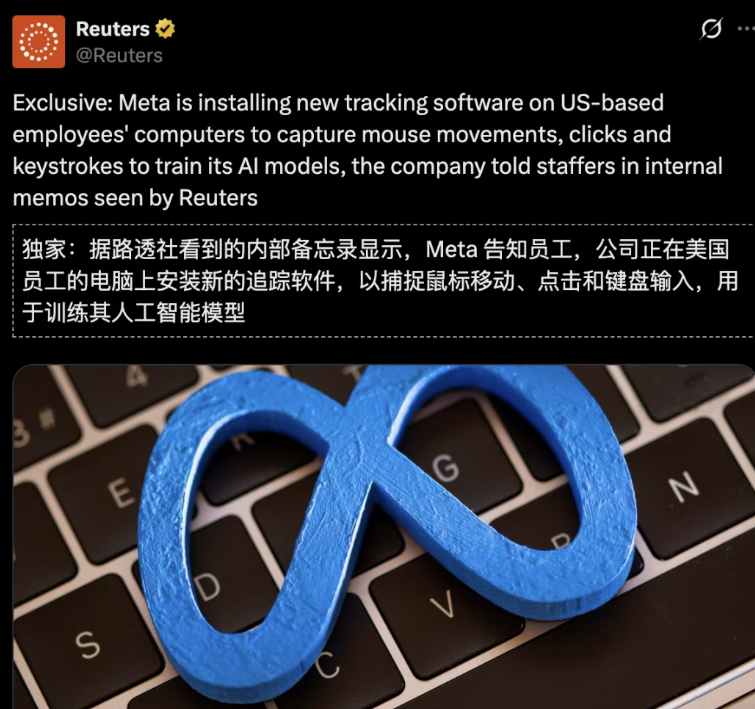
Exposes the dark side of AI training: how Meta and Tesla are 'distilling' human labor to build autonomous agents.
30-Second TL;DR
What Changed
Meta uses MCI software to track employee mouse and keyboard activity for AI training.
Why It Matters
The widespread extraction of human behavioral data raises significant ethical concerns and may reshape the future of labor and manufacturing competitiveness.
What To Do Next
Evaluate your data pipeline to see if you can incorporate behavioral telemetry to improve agent task completion rates.
Key Points
- •Meta uses MCI software to track employee mouse and keyboard activity for AI training.
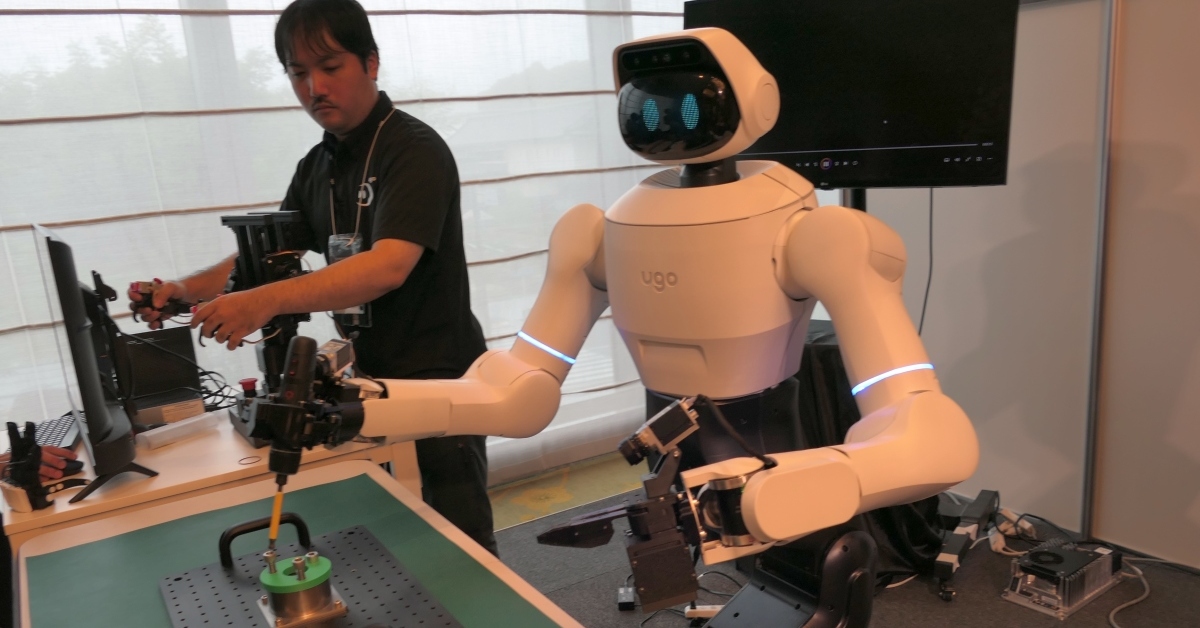
- •Tesla and Figure AI utilize video data of manual labor from workers in India to train robotics.
- •The industry is shifting toward 'distilling' human expertise rather than just augmenting it.
- •High-level manufacturing expertise remains a bottleneck that AI cannot yet fully replace.
Deep Insight
Background and context from public sources — not the original article. 33 sources cited.
Enhanced Key Takeaways
- •Meta's Model Capability Initiative (MCI), now referred to as 'Agent Transformation Accelerator' (ATA), extends beyond mouse and keyboard tracking to include periodic screenshots of US-based employees' work content, aiming to train AI agents for autonomous task completion and shift human roles to guidance and refinement.
- •Tesla's Optimus robot training has evolved to utilize first-person video captured by helmet-mounted camera rigs worn by human data collection operators, moving away from earlier motion-capture suits, and is augmented by AI-generated synthetic data and real-world data from Tesla's vehicle fleet.
- •Figure AI's 'Helix Lab' is dedicated to collecting extensive egocentric human video and interaction data to train its Helix vision-language-action model, enabling 'zero-shot human video-to-robot transfer' for its Figure 03 humanoid robots to perform complex tasks.
- •The practice of employing low-wage laborers in countries like India in 'hand movement farms' to record mundane tasks for humanoid robot training, including for Tesla's Optimus and Figure AI's prototypes, has raised significant ethical concerns about workers inadvertently training their own replacements.
- •The industry's intensified focus on 'distilling human skills' is partly driven by an acute shortage of high-quality, diverse training data, pushing companies to leverage internal behavioral data and explore synthetic data generation to meet the demands of large-scale AI models.
Technical Deep Dive
-
Meta's Model Capability Initiative (MCI) / Agent Transformation Accelerator (ATA):
- Software installed on US employee work computers.
- Tracks mouse movements, clicks, and keyboard inputs across work-related applications and websites.
- Periodically captures screenshots of employee work content.
- Data is intended strictly for training AI models to understand human-computer interactions and is not for performance reviews.
-
Tesla Optimus AI Training:
- Utilizes first-person video data from human task demonstrations, captured by camera rigs (helmet + backpack with 5 in-house cameras).
- Incorporates data from Tesla's fleet of millions of vehicles for visual and spatial understanding, which transfers to robot cognition.
- Employs a 'world simulator' that generates over 10,000 synthetic training variations per demonstrated task.
- All data streams converge on 'Cortex,' a computing cluster with over 67,000 H100-equivalent GPUs.
- Neural networks train in approximately 70,000 GPU hours per complete cycle.
- Uses a unified neural architecture shared with Full Self-Driving (FSD) systems.
-
Figure AI's Helix Model and Training:
- Helix Lab: A dedicated research and development facility for large-scale data collection.
- Focuses on capturing extensive 'egocentric human video' and interaction data from real-world environments.
- Helix Vision-Language-Action (VLA) model: Directly controls Figure's humanoid robots.
- Achieves 'zero-shot human video-to-robot transfer,' meaning robots learn from human videos without explicit step-by-step programming.
- Employs Reinforcement Learning (RL) in high-fidelity physics simulations.
- Thousands of virtual Figure 02 robots are simulated in parallel, collecting years of data in a few hours.
- Uses 'domain randomization' in simulation combined with high-frequency torque feedback for 'sim-to-real transfer' without additional tuning.
- Rewards the robot for mimicking human walking reference trajectories to achieve human-like gait.
Future ImplicationsAI analysis grounded in cited sources
Timeline
- 2025-03Figure AI introduces reinforcement learning for human-like humanoid locomotion in simulation.
- 2025-04Tesla begins hiring teleoperation specialists to teach Optimus robots, indicating significant investment in human demonstration data.
- 2025-09Figure AI announces 'Project Go-Big' for internet-scale humanoid pretraining, including a partnership for data collection in residential units.
- 2025-11Tesla's Optimus training involves data collectors performing tasks hundreds of times, captured by helmet-mounted cameras.
- 2025-12Figure AI opens 'Helix Lab' for large-scale egocentric human video and interaction data collection for its Helix model and Figure 03 robots.
- 2026-04Meta begins deploying 'Model Capability Initiative' (MCI), later renamed 'Agent Transformation Accelerator' (ATA), to track US employee activity for AI training.
Sources (33)
Factual claims are grounded in the sources below. Forward-looking analysis is AI-generated interpretation.
Weekly AI Recap
Read this week's curated digest of top AI events →
Related Updates

AI-curated news aggregator. All content rights belong to original publishers.
Original source: 虎嗅 ↗
This is a summary, not the original. Read the source, or get the weekly briefing.
The weekly digest
One email a week. Unsubscribe anytime.