Meshy.ai Launches in Japan for Automated 3D Model Generation
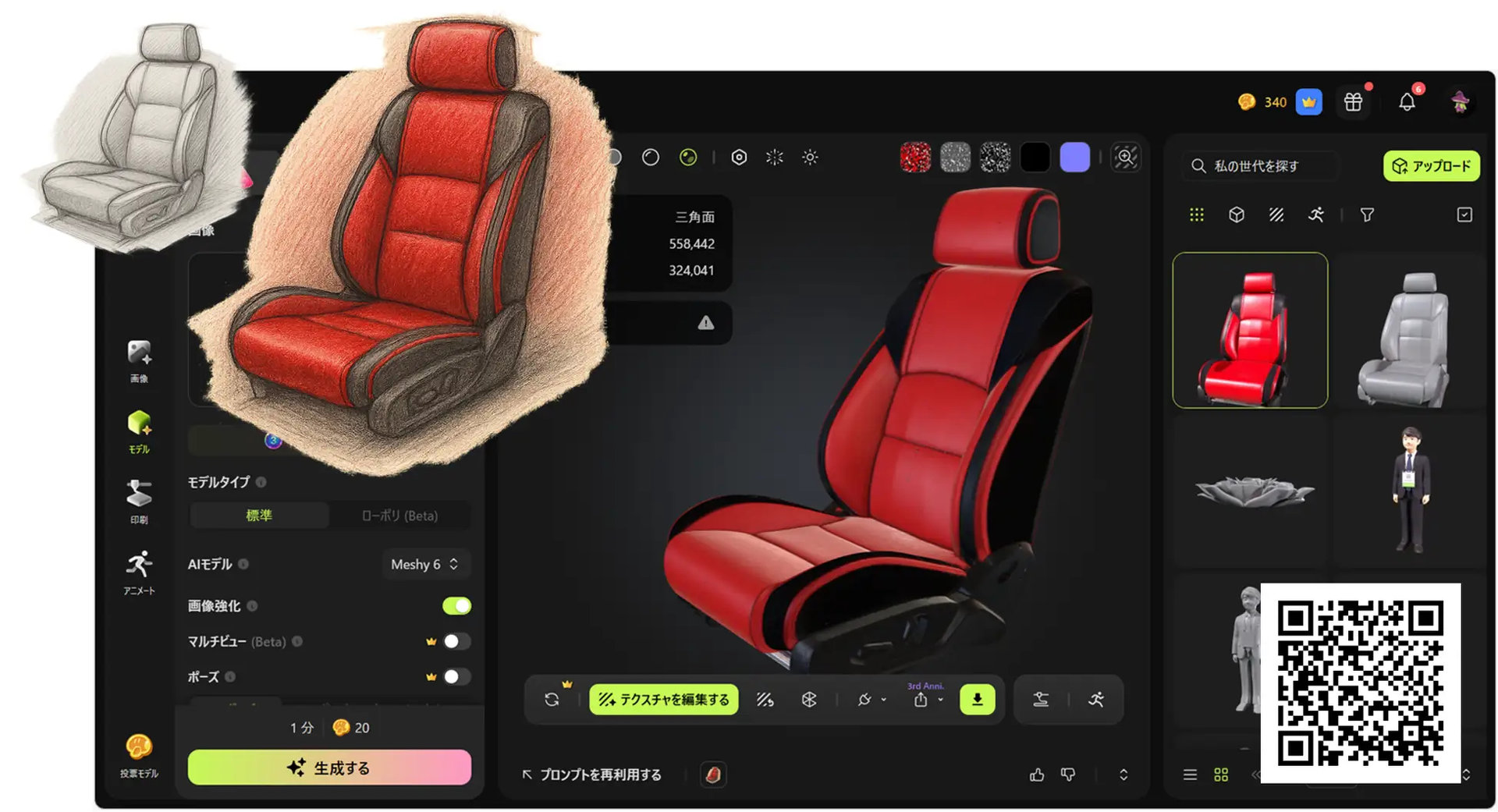
Discover a new tool that automates 3D asset generation, significantly reducing time-to-market for design prototypes.
30-Second TL;DR
What Changed
Enables 3D model creation from simple text prompts or 2D images.
Why It Matters
This tool lowers the barrier to entry for 3D asset creation, potentially accelerating rapid prototyping cycles for designers and developers. It represents a shift toward democratizing complex 3D workflows through generative AI.
What To Do Next
Sign up for a Meshy.ai trial to evaluate the mesh quality and topology for your specific 3D asset pipeline.
Key Points
- •Enables 3D model creation from simple text prompts or 2D images.
- •Targets professionals in prototyping and design who lack 3D modeling expertise.
- •Officially launched in the Japanese market by 3DS.
Deep Insight
Background and context from public sources — not the original article. 26 sources cited.
Enhanced Key Takeaways
- •Meshy.ai has successfully secured $52 million in funding from prominent venture capital firms, including Sequoia and GGV, underscoring significant investor confidence in its AI-driven 3D model generation capabilities.
- •The platform boasts a substantial user base, having attracted over 5 million users and facilitating the generation of more than 40 million 3D models, positioning it as a leading solution in the AI 3D tools market in terms of popularity and web traffic.
- •Meshy.ai offers advanced functionalities such as Physically Based Rendering (PBR) map support, adjustable polygon counts ranging from 3,000 to 100,000 (supporting both triangles and quads), and specialized tools like 'Smart Healing' and 'Mesh Settings' for fine-tuning and optimizing 3D models.
- •The platform provides extensive integration options, including native plugins for major 3D software and game engines like Blender, Unity, Unreal Engine, 3ds Max, and Maya, alongside a robust API for seamless incorporation into custom applications and workflows.
- •With the 'Meshy 6' update, the tool achieved 'sculpting-level' detail and enhanced mesh fidelity, introducing the ability for users to switch between 'Standard' high-detail and 'Low Poly' modes, catering to diverse needs from high-fidelity rendering to game engine optimization.
Competitor Analysis
- Meshy.ai
- Text, Image
- Luma AI
- Text, Image, Video
- Kaedim
- 2D Images, Sketches
- Spline AI
- Text, Image
- Masterpiece Studio (Masterpiece X)
- Text
- Tripo AI
- Text, Image
- Rodin AI
- Text, Image
- Meshy.ai
- General 3D assets, game dev, 3D printing, AR/VR, clean quad-mesh
- Luma AI
- Photorealistic 3D models & animations, NeRF tech, multi-asset campaigns
- Kaedim
- 2D to 3D conversion, game assets, architectural visualization, 'engine-ready' output
- Spline AI
- Web & UI design, interactive 3D elements, simple, lightweight models
- Masterpiece Studio (Masterpiece X)
- Rapid prototyping, AI-powered animation, VR creation
- Tripo AI
- Game development, 3D printing, optimized topology, fast generation
- Rodin AI
- Hyper-realistic virtual humans, high-quality production-grade models
- Meshy.ai
- Yes (PBR maps, 4K textures)
- Luma AI
- Photorealistic
- Kaedim
- Yes (fully textured)
- Spline AI
- Yes (AI-generated)
- Masterpiece Studio (Masterpiece X)
- Yes
- Tripo AI
- Yes (optimized game assets)
- Rodin AI
- Yes (photorealistic)
- Meshy.ai
- Yes (characters, quadruped animals)
- Luma AI
- Yes (video generation, Ray3 models)
- Kaedim
- No (focus on static assets)
- Spline AI
- Yes (3D objects, animations)
- Masterpiece Studio (Masterpiece X)
- Yes (AI-powered animation)
- Tripo AI
- Yes (built-in character rigging)
- Rodin AI
- Yes (character models, avatars)
- Meshy.ai
- Very good (8.5/10), 80-90% hard-surface accuracy
- Luma AI
- High poly, often needs optimization
- Kaedim
- High-quality, impressive geometric accuracy
- Spline AI
- Not photorealistic, minimal details
- Masterpiece Studio (Masterpiece X)
- Varies (75-85% simple, 60-75% complex)
- Tripo AI
- Good (8/10), optimized for game engines
- Rodin AI
- Highest quality (9.5/10), production-grade
- Meshy.ai
- OBJ, FBX, USDZ, GLB, STL, BLEND, 3MF
- Luma AI
- GLB
- Kaedim
- OBJ, FBX, GLB
- Spline AI
- GLB, OBJ, MP4, GIF, PNG, JPG, SVG, USDZ
- Masterpiece Studio (Masterpiece X)
- OBJ, FBX, GLB
- Tripo AI
- STL, GLB, FBX
- Rodin AI
- GLB, FBX
- Meshy.ai
- Free (100 credits/month), Pro ($20/month)
- Luma AI
- Free (limited credits), Lite ($9.99/month)
- Kaedim
- Free trial (3 generations), Starter ($24-29/month)
- Spline AI
- Free, Pro ($12/month)
- Masterpiece Studio (Masterpiece X)
- Free (250 credits), 750 credits for $14.99 on demand
- Tripo AI
- Free (15 credits/month), Pro ($12/month)
- Rodin AI
- Pro ($19.99/month)
| Feature / Company | Meshy.ai | Luma AI | Kaedim | Spline AI | Masterpiece Studio (Masterpiece X) | Tripo AI | Rodin AI |
|---|---|---|---|---|---|---|---|
| Primary Input | Text, Image | Text, Image, Video | 2D Images, Sketches | Text, Image | Text | Text, Image | Text, Image |
| Key Output / Specialization | General 3D assets, game dev, 3D printing, AR/VR, clean quad-mesh | Photorealistic 3D models & animations, NeRF tech, multi-asset campaigns | 2D to 3D conversion, game assets, architectural visualization, 'engine-ready' output | Web & UI design, interactive 3D elements, simple, lightweight models | Rapid prototyping, AI-powered animation, VR creation | Game development, 3D printing, optimized topology, fast generation | Hyper-realistic virtual humans, high-quality production-grade models |
| Texture Generation | Yes (PBR maps, 4K textures) | Photorealistic | Yes (fully textured) | Yes (AI-generated) | Yes | Yes (optimized game assets) | Yes (photorealistic) |
| Animation Features | Yes (characters, quadruped animals) | Yes (video generation, Ray3 models) | No (focus on static assets) | Yes (3D objects, animations) | Yes (AI-powered animation) | Yes (built-in character rigging) | Yes (character models, avatars) |
| Output Quality / Rating | Very good (8.5/10), 80-90% hard-surface accuracy | High poly, often needs optimization | High-quality, impressive geometric accuracy | Not photorealistic, minimal details | Varies (75-85% simple, 60-75% complex) | Good (8/10), optimized for game engines | Highest quality (9.5/10), production-grade |
| Export Formats | OBJ, FBX, USDZ, GLB, STL, BLEND, 3MF | GLB | OBJ, FBX, GLB | GLB, OBJ, MP4, GIF, PNG, JPG, SVG, USDZ | OBJ, FBX, GLB | STL, GLB, FBX | GLB, FBX |
| Free Tier / Lowest Paid Tier | Free (100 credits/month), Pro ($20/month) | Free (limited credits), Lite ($9.99/month) | Free trial (3 generations), Starter ($24-29/month) | Free, Pro ($12/month) | Free (250 credits), 750 credits for $14.99 on demand | Free (15 credits/month), Pro ($12/month) | Pro ($19.99/month) |
Technical Deep Dive
- Meshy.ai operates on a sophisticated AI engine utilizing state-of-the-art machine learning algorithms and neural networks, trained on an extensive dataset of 3D models, textures, and design patterns.
- The platform is capable of generating Physically Based Rendering (PBR) maps, which are crucial for achieving realistic textures and lighting effects in 3D models.
- Users have granular control over the output mesh, including the ability to adjust polygon counts from 3,000 to 100,000, with options for both triangle and quad topologies.
- The 'Meshy 6' update introduced enhanced mesh fidelity and 'sculpting-level' detail, allowing for toggling between 'Standard' high-detail and 'Low Poly' modes, optimizing models for various applications like high-fidelity rendering or game engines.
- Features such as 'Texture Richness,' 'Mesh Settings' (including Triangle/Quad Mode Conversion and Reduce Polygons), and 'Smart Healing' are implemented to improve the quality and optimize generated 3D models.
- The company's CEO, Yuanming (Ethan) Hu, has a background in computer graphics and AI from MIT, where he developed the Taichi GPU programming language, suggesting a strong foundation in high-performance graphics and AI computation.
Future ImplicationsAI analysis grounded in cited sources
Timeline
- 2021Meshy.ai Founded
- Prior to 2024Raised $52 Million in Funding from Sequoia and GGV
- 2024Recognized as No. 1 in popularity among 3D AI tools (A16Z Games)
- 2025-02-20Announced Recipients of the 2025 Meshy Fellowship Program
- Prior to 2026-05Released 'Meshy 6' update with enhanced mesh fidelity and detail modes
- 2026-05-18Meshy.ai Launches in Japan
Sources (26)
Factual claims are grounded in the sources below. Forward-looking analysis is AI-generated interpretation.
Weekly AI Recap
Read this week's curated digest of top AI events →
Related Updates
AI-curated news aggregator. All content rights belong to original publishers.
Original source: ITmedia AI+ (日本) ↗
This is a summary, not the original. Read the source, or get the weekly briefing.
The weekly digest
One email a week. Unsubscribe anytime.