Merz Visits Unitree Robotics in Hangzhou
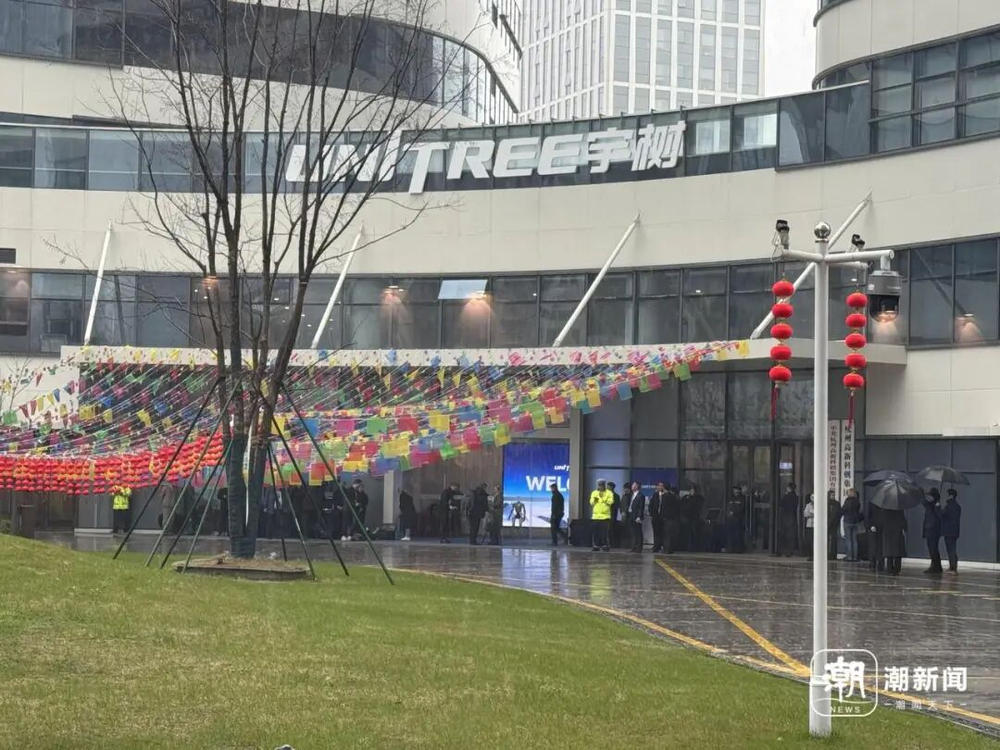
💡Unitree tops 2025 humanoid shipments; Merz visit signals Europe-China robotics deals.
⚡ 30-Second TL;DR
What Changed
Merz's delegation viewed industrial robot demos at Unitree HQ
Why It Matters
Boosts Unitree's global profile; accelerates embodied AI adoption in industry. Germany seeks Chinese innovation to revive manufacturing amid economic woes.
What To Do Next
Test Unitree's humanoid APIs for warehouse automation pilots.
Key Points
- •Merz's delegation viewed industrial robot demos at Unitree HQ
- •Unitree #1 in 2025 global humanoid robot shipments; leads 2026
- •China contributes 80% of 2025 global humanoid installs
- •German firms like Neura Robotics base China ops in Hangzhou
- •Highlights 'hard manufacturing' + 'soft intelligence' synergy
🧠 Deep Insight
Background and context from public sources — not the original article. 7 sources cited.
🔑 Enhanced Key Takeaways
- •Unitree's 2025 humanoid shipments of 5,500+ units represent approximately one-third of the global market (~16,000 units per CounterPoint Research), positioning it as the clear leader ahead of competitors like AgiBot and establishing a two-player dominance structure with AgiBot controlling ~39% market share.
- •Unitree's profitability since 2020 with annual revenues exceeding 1 billion yuan (~$140 million) and 90%+ in-house component manufacturing mirrors the DJI playbook, creating a cost structure competitors cannot match—a critical advantage as the industry scales from thousands to tens of thousands of units annually.
- •The 2026 production target of 10,000–20,000 humanoid units represents a 2–4x acceleration from 2025, contingent on technological maturity in factory automation where robots must match or exceed human efficiency in assembly, material handling, and logistics—currently a limiting factor for mass industrial deployment.
- •China's 80% share of global humanoid robot installations in 2025 reflects both domestic manufacturing capacity and a strategic industrial policy push, with top-five competitors (AgiBot, Unitree, UBTECH, Leju Robot) all Chinese, signaling potential geopolitical implications for Western robotics development and supply chains.
📊 Competitor Analysis▸ Show
| Competitor | 2025 Shipments | Market Share | Key Strength | Geographic Focus |
|---|---|---|---|---|
| Unitree | 5,500+ | ~34% | Quadruped dominance (70% global), in-house manufacturing, profitable since 2020 | China, expanding globally |
| AgiBot | 5,100 | ~39% | Early mover in humanoid segment, strong market positioning | China |
| UBTECH | ~1,400 (orders in yuan) | ~9% | Industrial humanoid orders (1.4B yuan), targeting 10,000 units by 2026 | China |
| Booster Robotics | ~1,000 (cumulative) | <6% | Global deployment focus | International |
| Robotera | Order volume 5.1B yuan | ~5% | Strong overseas orders (~50% of total) | China with international reach |
🔮 Future ImplicationsAI analysis grounded in cited sources
⏳ Timeline
📎 Sources (7)
Factual claims are grounded in the sources below. Forward-looking analysis is AI-generated interpretation.
- caixinglobal.com — Unitree Defends Robot Sales As Rival Claims Market Crown 102407436
- techmarketbriefs.com — Unitree
- autonews.gasgoo.com — Xiaozhi Weekly News Unitree Humanoid Robot Shipments Exceed 5500 Units 2015824041443430400
- eu.36kr.com — 3663387680469767
- scmp.com — Kung Fu Somersaults and Scale Unitree Eyes 20000 Robot Output 2026 After Gala
- kr-asia.com — After This Years Gala Spectacle Where Is Unitree Robotics Headed
- shop.unitree.com — Clarification Regarding Unitrees 2025 Sales Data
Weekly AI Recap
Read this week's curated digest of top AI events →
👉Related Updates


AI-curated news aggregator. All content rights belong to original publishers.
Original source: 虎嗅 ↗
This is a summary, not the original. Read the source, or get the weekly briefing.
Weekly AI briefing
One email a week. Unsubscribe anytime.