Memory costs squeeze entry-level smartphone margins
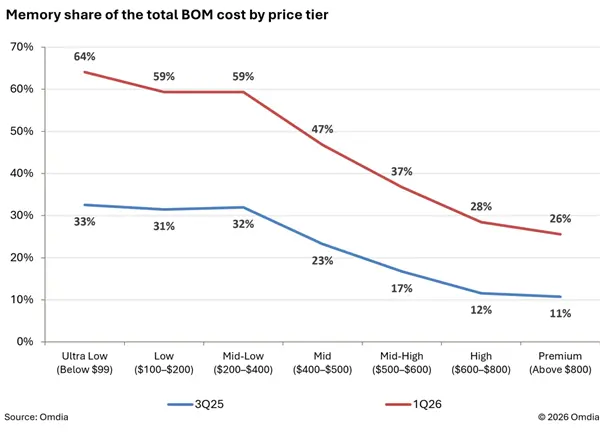
💡Rising memory costs threaten the mass-market adoption of on-device AI for budget smartphones.
⚡ 30-Second TL;DR
What Changed
Memory chip costs now represent nearly 60% of the BOM for sub-$400 phones.
Why It Matters
Reduced hardware iteration in the budget segment may limit the rapid deployment of on-device AI features to the mass market.
What To Do Next
Optimize your AI models for lower-memory footprints to ensure compatibility with budget devices facing hardware cost constraints.
Key Points
- •Memory chip costs now represent nearly 60% of the BOM for sub-$400 phones.
- •High component costs are forcing brands to slow down product iteration cycles.
- •The budget smartphone segment is facing significant margin pressure.
- •Supply chain volatility is directly impacting consumer device availability.
🧠 Deep Insight
AI-generated analysis for this event — not the original article.
🔑 Enhanced Key Takeaways
- •The surge in memory costs is primarily driven by the transition of major DRAM manufacturers toward High Bandwidth Memory (HBM) production to support AI server demand, creating a supply squeeze for standard LPDDR chips used in mobile devices.
- •Smartphone OEMs are increasingly adopting UFS 3.1 storage over newer UFS 4.0 standards in entry-level models to mitigate costs, despite the performance trade-offs in read/write speeds.
- •Inventory levels for NAND flash have stabilized, but pricing remains elevated due to strategic production cuts implemented by major suppliers to maintain profitability throughout 2025 and 2026.
- •To offset BOM pressure, manufacturers are shifting toward 'software-defined' differentiation, prioritizing AI-driven camera processing and OS optimization over hardware upgrades in the sub-$400 tier.
- •The shift in product iteration cycles has led to a noticeable increase in 'rebadged' or minor-refresh devices, where internal hardware remains identical to previous-generation models to avoid new R&D and component procurement costs.
📊 Competitor Analysis▸ Show
| Feature | Entry-Level (Budget) | Mid-Range | High-End (Flagship) |
|---|---|---|---|
| Memory Type | LPDDR4X / LPDDR5 | LPDDR5X | LPDDR5T / LPDDR6 |
| Storage Standard | UFS 2.2 / 3.1 | UFS 3.1 / 4.0 | UFS 4.0 / 4.1 |
| BOM Impact | High (60%+) | Moderate (30-40%) | Low (15-25%) |
| Iteration Cycle | 18-24 Months | 12-18 Months | 12 Months |
🛠️ Technical Deep Dive
- Memory Architecture: Entry-level devices are increasingly utilizing LPDDR4X-4266 or LPDDR5-6400, which are cheaper but offer lower bandwidth compared to the LPDDR5X-8533 used in premium segments.
- NAND Flash Implementation: Manufacturers are favoring 128-layer or 176-layer 3D NAND nodes for budget devices, as these mature processes offer better yield and lower cost-per-gigabyte than cutting-edge 232+ layer nodes.
- Thermal Management: Due to the high cost of advanced cooling solutions, budget devices are utilizing passive graphite sheets rather than vapor chambers, limiting sustained performance during memory-intensive tasks.
🔮 Future ImplicationsAI analysis grounded in cited sources
⏳ Timeline
Weekly AI Recap
Read this week's curated digest of top AI events →
👉Related Updates



AI-curated news aggregator. All content rights belong to original publishers.
Original source: cnBeta (Full RSS) ↗
This is a summary, not the original. Read the source, or get the weekly briefing.
Weekly AI briefing
One email a week. Unsubscribe anytime.