Master Kong's 'Self-Amused' Innovation Strategy Struggles
💡A cautionary tale on why high-frequency product launches without strategic focus fail to drive growth.
⚡ 30-Second TL;DR
What Changed
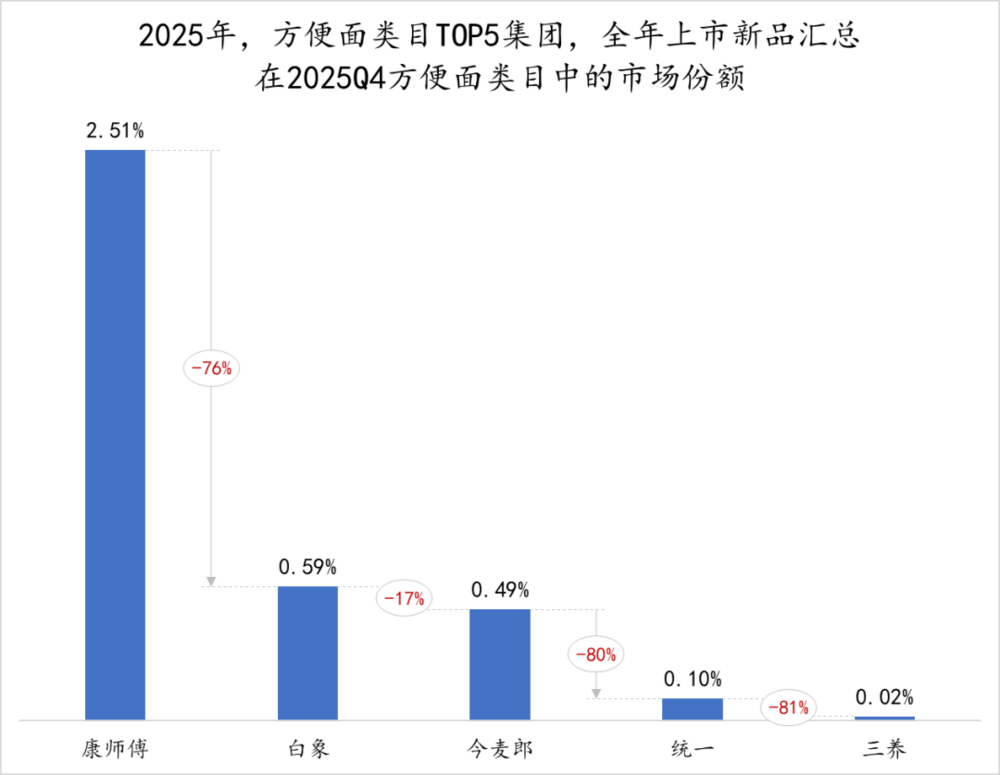
Launched 367 SKUs in 2025 with only 2.51% market share for new products.
Why It Matters
The case illustrates how rapid, unstrategic product iteration can lead to brand dilution and resource waste in the FMCG sector, serving as a cautionary tale for legacy companies attempting digital and product transformation.
What To Do Next
Analyze your product's 'hit rate' versus launch frequency to ensure innovation is driven by data-backed consumer insights rather than internal performance pressure.
Key Points
- •Launched 367 SKUs in 2025 with only 2.51% market share for new products.
- •Core beverage and instant noodle businesses show declining growth trends.
- •Failed to capture the high-growth 'zero-sugar' and 'premium' market segments effectively.
- •Over-reliance on 'innovation' as a buzzword in financial reports masks deeper structural issues.
🧠 Deep Insight
AI-generated analysis for this event — not the original article.
🔑 Enhanced Key Takeaways
- •Master Kong's parent company, Tingyi Holding Corp, has faced significant margin pressure due to rising raw material costs, specifically palm oil and PET resin, which have eroded the profitability of their core instant noodle and beverage segments.
- •The company's distribution network, traditionally its strongest moat, is facing disruption from 'community group buying' platforms and O2O (online-to-offline) retail models that bypass traditional wholesale channels.
- •Internal restructuring efforts in 2025 included a shift toward 'digital-first' supply chain management, yet implementation has been hampered by legacy data silos between the noodle and beverage divisions.
- •Market analysts have noted that Master Kong's R&D expenditure as a percentage of revenue remains significantly lower than global FMCG peers like Nestlé or PepsiCo, limiting their ability to develop truly disruptive product categories.
- •The 'Self-Amused' innovation strategy is largely attributed to a top-down management approach that prioritizes SKU proliferation to occupy shelf space rather than data-driven consumer insights.
📊 Competitor Analysis▸ Show
| Feature | Master Kong | Uni-President | Nongfu Spring |
|---|---|---|---|
| Core Strategy | SKU Proliferation | Premiumization | Brand/Category Focus |
| Beverage Growth | Stagnant | Moderate | High (Tea/Water) |
| Digital Maturity | Low/Legacy | Moderate | High/Data-Driven |
| Pricing Power | Low (Mass Market) | Moderate | High (Premium) |
🔮 Future ImplicationsAI analysis grounded in cited sources
⏳ Timeline
Weekly AI Recap
Read this week's curated digest of top AI events →
👉Related Updates

AI-curated news aggregator. All content rights belong to original publishers.
Original source: 虎嗅 ↗
This is a summary, not the original. Read the source, or get the weekly briefing.
Weekly AI briefing
One email a week. Unsubscribe anytime.